

France Stops Paraguay’s Revolution in Sweltering Philadelphia Heat
Paraguay manager Gustavo Alfaro called it a revolution. Ninety minutes later, France had stopped it.
Not easily, not comfortably, but decisively enough to book a place in the World Cup quarterfinals with a narrow 1-0 victory over Paraguay in temperatures that climbed beyond 37°C in Philadelphia. It wasn’t the dazzling attacking display many have come to expect from Didier Deschamps’ side. Instead, France were dragged into the kind of bruising, physical battle Paraguay have made their identity throughout this tournament.
Against an out of form Germany it worked. Against France, the World Cup favorite, it finally reached its limit.
Paraguay Stifles France in the First Half
Paraguay spent the opening half defending almost exclusively inside their own half. France finished with nearly 80 percent possession before halftime, but remarkably created almost nothing. Five first-half shots, an expected goals figure barely above 0.10, and long stretches where Kylian Mbappe and Ousmane Dembele were left wondering how to break through a wall of red-and-white shirts. Bradley Barcola, Michael Olise, nobody wanted to take a long range crack at Paraguay’s cult hero goalkeeper Orlando Gill.
Paraguay had no interest in entertaining anyone. They had no interest in matching France pass for pass. They simply wanted to survive. And for 45 minutes, they did.
Alfaro’s team defended exactly the way they eliminated Germany. 5 at the back. Endless tactical discipline. Bodies flying into blocks. Midfielders tracking runners for every meter. It was vintage CONMEBOL football, where every duel matters and every loose ball becomes a battle of will. Outside South America, many will call it negative football. Inside South America, they’ll simply call it competing.
The numbers perfectly illustrated the contrast. France completed 569 passes to Paraguay’s 183. Paraguay attempted 29 tackles compared to France’s 13. They committed 13 fouls, France 11. Every restart became another opportunity to slow the rhythm, frustrate France and turn the match into exactly the kind of ugly contest Paraguay wanted.
Paraguay Somehow Avoid Yellow Cards but Still Concede a Penalty
The approach also generated criticism.
Several cynical fouls went unpunished by referee Ilgiz Tantashev, allowing Paraguay to continually walk the disciplinary tightrope without ever receiving a yellow card. There were flashpoints throughout the afternoon as tempers flared, particularly involving Mbappe, but France largely refused to lose their composure. Many would argue that Tantashev lost control of the match.
Eventually the pressure became too much. After another sustained attack, VAR intervened to award France a penalty for a foul on substitute forward Desire Doue, a player with relatively fresh legs in the heat. Some Paraguayan supporters argued it was soft. Others pointed to the cumulative nature of the defending. Either way, it reflected where the match had been heading.
Mbappe stepped forward without hesitation.
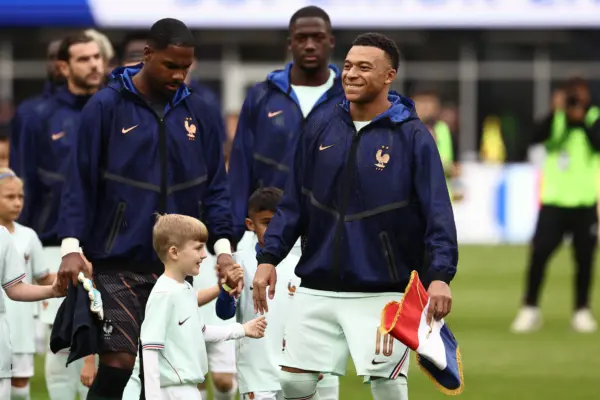
Even after Gustavo Velazquez attempted to scuff the penalty spot, Mbappe calmly converted to give France the breakthrough they had spent an hour searching for, continuing his pursuit of Lionel Messi in the Golden Boot race. For all Paraguay’s determination, they never truly threatened to equalize.
Julio Enciso found little space against one of the tournament’s strongest defensive units, and France never looked close to surrendering their lead once they finally moved ahead. Deschamps’ side accepted the physical battle, matched Paraguay’s intensity, and refused to be distracted by the gamesmanship.
France Rejects The Chaos
Sometimes the best response to chaos is simply refusing to participate in it, France refused to get into fights and draw a red card of their own, something that could have altered the outcome of this game, or their next.
After the match, Alfaro spoke emotionally about the journey his players have taken.
“I told the players we’re going to face players who fight for the Ballon d’Or,” he said. “We have kids who never met their fathers, who went through very severe traumas. Despite everything, it can be done.”
He also highlighted the stories behind his squad.
“Matias Galarza couldn’t play at River. Let me clarify—he can play against Germany and France. He can play on any team in the world.”
And perhaps the most powerful story belonged to goalkeeper Orlando Gill, a player who was making top saves until the end, trying to give Paraguay a chance to equalize.
“Do you know how long it’s been since he collected a paycheck? He had to sell his clothes to save his daughter’s life.”
Alfaro’s revolution ultimately fell short on the scoreboard, but Paraguay leave this World Cup with renewed respect in Latin America. They eliminated Germany, frustrated France for long stretches, and reminded the football world that organization, resilience and belief can narrow even the widest talent gap.
France, meanwhile, advance with lessons of their own.
This wasn’t beautiful football, but World Cups rarely are once the knockout rounds begin. The ability to adapt to difficult circumstances may ultimately matter more than producing highlight reels. France showed patience, maturity and enough quality to survive a uniquely uncomfortable afternoon, they showed they aren’t brittle at all.
France vs Morocco, A World Cup Rematch 4 Years in the Making
The reward is a quarterfinal against Morocco, a team that has quietly become one of the tournament’s most complete sides. A team unbeaten for their last 34 matches.
Morocco already eliminated the Netherlands on penalties, earned a draw against Brazil in the group stage and dispatched Canada, who played without Alphonso Davies, 3-0 in the Round of 16, a game where their finishing was clinical, all three goals coming in the second half. This is no longer the surprise package from Qatar in 2022. This is an established football power that consistently belongs among the world’s best eight teams.
Unlike Paraguay, Morocco possesses genuine attacking pace capable of hurting France in transition. Unlike Paraguay, they won’t simply sit inside a low block for 90 minutes. Mohamed Ouahbi’s side can defend, counterattack and punish mistakes with ruthless efficiency.
France remain deserved favorites to lift the World Cup. Argentina have looked overly dependent on Messi. England continue searching for their best football. Spain have shown vulnerability, but also a great defence. If this tournament has proven anything, it is that reputations no longer win knockout matches.
Philadelphia showed France can survive an ugly fight. The quarterfinal against Morocco will reveal whether they can survive one of the tournament’s best teams.
Main Photo Credit: Smartframe Images