
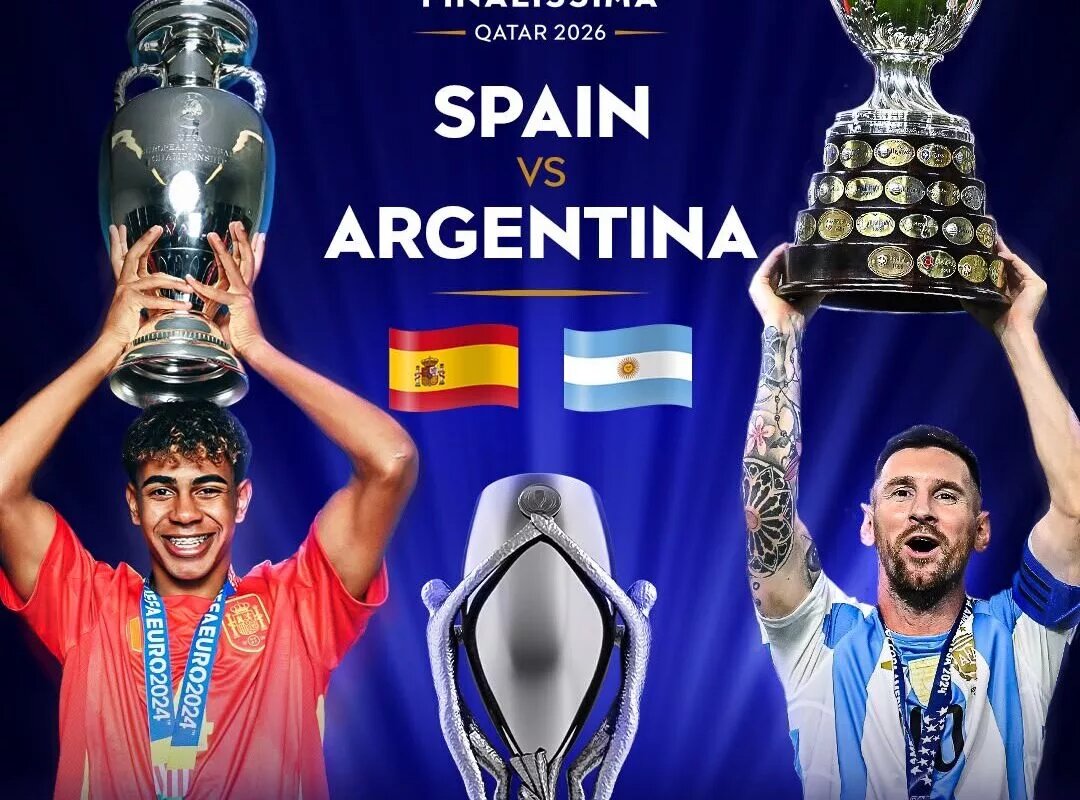

Today brought the news many had feared: the 2026 Finalissima, set to pit defending World Cup and 2024 Copa América champions Argentina against UEFA Euro 2024 champions Spain, has been cancelled. Spain are among the four genuine favorites to lift the trophy this summer at the World Cup in the United States, Mexico, and Canada — making this one of the most tantalizing international matchups imaginable. Instead, both sides will pursue alternative fixtures as they continue their own World Cup preparations.
A Cancellation That Isn’t A Surprise — But Still Stings
The Finalissima is not an established tournament like the UEFA or CONCACAF Nations Leagues, nor the now-defunct FIFA Confederations Cup. It returned in 2022 when Argentina dismantled Italy 3-0 at Wembley Stadium in front of 87,000 supporters — another historic night for Argentina captain and football legend Lionel Messi.
This edition promised to be equally memorable. Messi was set to face Spanish wonderkid Lamine Yamal in what would have been a FC Barcelona past-versus-present collision on the international stage. 80,000 tickets had already been sold for the match at Lusail Stadium in Qatar — the same venue that hosted the 2022 World Cup final — on March 27th, during FIFA’s final international window before the tournament kicks off.
The venue had to be moved after war broke out between Iran and the United States, drawing Qatar and other U.S.-allied nations in the region into the conflict. UEFA and CONMEBOL, principally Argentina’s AFA, were unable to agree on a replacement. A two-leg proposal — one match at the Santiago Bernabéu in Madrid, one in Buenos Aires — was floated, as were discussions about a neutral venue, but financial and logistical disagreements ultimately killed both options. Neither federation was willing to play the match after the 2026 World Cup, and without a viable alternative, the fixture was cancelled.
What’s Next for Argentina and Spain
Argentina has a match scheduled against Qatar and Spain against Egypt, but both games may also be cancelled or relocated given the ongoing regional instability.
The war is the primary reason for the cancellation, but the outcome was not entirely unexpected. Sports broadcaster Ben Jacobs reported that Argentina manager Lionel Scaloni had reservations about the fixture — “Argentina lost 6-1 to Spain just before the 2018 World Cup and the coaching staff felt that defeat affected their tournament.” From Argentina’s perspective, the Finalissima was driven more by commercial logic than sporting necessity. But ultimately, it is the fans who lose out most.
Financially, it was a €60M disaster. As reported by Marca, Qatar covered logistics/TV (€20–30M), federations got €6–10M each—now refunds will have to be issued.
Too Much Football, Not Enough of the Football That Matters
Modern football is drowning in fixtures. Club calendars have expanded relentlessly — expanded leagues, expanded European competitions, expanded Club World Cups, pre-season tours to every corner of the globe. Players are exhausted, injury lists grow longer every season, and somewhere in the noise, supporters are expected to care just as much about a mid-July friendly in Las Vegas as they do about a World Cup knockout match.
Most of it isn’t memorable. Club pre-season tours are commercial exercises dressed up as football. And yet this is the football calendar we protect, while the Finalissima — Messi against Yamal, world champions against European champions, on the eve of the biggest tournament on earth — gets cancelled.
Great international matchups are a different category entirely. They give us history in real time. They force the world’s best players into the same arena without the buffer of club allegiances or tactical familiarity. They answer questions fans are already arguing about. No amount of club pre-season tours or money grab friendlies will replace that.
The Nations League Has Narrowed The Window For Greatness
When UEFA introduced the Nations League in 2018, it was partially praised for replacing low-stakes friendlies with competitive, structured football. But it came at a cost: the top European nations now have a defined international calendar for most FIFA windows, leaving little room to schedule genuinely marquee matchups outside of it.
A Pre World Cup Window With Compelling Friendlies
This pre-World Cup window is one of the few exceptions. France are set to face Brazil in the Road to 26 Series in the United States. Portugal and Belgium take on the USA and Mexico. The Netherlands face Ecuador. Uruguay meet England at Wembley. Colombia take on Croatia and France. These are the kinds of matchups fans travel for, cancel work for, argue about for weeks. They matter not because a trophy is on the line but because the best teams in the world are actually playing each other.
The global game needs more of this, not less. Teams from outside UEFA and CONMEBOL — the United States, Mexico, South Korea, Japan, Senegal, Ivory Coast — develop and benchmark themselves precisely through these encounters with the world’s elite. A Spain or Argentina that is willing to play, and to play seriously, raises the level of everyone around them.
And for the global football public, there is no substitute for seeing Messi’s Argentina tested against the very best, with something to prove — not Argentina against a Venezuela side already eliminated in qualifying on a Miami pitch.
The Finalissima Deserved Better — And So Did We
Football handed UEFA and CONMEBOL a gift: two continental champions, a willing venue, 80,000 tickets sold, and the perfect pre-tournament storyline. Messi and Yamal. Argentina and Spain. The ghost of that 6-1 scoreline from 2018 in the background.
The war made the original plan impossible, and that part is no one’s fault. But the failure to find a solution — to move mountains for a match this significant — reflects something uncomfortable about how international football is governed. When the financial and political conditions aren’t perfectly aligned, even the best fixtures become disposable.
The 2026 World Cup will still deliver unforgettable moments. But if Argentina and Spain don’t meet in that tournament, we’ll have never seen this generation of both sides tested against each other— and that’s a genuine loss, not just a scheduling inconvenience.