
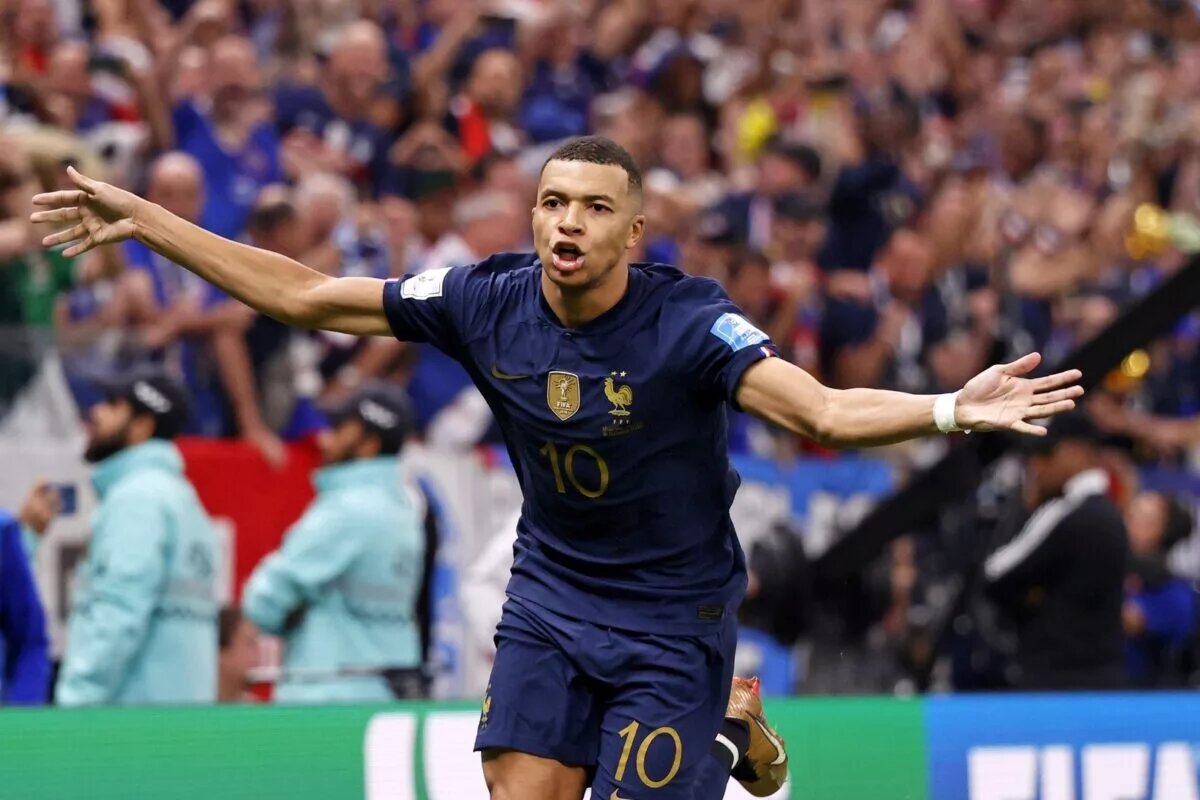

Kylian Mbappe’s 59 goals in the calendar year came in 58 matches in which Real Madrid often looked like a team still searching for its own identity but that’s precisely why it matters, it feels less like a record and more like a preview of what could happen in 2026.
When the votes for the Ballon d’Or were counted, Mbappe finished seventh. The award covered the previous season as a whole, and what he lacked were team achievements. Real Madrid were eliminated convincingly in the Champions League quarter-finals, finished behind Barcelona in La Liga, and failed to make an impact at FIFA’s Club World Cup. The only trophy Mbappe won in his debut season in Madrid was the UEFA Super Cup, and that simply was not enough.
However, if we are looking at 2025 as a complete calendar year, then Mbappe is unquestionably the player whose individual performances defined the past 365 days.
The crowning moment came in the 86th minute against Sevilla. With that goal, Mbappe reached 59 for the calendar year, matching the tally Cristiano Ronaldo produced in 2013, at the height of his individual rivalry with Lionel Messi. Mbappe did not have a direct rival pushing him, but he was chasing the shadow of the man whose poster once hung on his childhood bedroom wall. In the end, he caught him: 59 goals in 58 games for Real Madrid.
How Kylian Mbappe Matched Ronaldo’s Peak in a Year of Chaos
Ronaldo’s Apex vs. Mbappe’s Foundation
Perhaps the biggest difference between Ronaldo in 2013 and Mbappe in 2025 lies in context. Ronaldo delivered that output as the culmination of a completed era. Real Madrid entered 2013 under Jose Mourinho, and neither Carlo Ancelotti nor Gareth Bale significantly altered the framework of play. On the contrary, Ancelotti and Bale arrived as additions to Mourinho’s foundation. The style remained direct, precise, and focused on releasing Cristiano Ronaldo into space.
Ultimately, that transition led to La Decima in the Champions League because the team was a finished product: structured, hierarchical, and tactically arranged around Ronaldo’s finishing. His rivalry with Messi was the central narrative axis of the sporting world at the time, and Ronaldo did not need to prove he was Real Madrid’s focal point. That was assumed. His 59 goals were a logical continuation of dominance within a machine calibrated to his needs.
Read More: Huge Breaking News From Manchester United
Mbappe did not have those conditions.
Since 2013, and even earlier, given how heavily Ancelotti leaned on Mourinho’s tactical foundations, Real Madrid had enjoyed philosophical continuity. That continuity was briefly interrupted by Rafael Benitez, Julen Lopetegui, and Santiago Solari, but Ancelotti and Zinedine Zidane ultimately shaped a recognizable way of thinking unique to Real Madrid. Key players came and went, the squad changed, but the guiding idea remained the same. The arrival of Xabi Alonso marked a break from that continuity and a dramatic philosophical shift, the creation of new frameworks in which Real still has to build itself into a recognizable team.
That is precisely why Mbappe’s 59 goals in a calendar year matter so much. Unlike Ronaldo, he did not score them as the peak of a completed era, but as the foundation of something still being built.
Surviving the Chaos: A Year of Transition
For Real Madrid, the year was anything but stable. Carlo Ancelotti’s era came to an end, and Xabi Alonso’s start was far from secure. Several key players suffered major dips in form, the club struggled to replace Luka Modric and Toni Kroos in midfield, the game became increasingly disjointed, and at one point there were loud rumors of the coach being sacked, because at Real Madrid, no crisis is ever purely about results. The situation resembled yet another failed transition period more than a new project in full swing. Yet Mbappe somehow kept delivering.
Just a year earlier, Mbappe had spoken openly about hitting rock bottom after missing a penalty in Bilbao. He did not hide behind cliches; he offered a precise diagnosis of his early months in Madrid, weighed down by enormous expectations, the long saga surrounding his arrival, and the burden of constant comparisons to Ronaldo.
Monaco and Paris Saint-Germain are big clubs, but Mbappe had never encountered pressure like the one waiting for him at Real Madrid. In 2021, Lille won the French title, and no one questioned Mbappe. By contrast, after he failed to score in the first three league matches last season, the dominant topic in European football became whether Mbappe could truly be Real Madrid’s main man, and whether he could genuinely be discussed as one of the world’s best players, as Ronaldo once was.
Read More: Enzo Maresca Reportedly Leaves Chelsea
The answer did not come in a single match, but through the habit of scoring regularly, even when the team was not functioning properly. This season, Xabi Alonso found himself overseeing a string of matches in which Real did not control the tempo or dominate territory, but they had Mbappe. Slowly, a sense developed that every match began with an invisible Real Madrid advantage, because it is impossible to fully neutralize such a forward. Mbappe’s 59 goals in the calendar year came in 58 games in which Real Madrid often looked like a team still searching for its identity.
Vinicius Junior and Rodrygo collapsed in production during the second half of the season, the system increasingly relied on a single player, and Alonso, consciously or unconsciously, out of pure survival instinct, began shaping a Real Madrid that existed through Mbappe. He did not choose that approach because it was ideal, but because it was the only thing he could reliably lean on.
In that sense, the comparison between Mbappe and Ronaldo does not work in terms of style, charisma, or even pop-cultural impact. It works in terms of function. Both were pillars of Real Madrid, but at opposite points in the club’s history. Ronaldo was the apex of a completed structure; Mbappe is the first load-bearing column around which Xabi Alonso is still trying to construct a coherent team.
This is not even a debate about who the better player is. Ronaldo may well have been the greater leader, and he did score his 59 goals in just 50 matches. The essence lies elsewhere. Mbappe did not score his 59 goals in a year when Real dominated and everything was perfectly aligned, but in a year of survival. Real Madrid won La Decima in 2013, with Ronaldo as the crown jewel of a finely tuned team. In 2025, Real suffered several major disappointments and is still struggling to assemble a functioning system, and that is precisely what makes Mbappe’s output special.
He reached 59 goals despite the state of play on the pitch, not because of reliable mechanisms working around him. That is why those 59 goals feel less like a record and more like a signal of what could happen in 2026, if Xabi Alonso and Real Madrid truly succeed in building a functional system around Kylian Mbappe. The foundation is in place. Now comes the challenge of constructing something coherent around it, and if they do, the football world may finally witness what could happen when a generational talent operates within a team built to maximize his brilliance.
Featured Image Credit:
Main image credit: Yukihito Taguchi-USA TODAY Sports