
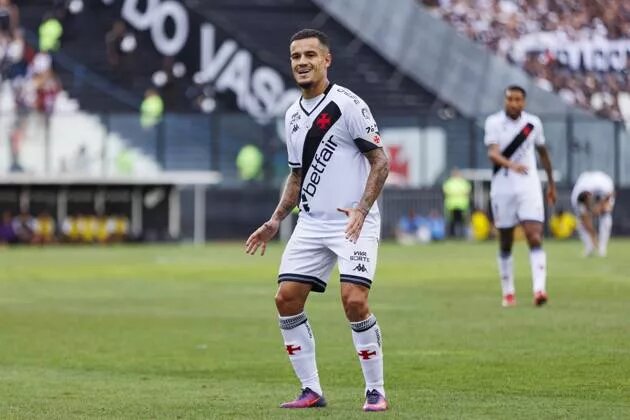

Over the weekend, Philippe Coutinho and Ángel Di María reminded football fans why they once lit up Europe. The two veterans produced unforgettable set-piece moments — Coutinho with a thunderous free kick in Brazil and Di María with a perfect Olympic goal from a corner in Argentina — proving that quality, and magic, endures no matter the league.
Philippe Coutinho’s Magical Free Kick
At 33, Philippe Coutinho has lived a career of huge peaks and massive disappointment. After 41 goals in 152 appearances for Liverpool — where he won player-of-the-year honors twice — a big-money move to Barcelona never quite delivered the sustained heights everyone expected. Loan spells at Bayern Munich and a stint at Aston Villa followed, and the last few seasons saw his output dip. He scored once in 22 appearances for Villa, spent time in the Middle East with Qatar’s Al-Duhail, then returned home to Brazil with Vasco da Gama, the club that shaped his early years.
Like other big names who have returned to South America, Coutinho joined a Brasileirao that has become a refuge for high-profile talent — alongside the likes of former Barcelona and PSG star Neymar at Santos, Dutch international top scorer Memphis Depay at Corinthians, and Tottenham hero Lucas Moura at São Paulo. Despite mixed team results, Coutinho remains a focal point and a marquee name for Vasco.
Most notably this weekend, with Vasco battling relegation, Coutinho stepped up against Ceará and unleashed a stunning free kick from outside the box — a strike that beat the keeper and reminded everyone of his technique and power. The match finished 2–2; Vasco sit 15th in the 20-team table with 23 points, one point clear of the drop zone and four points off the Sudamericana places.
Philippe Coutinho’s Vasco da Gama Fights to Avoid Relegation in the Brasileirao
Vasco da Gama’s continental campaign already faltered — they were eliminated from the 2025 Copa Sudamericana after collecting just eight points in six group matches and falling to Ecuador’s top team Independiente del Valle in the knockout playoff — a reminder of the gulf between veteran star power and cohesive club projects built around youth academies like IDV’s that now supply talents like Chelsea’s Kendry Páez and Moisés Caicedo, Arsenal’s Piero Hincapie, and PSG’s Willian Pacho.
This season Coutinho has been productive: a goal and two assists in the Copa Sudamericana, three goals in the Copa Betano do Brasil, and four goals with one assist in 16 Brasileirao appearances — already an improvement on last year. He found the net twice in a 6–0 rout of Neymar’s Santos in August. Santos is another club in the relegation mix, while being considered for a World Cup recall, Neymar has just 3 goals in 13 domestic league games and has been inconsistent in his return to Brazilian football.
Despite the mixed results, moments like Coutinho’s free kick keep him on the “what-if” list of modern football — the player Jurgen Klopp reportedly didn’t want to sell — a player who still has flashes of the brilliance that made him a global name. Philippe Coutinho last played for the Brazilian national team in 2022.
Ángel Di María Scores an Olympic Goal From a Corner for Rosario Central
Ángel Di María, now 37, bid an emotional farewell to the Argentina national team in World Cup qualifying against Chile last year after a storied international career that saw him play his final game for the country in the 2024 Copa America final, a tournament Argentina won. Fresh off a brilliant Club World Cup for Benfica, Di María returned to his boyhood club and signed for Rosario Central, bringing immeasurable experience and a still-sharp left foot, after a career at some of the world’s most iconic clubs, Benfica, Real Madrid, Manchester United, and seven productive years at PSG.
Seven games into his spell at Rosario, Di María has four goals — and his latest was pure Di María: an olympic goal directly from a corner that flew untouched into the net against Boca Juniors. The strike drew gasps and a classic Di María celebration; he later exchanged shirts with Boca Juniors Leandro Paredes after Rosario’s 1–1 draw against the Argentine giants.
Di María’s influence is obvious. In matches he’s scored, Rosario have found goals; when he hasn’t, they’ve struggled to score at all. He also decided a Rosario derby earlier in the season, converting a match-winning free kick in the clash with Newell’s Old Boys. Rosario sit sixth in their 15-team group in the Liga Argentina, a group that River Plate leads, and fans have placed all their hopes squarely on his creativity and dead-ball excellence.
Two South American Derby Clashes and the Weekend’s Drama
South America’s weekend of football was bigger than two set-piece moments. In Chile, Universidad de Chile beat Colo-Colo 3–0 with a man advantage to claim the Supercopa, with 21-year-old Chilean international Lucas Assadi among the scorers. This is after Colo-Colo had won the previous league game against their rivals 1-0, with a man advantage in that matchup. The unheralded team Coquimbo Unido lead the Chilean table by a huge margin and chase a first-ever league title.
The Clásico del Astillero in Ecuador saw Barcelona SC hammer Emelec 4–0 amid crowd disturbances that delayed the game; Independiente del Valle continue to dominate the Liga Ecuabet with a 12-point lead over Barcelona in the table. In Peru, the biggest club in the country Universitario sit eight points clear of Alianza Lima with eight matches remaining as they look to continue their league winning streak, while Marcelo Bielsa, the Uruguay national team manager, was spotted watching a Liverpool–Peñarol clash at the Liverpool stadium like an ordinary fan, a vivid image of South American football’s passion despite modest resources.
Colombian Giants in Turmoil
In Colombia’s Liga Betplay Dimayor, three of the country’s traditional powers are in turmoil. América de Cali are last in the table after nine games and played in front of a near-empty stadium for the recent derby clash with Deportivo Cali; Millonarios sit 14th and out of the playoff places after 11 matches; Atlético Nacional, recently eliminated from the Copa Libertadores by Sao Paulo after Edwin Cardona’s costly missed penalties and sending-off, are only seventh in the league and fans are demanding that Argentine manager Javier Gandolfi be fired. Supporter anger has been visible — Millonarios fans protested by throwing shoes onto the pitch — and managerial changes are afoot.
Copa Libertadores and Copa Sudamericana Quarterfinals Get Underway
This week, the Copa Libertadores and Copa Sudamericana will begin their quarterfinal stage, the highlighted matches in the Sudamericana include top scorer Dayro Moreno‘s Once Caldas taking on Independiente del Valle, Universidad de Chile faces Alianza Lima, Bolivia’s Bolivar plays Atletico Mineiro from Brazil, and Club World Cup participants Fluminense take on Argentina’s Lanus.
In the previous round, Universidad advanced over Argentina’s Independiente in a second leg that saw massive fan violence by the Argentinian clubs supporters, directed at the traveling Chileans. These violent scenes have, once again, damaged the image of South American football.
In the Libertadores, the only team remaining outside of Brazil and Argentina is Ecuador’s LDU Quito. They face Brazil’s Sao Paulo, while Velez Sarsfield plays Racing in an all-Argentine clash. Palmeiras, second on the Brazilian league table and the class of the league in recent years, will have a battle of giants against Argentina’s River Plate, Brazilian league leaders Flamengo take on Argentina’s Estudiantes.
From the nostalgia of returning stars to derby fireworks and the struggles of traditional powers, South American football never stops delivering. Philippe Coutinho and Ángel Di María provided the headlines this weekend, but the real story is the mix — veterans squeezing out one more moment of brilliance, kids trying to make their name, and crowds that turn every match into something bigger than the sport itself.
Main Photo Credit: Imago Images photo by Wanderson Colino Eurasia Sport Images