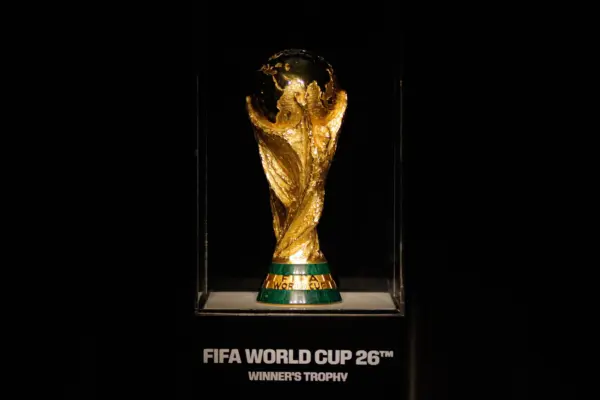
With 99 days until the 2026 FIFA World Cup kicks off in Mexico City, major questions remain — not just about what will happen on the field, but about political, financial and security concerns surrounding the biggest event in global sport. The first 48-team World Cup is supposed to be a celebration of expansion and global reach. Instead, it arrives amid geopolitical tension, economic scrutiny and logistical uncertainty.
Here’s a deeper look at the most pressing issues with three months to go.
Which Teams Will Complete the 48-Team Field?
The final places in the first 48-team World Cup will be decided later this month. Mexico hosts the six-team inter-confederation playoffs, while UEFA’s four playoff paths will determine Europe’s remaining representatives.
Italy and Denmark headline the European field. Italy, four-time World Cup champions, are attempting to avoid a third straight tournament absence — an outcome that would be unthinkable for a nation of their pedigree. Denmark remain one of Europe’s most consistent tournament sides, capable of both defensive discipline and tactical flexibility. Turkey and Ukraine also enter as dangerous contenders with recent tournament experience, while a talented Sweden underperformed in qualifying.
Outside UEFA, DR Congo are the highest-ranked nation still alive, sitting just inside the world’s top 50. The remaining qualifiers will significantly shape the balance of several groups, including one featuring Canada, Qatar and Switzerland, and another involving hosts Mexico alongside South Korea and South Africa.
World Cup expansion adds intrigue and geographic diversity, but most of the remaining contenders sit outside the global elite. The final six spots are unlikely to dramatically alter the list of true title contenders — but they could influence which major nation faces a more complicated group-stage path.
Will Iran — or any other qualified nation — face visa or participation issues?
The United States and allied nations launched military action against Iran this weekend, immediately casting uncertainty over Iran’s participation. Iran are already qualified and placed in a group with New Zealand, Belgium and Egypt — a manageable path on paper. But now their presence is in doubt.
President Donald Trump said he “does not care” whether Iran participates in the World Cup. While FIFA traditionally tries to separate sport from politics, active conflict between a host nation and a qualified team presents an extraordinary scenario.
History shows that tense diplomatic relations have not automatically prevented participation — Iran faced the United States at the 1998 World Cup during prolonged hostility (but not active war), and Argentina met England in 1986 just four years after the Falklands War. However, an ongoing state of war during a tournament hosted on the soil of an opposing power would be virtually unprecedented in modern football.
Visa concerns extend beyond Iran. U.S. immigration policies have already impacted travel for countries such as Haiti and Senegal. Broader geopolitical tensions could complicate entry procedures for others. FIFA will likely continue to work aggressively behind the scenes to ensure compliance and smooth travel, but political realities remain outside its full control.
Will tickets truly sell out, and will stadiums be filled?
FIFA maintains that demand for the 2026 tournament is historic. President Gianni Infantino told the media that 77 of the 104 matches have received more than one million ticket requests. Marquee fixtures — including matchups such as Portugal vs Colombia — will rank among the most expensive sporting tickets ever sold.
The concern lies not with finals or high-profile group matches, but with depth. A 104-match tournament requires sustained demand across five weeks. While Argentina, Brazil, France, Mexico and the United States will reliably fill stadiums, questions remain about neutral-site games involving smaller nations such as Austria, Qatar, and Jordan.
High pricing has already drawn criticism from long-time supporters who feel priced out of what was once a more accessible global festival. Corporate hospitality and premium packages may ensure revenue targets are met, but optics matter. Empty seats — even in isolated group matches — would undermine the perception of universal demand.
Secondary markets will provide a clearer signal as kickoff approaches. If resale prices dip sharply for lower-tier matches, it may indicate that the pricing strategy overestimated elasticity in certain markets.
Will FIFA’s official Fan Fests proceed as scheduled across host cities?
Fan Fests have become one of the defining features of the modern World Cup — communal spaces where supporters gather, often free of charge, to watch matches on large screens. They are also expensive, security-intensive undertakings.
New York/New Jersey recently canceled its large-scale plans, opting instead for smaller, scaled-down events. Other U.S. host cities continue to request additional security funding, with Foxborough locked in an ongoing dispute over financial responsibilities for tournament security.
In Mexico, recent cartel violence has raised broader concerns, though it remains extremely unlikely that matches themselves would be relocated. Still, large public gatherings represent soft targets, and security planning will shape how expansive — or restricted — these communal experiences become. Seeing smoke rising and chaos at the international airport in Guadalajara, a World Cup host city was a shock for many.
Can security measures be both effective and welcoming for supporters?
Security will be extensive across all three host nations. Mexico is expected to deploy significant federal and military resources. Canada, generally viewed as stable and welcoming, will focus largely on crowd management and infrastructure.
In the United States, concerns are less about stadium safety and more about the broader environment. Immigration enforcement practices and domestic political rhetoric from the Trump administration and its “ICE” immigration force have drawn international scrutiny. For some supporters — particularly those from Latin America, Africa and Asia — perceptions of risk have already impacted their decision whether to attend the tournament and how they will enjoy the games.
The challenge will be maintaining visible security without creating an atmosphere of surveillance or hostility. The World Cup is designed to project openness and global unity. Achieving that image amid heightened security protocols may be impossible in the current political and security environment.
How will the expanded 48-team format impact competitiveness and match quality?
The 2026 edition marks the first expansion to 48 teams, increasing total matches to 104. FIFA argues the move democratizes opportunity and broadens global representation while also generating more revenue. Critics counter that it risks diluting competitive quality.
Group-stage mismatches are possible, particularly when elite European or South American powers face emerging football nations. Additionally, advancement scenarios involving third-place teams could reduce late-group tension in certain cases.
At the same time, expanded fields have historically produced surprise stories. Smaller nations now gain realistic pathways to knockout rounds. Whether the trade-off favors inclusivity over intensity will become clearer once the tournament begins.
Which major stars could miss the tournament through injury — and which young players will emerge?
Injuries remain a looming concern. Real Madrid’s Rodrygo has already suffered an ACL tear, ruling him out for Brazil. With domestic seasons reaching their final stretch and little recovery time before kickoff, player workload is under scrutiny. An injury now, leaves a player with almost no time to recover before the tournament.
For established stars, simply arriving fit will be an achievement. For younger players, the expanded format increases exposure opportunities. Established prodigies like Lamine Yamal will attract attention, but the tournament traditionally introduces new names to global audiences — particularly from smaller or newly qualified nations. Even young players like Mexico’s Gilberto Mora are fighting to be fit for the tournament.
Will a focus on set pieces undermine the enjoyment of World Cup games?
Tactical trends in club football, especially in the Premier League, increasingly emphasize set-piece efficiency and physicality. Even managers such as Liverpool’s Arne Slot have complained that some matches are “no longer a joy to watch.”
International tournaments often amplify conservative strategies. Margins are thin, knockout stakes are high, and defensive structure is prioritized. If matches tilt heavily toward dead-ball scenarios and attritional play, spectacle could suffer, and modern football tactics and refereeing will remain under scrutiny.
Yet World Cups also produce moments of creativity that transcend tactical caution. Whether 2026 leans toward control or chaos remains one of the most intriguing unknowns.
Main Photo Credit: Smartframe Images