
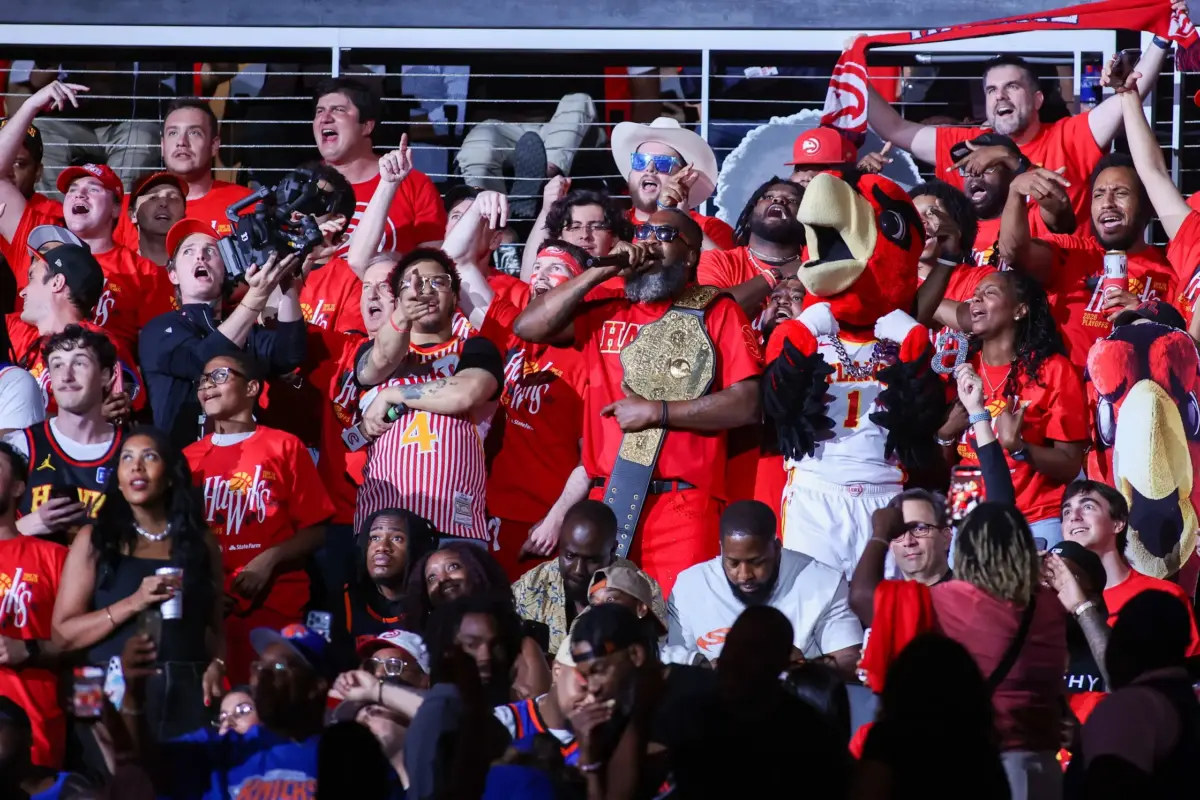
The Atlanta Hawks’ offseason began over a week ago, but only after the New York Knicks bounced them out of their own building.
Though that Game 6 loss didn’t overshadow what the Hawks accomplished in the preceding months, it did much to put the team’s weaknesses under the microscope. There will always be those on the extreme ends of the spectrum, one group believing the Hawks’ series against the Knicks wasn’t meaningful, the other acting like it’s the end of the world. However, most of Atlanta’s endearingly loyal fan base seems to be on the same page.
What Should The Atlanta Hawks Do In The 2026 Offseason?
Following the Trae Young trade, Jalen Johnson is officially the present and the future. Nickeil Alexander-Walker, the 2025-26 Most Improved Player, punched above his weight as Johnson’s second option. Between their young pieces and draft capital, their front office is rife with options. On that note, Hawks general manager Onsi Saleh has shown himself to be a capable and forward-thinking lead executive.
This has lent itself to there being a sense of comfort around the Hawks entering the offseason. It’s not exactly peace or serenity, with anxiety making its presence felt. Her pessimistic sister, doubt, is hanging around the corner. Nonetheless, they’re not in the chaotic state that they were over the past two seasons. Now, they’re ready to build, calmly and confidently.
2026 NBA Draft
With the lottery order set, the Hawks will officially have the eighth overall pick in the 2026 NBA Draft, by way of the New Orleans Pelicans. They also have control of their original draft selections, which are slotted at No. 23 and No. 57 pick overall. Given all the hoopla surrounding their acquisition of the Pelicans’ top pick in the 2026 NBA Draft, having a selection that landed outside of the top-five was disappointing. Nevertheless, Atlanta still finds itself with prime real estate on the draft board, as top-10 picks are typically seen as having star potential as well.
Kingston Flemings (No. 8)
When the Hawks find themselves on the clock on June 23, they’ll likely be in position to add at least one of the top true freshman point guards. Darryn Peterson (Kansas), a prolific scorer with playmaking upside, will have likely been scooped up by then. The most outstanding lead guard in the NCAA last season, Darius Acuff Jr. (Arkansas), is unlikely to make it past the Sacramento Kings’ seventh overall pick. However, there’s a solid chance that at least one of All-American playmaker Kingston Flemings (Houston) and All-ACC creator Mikel Brown Jr. (Louisville) are still waiting to hear their name called.
Between Flemings and Brown, the former is the more polished product.
It starts with the difference in their scoring efficiency. In 2025-26, Flemings averaged 16.1 points per game on .476-.387-.845 shooting splits. For comparison, Brown averaged 18.2 points per game on .410-.344-.844 shooting splits. From there, one can compare their passing efficiency. Last season, Flemings held a 2.91:1 assist-to-turnover ratio, while Brown posted a 1.52:1 assist-to-turnover ratio. Looking at the raw numbers, Flemings (66) and Brown (65) had nearly the same number of turnovers, but Flemings (192) dished out nearly 100 more assists than Brown (99).
Ultimately, Brown is more prolific in terms of 3-point volume, taking 160 attempts to Flemings’ 106. Yet, he’s a statistically inferior option. For players whose highlights (and lowlights) can make it difficult to split hairs, that should make a significant difference.
Meleek Thomas (No. 23)
After adding the well-rounded Flemings as their future franchise point guard, the Hawks can then address the other elephant in the room. Throughout the season, Johnson and Alexander-Walker frequently seemed overburdened as shot-creators. Adding CJ McCollum and then Jonathan Kuminga helped but not enough, Atlanta’s sputtering offense averaging just 100.3 points per game against the Knicks in the playoffs. On top of that, McCollum is guaranteed to become a free agent this offseason, his expiring contract among the reasons the Hawks acquired him.
Bringing Flemings to the mix will enhance their offense in a layered way. The 6-foot-4 Texan is equal parts floor general and midrange maestro, offering both outside shooting and above-the-rim athleticism. His on-the-fly ball-handling makes him that more dangerous. However, adding another perimeter scorer would be advisable. Thus, Arkansas true freshman Meleek Thomas enters the chat at pick No. 23. Though his lack of athletic pop and hero-ball tendencies limited his overall efficiency (43.5%), the 6-foot-5 combo guard knocked down 41.6% of his 3s. A legitimate on- and off-ball scorer, Thomas averaged 15.6 points per game in 2025-26.
Rueben Chinyelu (No. 57)
With the Hawks recently bringing in Kansas/Louisville center Flory Bidunga and Virginia Tech center Ugonna Onyenso for a pre-draft workout (h/t AJC reporter Lauren L. Williams), the middle could be the direction Atlanta goes. The latter is more likely to be on the board at the end of the draft, not in the least because Bidunga will probably head back to college if he thinks he’s in danger of going undrafted. If Onyenso ends up being the selection, a 6-foot-11 shot-blocking specialist doesn’t sound bad.
Ugonna Onyenso put forth yet another Herculean defensive effort in a narrow ACC Championship loss to top-ranked Duke.
Gave a typically unflappable Cam Boozer fits all game with his length, mobility, motor, and rim-protection instincts, holding him to just 3-of-17 from the field.… pic.twitter.com/52aD4R2Uql
— Jon Chepkevich (@JonChep) March 16, 2026
However, Onyenso’s performance against Duke and a top prospect like Cameron Boozer in the ACC Championship Game may have left a lasting impression on teams with an earlier second round pick. Instead of him, the Hawks could be forced to hone in on the likes of Florida junior Rueben Chinyelu, Oregon senior Nate Bittle, or 19-year-old international prospect Luigi Suigo. Chinyelu is the only one that hasn’t flashed floor-spacing ability but Atlanta’s interest in Bidunga underscores what they’re looking for most in their next center.
Defense. Rebounds. Unlike Bidunga, Chinyelu wasn’t swatting away shots like flies last season but he’s an exceptional athlete, even in terms of his lateral agility. For a player listed at about 6-foot-10 and 250 pounds (with a 7-foot-8 wingspan), that’s big.
Free Agency
Exactly one week after the NBA Draft, free agent negotiations are officially set to begin. By this time, the Hawks will have fortified their perimeter and interior with their draft selections of Flemings, Thomas and Chinyelu.
At this point, they should and will prioritize re-signing McCollum, who played a key role in Atlanta’s offense as a shot-creator and playmaker. The additions of Flemings and Thomas should have an impact on his usage, which was too high at times. However, McCollum’s veteran savvy and mentality are intangibles that neither of those one-and-done prospects can replicate.
If McCollum chooses not to re-sign though, the Hawks do have other options. In fact, several proven offensive-minded guards will be available, including Chicago Bulls guards Anfernee Simons and Collin Sexton. Of note, so will first-time All-Star Norman Powell, who may have become disillusioned with the Miami Heat due to Erik Spoelstra’s questionable rotation decisions.
The Hawks will have four other free agents in Gabe Vincent, Jock Landale, Keaton Wallace and Tony Bradley. They also hold team options for Kuminga ($24.3m), Zaccharie Risacher ($13.8m) and Mo Gueye ($2.4m).
Of those seven players, retaining Gueye is the simplest decision. While the 23-year-old is in need of offensive development, he’s a strong multi-positional defender on a very affordable contract. Kuminga and Risacher are also players who need to polish their offensive games while displaying defensive upside. Kuminga’s salary is a cause for concern, in part because he may not live up to it, but he could make life easier for everyone by agreeing to a multi-year deal with a lesser figure.
Aside from Gueye, Kuminga and Risacher, Atlanta should strong consider re-signing Landale. Unlike Chinyelu, Landale is a legitimate 3-point threat, converting 38.3% of his 3s in 2025-26. As a true stretch-five, he inherently helps players like Kuminga, Dyson Daniels and Jalen Johnson by creating more space for them to attack the rim. However, because of Landale’s questionable lateral agility, the Hawks should prioritize a floor-spacing big that offers more defensively. Namely, Portland Trail Blazers free agent Robert Williams III, whose injury history may allow them to pay less than what he earned last season ($13.3 million).
Atlanta holds both their non-taxpayer mid-level exception ($15 million) and bi-annual exception ($5.5 million) this offseason.
Additional Moves
Following those moves, this is what the Hawks’ 2026-27 depth chart would look like:
Kingston Flemings, CJ McCollum
Nickeil Alexander-Walker, Meleek Thomas, Buddy Hield
Dyson Daniels, Zaccharie Risacher, Corey Kispert
Jalen Johnson, Jonathan Kuminga, Mo Gueye, Asa Newell
Onyeka Okongwu, Robert Williams III, Rueben Chinyelu
Compared to their 2025-26 roster, they’ve essentially replaced Vincent and Wallace with Flemings and Thomas. With Vincent and Wallace both averaging under 5 points per game last season (and shooting under 40 percent from the field), the primary difference will be felt offensively. Flemings isn’t as aggressive a scorer as Trae Young, for better and for worse. All the same, he’s a confident three-level scorer who should be able to take advantage of the attention Johnson, Alexander-Walker and even McCollum draw.
Offensively, the biggest concern will be streaky 3-point shooting. Still, the Hawks have several floor-spacing big men to help mitigate that problem. At the other end, their perimeter defense should be on par with what it was in 2025-26. However, they could still stand to add another wing defender. With rumblings about their interest in Denver Nuggets forward Cameron Johnson, a trade package headlined by a future first-round pick could do the trick. Due to Johnson’s age (30) and injury history, Atlanta shouldn’t have to offer any more than that, besides the salary to match (Corey Kispert and Buddy Hield).
© Brett Davis-Imagn Images