
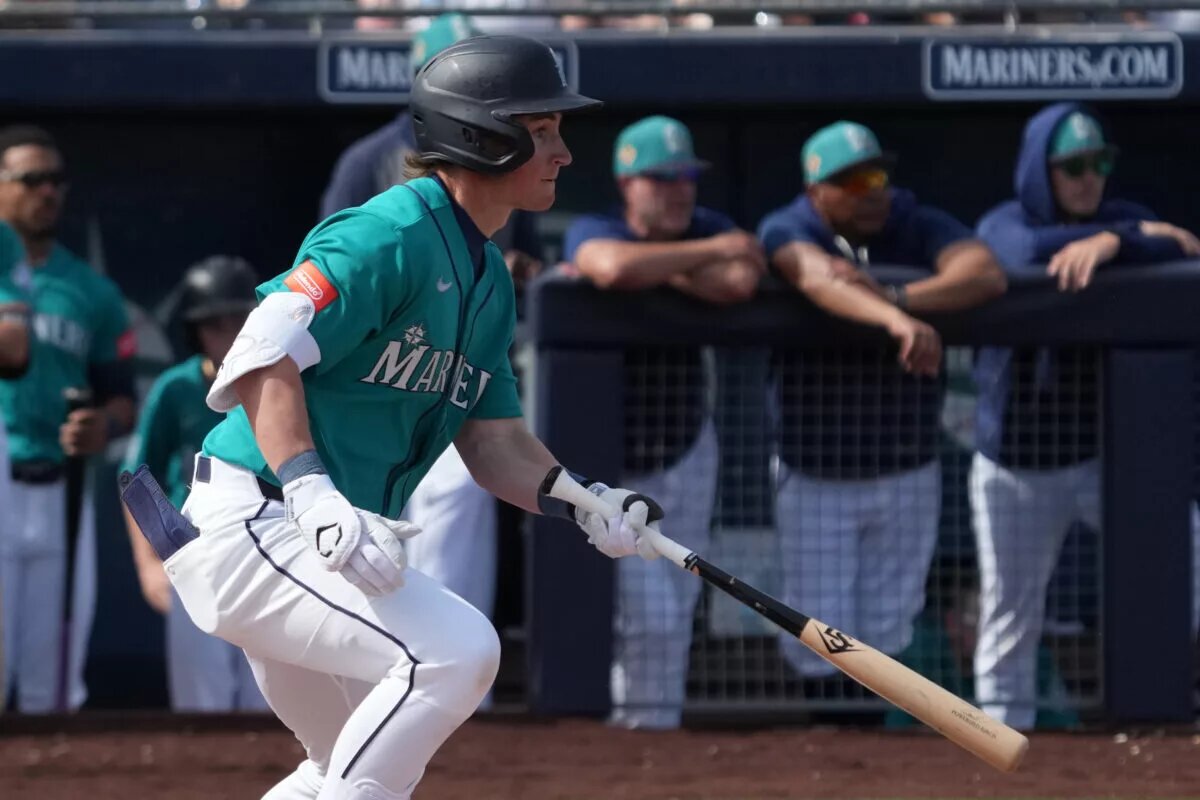

Colt Emerson, a top-10 shortstop prospect in the Seattle Mariners system, has signed an eight-year, $95 million deal, making it the biggest contract for any player yet to debut in MLB history. The deal also includes a ninth-year club option, a full no-trade clause, and incentives that could bring the contract up to $130 million, as reported by Robert Murray of FanSided.
This is a groundbreaking deal for a player yet to take his first at-bat at the major league level, but it points toward a shift in approach from major league front offices. Ultimately, the Mariners believe strongly in Emerson’s potential.
Mariners Commit to Top Prospect Colt Emerson with Eight-Year Deal
Why This Is a Low-Risk Move
While this may seem like a significant commitment for a 20-year-old prospect, from a front office perspective, this is close to a no-brainer. Given the player profile, position, and contract length, it is an incredibly low-risk move despite the financial outlay.
BREAKING: Colt Emerson and the Seattle Mariners are in agreement on an eight-year, $95 million contract extension, sources say. The deal includes a ninth-year club option, a full no-trade clause and escalators that can bring it north of $130 million. Emerson is represented by…
— Robert Murray (@ByRobertMurray) March 31, 2026
The floor is very high—an above-average defensive shortstop with a contact bat—with the ceiling of a five-tool player capable of producing 5–6 WAR if he maximizes both his power and defense. The current market value of a win (WAR) in free agency is around $8–12 million, according to FanGraphs, and continues to rise. To return value on this deal, Emerson would need to accumulate roughly 8–12 WAR over the eight-year contract.
Given his position, he could realistically reach that value within three full seasons once he becomes a regular at the major league level. By locking him in from age 20 through 28, by the time the club option comes into play, the Mariners could be receiving a considerable discount on his production.
A Growing Trend?
The Milwaukee Brewers made a similar move this week, signing their elite shortstop prospect Cooper Pratt to an eight-year, $50.75 million deal. As they also did with Jackson Chourio before his rookie season, the Brewers are clearly following a similar model of tying down elite prospects who will be future starters to long-term deals.
For mid-market teams, such as the Mariners and Brewers, this provides flexibility. Knowing what you are committing financially to core pieces allows teams to build around that foundation more effectively. Both clubs have some of the best farm systems in baseball, so providing pathways for these prospects in the minors is also vital. The Mariners now have premium positions locked in on long-term, team-friendly deals, which will be important when it comes to extending members of the starting rotation. The Brewers are building similarly. This also reflects a broader commitment from teams like Seattle and Milwaukee to build around their minor league systems and lock in core talent early.
It’s been the perfect fit from the start.
Colt Emerson will call Seattle home for a long time. #TridentsUp pic.twitter.com/qerFWpjbMx
— Seattle Mariners (@Mariners) March 31, 2026
Paying Early, Saving Later
The logic is simple: pay more during the pre-arbitration years and then reap the benefits during a player’s peak seasons. Once Emerson reaches his age-25 season and beyond, the Mariners could be paying well below market value for his production.
Prospects with this profile, particularly at premium positions, offer significant surplus value. Locking in that level of talent for the best part of a decade gives teams long-term stability. Emerson has already shown flashes in spring training, and his skill set should translate well to the major league level. The Mariners are effectively betting that he will hit that floor, and given his profile, that appears to be a reasonable expectation.
If he can unlock additional power and develop into an elite defender, they could be saving themselves upwards of $20 million per year during his peak seasons.
The Risk—and Why It Still Makes Sense
Of course, there is always risk. Prospects are volatile, and it is not impossible that the Mariners do not fully return value on the deal. However, Emerson’s profile, intangibles, and position make this as safe a bet as a team is likely to make on a player yet to debut.
While the deal may appear aggressive at first glance, the long-term logic is clear. This is not just a bet on Colt Emerson, but on a wider front office strategy. For teams operating outside the very top tier of payroll, this approach offers a path to sustained competitiveness. Deals like this suggest a growing shift in how front offices value and secure elite young talent. If Colt Emerson reaches even his floor, the deal will justify itself. If Emerson reaches his ceiling, it could become one of the most team-friendly contracts in baseball.
Main Photo Credit: Rick Scuteri-Imagn Images