

At WrestleMania, the WWE’s top female wrestlers have made themselves a main attraction, from main eventing to stealing headlines and subverting expectations. In some cases, overachieving, besides ugly, nonsensical booking, the WWE’s female roster always stands out. Usually, they show up. The 2015 Women’s Revolution created this consistency.
However, it was not WWE’s first women’s revolution. Although many of the best women’s matches in WrestleMania history have been recent contests, without women’s wrestling at the forefront of the build for the first WrestleMania, the gamble would have failed. Something easy to forget given the subsequent years where women at WrestleMania and in the WWE in general were minimized.
Eras of Reduction
For decades, across eras, women’s wrestling wasn’t a priority. During the PG Era, women’s matches were painfully short. Less than five minutes (if lucky), sometimes featuring multiple women, and seemingly designed to cool off the audience. Matches that became cues for bathroom and concession breaks.
If, like me, you became a fan in the Ruthless Aggression Era, you remember bikini contests, bra and panties matches and the widespread objectification of women. Women took a significant front-of-centre role in The Attitude Era, but the emphasis was on sex appeal and titillation over in-ring action. The early 1990s had Alundra Blayze and Bull Nakano, yet despite sporadic innovative matches, the division was a side-lined afterthought. Less is said about the 1980s and the criminally underutilised talent. Velvet McIntyre, The Jumping Bomb Angels, Rockin Robin, and Sherri Martel, before the latter became a manager.
There were only three women’s matches at WrestleMania before 1994. WWE rarely references or celebrates this era of women’s wrestling before the Women’s Revolution, beyond the Hall of Fame and brief mentions. Yet, perhaps the biggest reason the significance of the women who made WrestleMania is overlooked is that the attention usually goes to the star-maker, the non-wrestler who provided the spark.
First Women’s Revolution
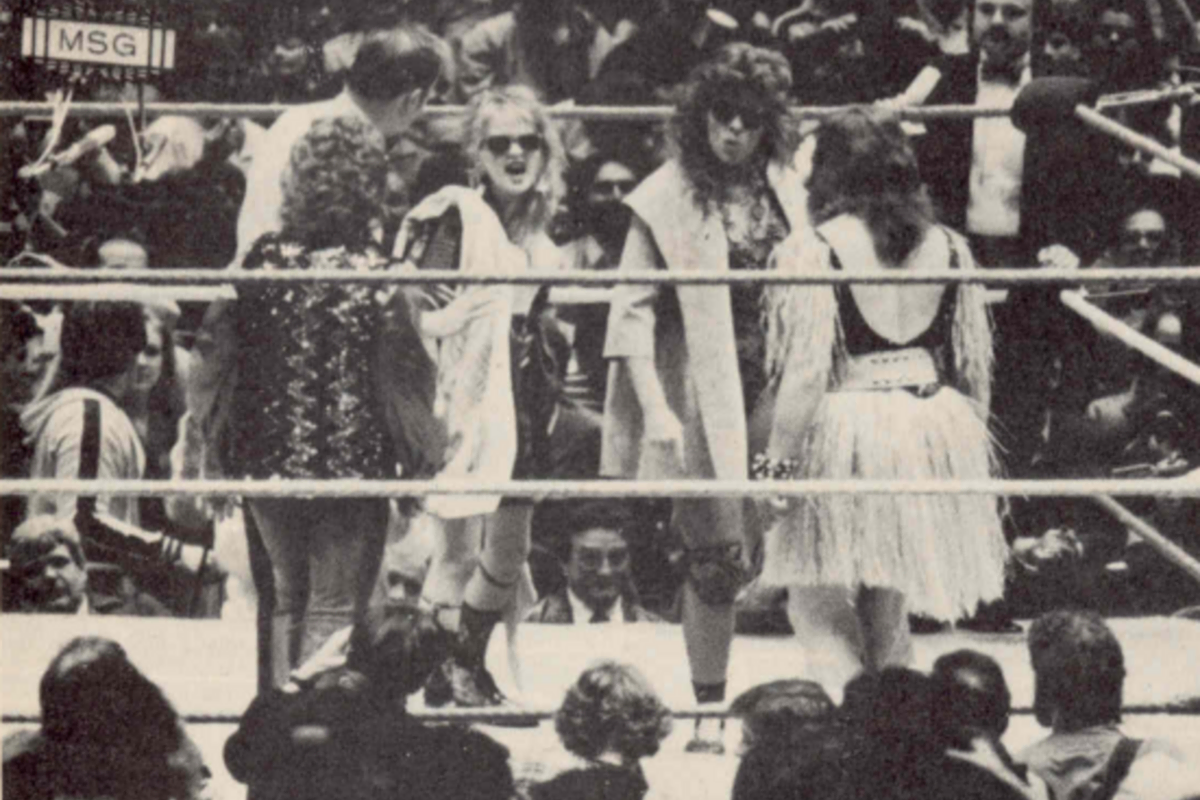
WrestleMania wouldn’t be the phenomenon it has become without popular crossover and celebrity involvement. The main event of WrestleMania I involved more than The A Team’s Mr. T, in the colossal tussle with Paul Orndorff and Roddy Piper. Muhammad Ali refereed. Yankee’s manager, Billy Martin, was the ring announcer. Liberace was the timekeeper. Mr. T was the big draw, yet in the semi-main event, pop sensation Cyndi Lauper had already set the foundations.
Supporting Wendi Richter, who regained the WWE Women’s Championship from Leilani Kai in six minutes, Lauper had already started a revolution. One that went beyond putting the spotlight on WWE’s women’s division, but the entire company.
As Brian Zane of Wrestling With Wregret, when re-reviewing WrestleMania I, how many overlook how this semi-main event impacted not just the success of WrestleMania. Without Lauper, there would have been no Rock ‘n’ Wrestling Connection preceding WrestleMania. No WWE.
Again, fans will ask why Lauper is still not in the WWE Hall of Fame. Although Lauper brought the attention, it’s overlooked that Richter, Kai, and The Fabulous Moolah were the ones who did the fighting. With Moolah, we must acknowledge that, like all controversial wrestling figures, while she helped start a potential new emphasis on women’s wrestling, she contributed significantly to its early demise.
Girls Do More Than Have Fun
Like much of history, it started with luck and a chance encounter between. The right people meeting at the right time. A strange meet-cute of eccentric personalities on a flight from Puerto Rico, Cindy Lauper met WWE Wise Man, Captain Lou Albano, while she was still with her band, Blue Angel. The friendship was timely for both. Lauper was starting her solo career.
The initial traction of Lauper’s debut album and the first single, “Girls Just Want to Have Fun”, was limited. According to Lauper, critics and decision-makers considered her voice to be too high. Her then-boyfriend/manager, David Wolff, encouraged Lauper to involve Albano in the video for “Girls Just Want to Have Fun” and WWE more generally to broaden her fan base.
Timing was everything. MTV was fresh and innovative, with music and TV with music videos. A form still popular, if altered by its spiritual successors with video-based social media platforms. The video became a staple of the channel and a cultural milestone. One that featured Albano playing opposite Lauper as her father, who she puts in a hammerlock.
Barely predating the arrival of Hulk Hogan and the Hulkster’s first world championship victory, Lauper opened the door for the then-WWF’s mainstream exposure. This doesn’t diminish Hogan’s prominence and impact, even considering his complex and controversial legacy.
Addressing revisionism, Hogan was already a big star thanks to Rocky III. Hogan had already appeared on talk shows like Johnny Carson in 1982. Undoubtedly, Vince McMahon’s marketing redesigned the American hero archetype around Hogan. However, like with Rocky III, Hogan, WWF and Ritcher got the pop-culture rub from Lauper’s presence.
No WrestleMania Without MTV
When reflecting on the media grind leading to WrestleMania, the focus often goes on Hulk Hogan and Mr. T’s appearances on shows like Hot Property or Saturday Night Live. However, before this, throughout her breakout, Lauper repeatedly praised Albano’s influence on her early career on talk shows like The Tonight Show and Late Night with David Letterman. The latter, in turn, led to Captain Lou Albano’s appearance on Letterman.
The friendship-turned-feud resulted in the first WWF/MTV special. The Brawl to End it All was promoted solely around the managerial challenge between Lauper, who picked Wendy Richter to face Albano’s pick, the WWF Women’s World champion, Fabolous Moolah. WWE and fans do not often talk about how one of the WWF’s biggest TV events on its road to global and market dominance was headlined by women.
Drawing a massive 9.0 in the Nielsen ratings, MTV’s appeal to younger audiences undoubtedly helped WWE appear cool. Its sequel, The War to Settle the Score, set up WrestleMania. Ironically, this time, the women’s title change, with Leilanai Kai stealing the championship from Richter to set up their WrestleMania match, was unaired. Still, the feud provided the space for Hogan vs. Roddy Piper. Flanked by Lauper and Albano on the way to the ring. Mr. T sat at ringside and post-match, the A Team man’s involvement set up history.
The Bite of the Spider Lady
Although Lauper was there for the star power, as Wrestling’s Main Event magazine highlighted in a double page spread in November 1984, “A Star is Born” in Richter. A well-travelled veteran who competed in Mid-South, Stampede and AWA, Richter represented in her flashy attire and charisma something new for the women’s division. As Lauper called her in a post-victory promo, a symbol of the new woman.
Her popularity, with help from Lauper’s endorsement, made her the second biggest babyface in the promotion. Beating Moolah, who had a stranglehold on women’s wrestling for nearly two decades, gave Richter momentum and credibility.
Although Richter became, for a short time, a household name, the disparity in pay between men and women was significant. A rift emerged. Given her status, Richter’s request for a pay rise led to the original screw job. Dressed as The Spider Lady, the ref counted one, shoulder up from Richter, two, three. The stranglehold on women’s wrestling was reapplied. Richter left the WWF.
According to Jim Cornette on The Fabulous Moolah’s Dark Side of the Ring episode, he believed that if things had worked with Richter, WWE could have established a stronger, viable women’s division much earlier. It’s an interesting what-if. Regardless, the sour ending, like with other Screw jobs in wrestling, is an in-house cancel culture embedded in wrestling history, which has likewise helped diminish the memory of the semi-main event of the first WrestleMania’s legacy.
Hall of Fame Debate
To some degree, Richter’s contribution to WWE is at least recognised by a WWE Hall of Fame induction. Still, Cyndi Lauper will likely be someone many fans discuss this year. Lauper’s attitude toward such celebrations might be one reason for her lack of inclusion. Yet as Lance Storm once tweeted:
“WWE HOF discussion: Cyndi Lauper does not deserve to be in the Celebrity Wing of the WWE HOF. She deserves to be a full-fledged HOF member. She was a pro wrestling manager, and her popularity and MTV tie-in played a huge role in the success of the Rock & Wrestling Connection.” Transcript from SPORTF.com.
Unlike his idealistic take on Mercedes Mone’s title collecting, it’s hard to disagree with Storm. Yet while fans will fight for Lauper’s recognition, what about acknowledging that without Ritcher, without Moolah and Kai there to connect with the crowd once the bell rang before and at WrestleMania I, the Showcase of the Immortal might not be the phenomenon it’s become.