

With the coverage AEW has received for “F### ICE” chants or comments on WWE’s perceived close affiliation with Donald Trump’s administration, some want wrestling to be separate from politics. It echoes a larger cultural sentiment that stretches beyond wrestling and sport. In the arts, the repeated suggestion that artists should ignore politics overlooks a fundamental reality.
The arts, sports, and even pro wrestling cannot and have never ignored politics. Politics is woven into every facet of life. Politics is all-encompassing. It impacts every person. So even to take a stance to be apolitical is itself political. Neutrality is a political choice.
Compared to other performative arts and sports, professional wrestling cannot separate itself from politics. Wrestling is pageantry, a morality play, a mirror to society as shown through the mirror of kayfabe. The art of making something not real appear real has transcended wrestling.
Multiple academic essays have argued that modern politics has adopted kayfabe as a political tool. It’s not just the WWE Hall of Famer, Donald Trump, who utilizes kayfabe.
That’s without even considering the deeply political nature of what happens behind the scenes. The hierarchical structure, “creative control”, backstage manoeuvring, blackballing/cancelling, inter-promotional relationships, etc.
American wrestling’s success is built on politics. Fundamentally, the politics of American idealism and identity. It has always reflected the national mood, hopes, fears, and double standards.
All American Heroes
Let’s start with the template of the American babyface champions. The archetype that embodies in body, spirit, and morality national values. A fusion of political ideals with characterisation. Before Hulk Hogan, there was Bob Backlund, who reigned as the WWWF/WWF World Champion for nearly six years. Pushed by Vince McMahon Sr’s as his “All-American Boy”, Backlund embodied traditional American values and spirit during the 1970s.
Backlund’s reign moved away from former champions like Bruno Sammartino and Pedro Morales, who represented a different element of the American political mythology: the immigrant story. The transformation allowed by the American Dream. The idea that everyone, regardless of background or creed, in America, with hard work, can make it.
Hulk Hogan’s a larger-than-life character pushed this idealism into the mould of Reaganite America. Yet, across Hogan’s legacy as an American hero, Hogan’s successes and failures aptly mirrored the duality and sometimes uncomfortable nature of American values, identity, and politics, even until his death.
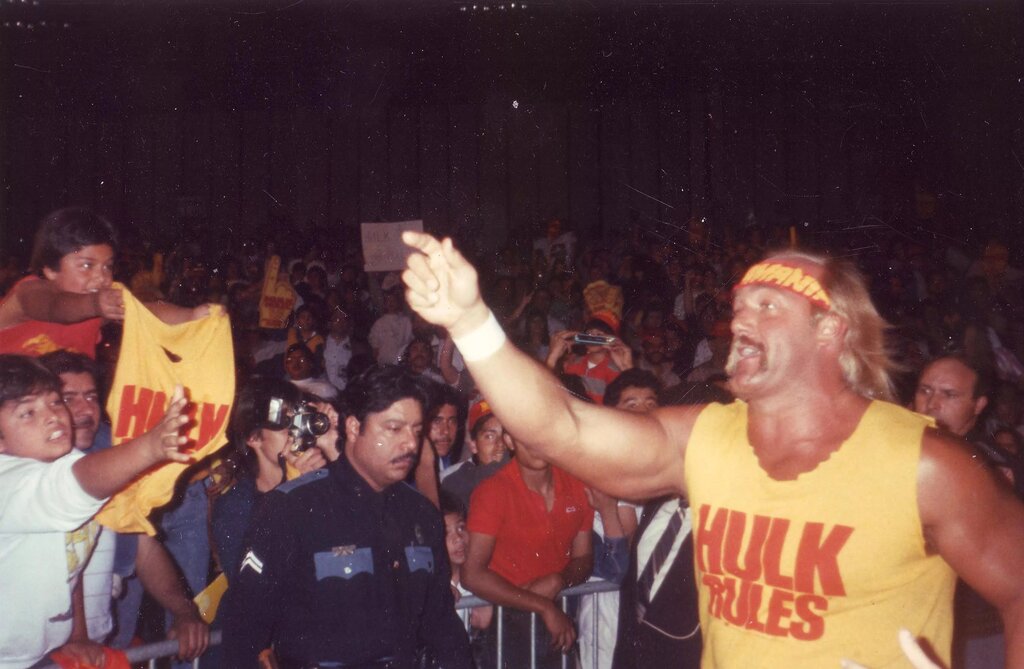
As a construct, Hogan’s individualism and dominance reflected more than Vince McMahon’s dominance of wrestling and destruction of the territories. As a metaphor, it reflected the neo-liberal capitalistic mantra: “greed is good”. Even before his death, Hogan’s conservative support for Trump reflected a fracturing of American generations. The desire for the “good old days”. Hogan’s heel turn reflected a national distrust of authority.
Even the steroid scandal, predating wider controversies linked to performance-enhancing drugs in other sports, reflected a harsh truth discussed in the documentary Bigger, Faster, Stronger*.
While such drugs were/are frowned upon, the documentary created by the brother of pro wrestler Mike Bell highlighted how the American win-at-all-cost mentality could fuel hypocrisy. The demand and results of physical perfection and athletic feats excite and engage audiences, with the end euphoria justifying the means.