
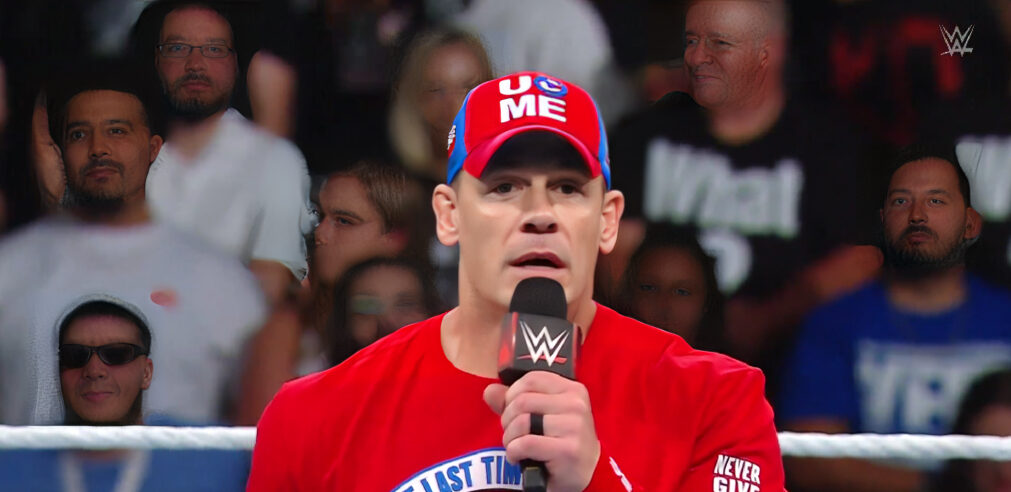
When John Cena repeated that he was doing “what is best for business” during the Royal Rumble press conference and in announcing his automatic entry into the Elimination Chamber, to some that may have felt like a shocking, potential heel turn. But the Authority’s old catchphrase, which has become a bit of a calling card in WWE, didn’t sound unnatural coming out of the mouth of a man who has spent decades doing just that. John Cena as a person, and more importantly as a character, has been unarguably what is best for WWE’s business for the better part of his career.
Although The Authority was the last in a revolving door of villainous management figures who tried to replace Cena as the company’s centerpiece, the irony was clear to long-time and “smart” fans. Cena was the corporate choice and at times, the fan’s choice. It wasn’t the worker vs. boss dynamic of Steve Austin vs. Vince McMahon of the late 90s. Besides a lack of attitude and edge, the PG money-making strategy was see-through.
Dropping his Ph.D. in Thuganomics, you might say that like Wu-Tang, Cena was for the children. Cena provided them with a message of empowerment and sporting history. Hustle, loyalty and respect. It wasn’t just a catchphrase, it was a way of life. Yet cynically, unlike Wu-Tang, Cena sold a rainbow of colorful shirts, cereal, and garden gnomes! More marketing than man, some fans (and at times, most fans) rejected Cena. It was never uncommon to hear dueling “Let’s Go Cena, Cena Sucks!” chants through arenas worldwide.
Cena’s press conference words highlight how normal and accepted it’s become for business to bleed into storylines. Previously, the words “what’s best for business,” were often viewed sarcastically and certainly ironically. They were said to spite and laugh off disaffected fans. But coming from Cena, it feels different. What fans once had contempt for is now accepted, embraced, and celebrated. No wrestler embodies this change in attitude and mood more than John Cena who now, then, and, forever seems to personify WWE as a business.
John Cena and the Literal Business of Wrestling
WWE is All About the Numbers
Discussion of WWE today online, in the press, and at events, focuses on business. Repeatedly fans cheer when they’re part of record-breaking gates. Fans online tout all kinds of metrics alongside or above their own personal satisfaction with WWE’s creativity and wrestling. There’s an entire cottage industry dedicated to WWE business analytics that likewise feeds into the discord of AEW and other promotions. We compare every rating, attendance figure, or available number to predict the competition’s downfall or to justify why WWE is still the best wrestling company even if week in, that isn’t always the case. Creative decisions are discussed like gains or losses on the stock market. And much like that market, fans are heavily invested and want to see their investment rewarded on the screen.
This attention to detail of the financial aspects of wrestling in our fandom started after the last boom, the post-Attitude Era. Fixations on WWE’s declining ratings, PPV buys, and attendance had many saying the company’s death was imminent. As discussed this week in an article on wrestling fan outrage, fan investment is no longer as important to top wrestling companies as it once was. The reality has led to a steady rise in record profits despite some older fans’ disengagement. When it comes down to it, WWE is a business, and as much as it focuses on entertainment and fan experience, it’s driven by the same thing all businesses are: its bottom line (and not just because Stone Cold said so).
For years, John Cena was the easy scapegoat for fans’ creative dissatisfaction. Especially as the character for those fans lost its edge. Commercial interests were blatant. Like Hulk Hogan, Cena had a broader appeal, superficially to children and women. WWE took advantage. Cena’s character’s “never give up” moniker went untested by challenges that rarely pushed him to that point. Metaphorically, Cena was like WWE post-WCW. The competition never had the long-term creative or corporate machinery to be an alternative.
It was easy to say Cena “sold out” but as Seth Rollins famously said after betraying the Shield, he didn’t sell out, he bought in. And that’s exactly what Cena did. He bought into his character and his character’s motivations. “Corporate” Cena led WWE into The PG Era with childish (sometimes toilet) humor that alienated hardcore fans but all the while, created a new generation of fans who can continually be seen sporting his merch and buying tickets to see him wrestle. And behind the scenes, his character continued doing what was “best for business,” granting more dreams for Make-A-Wish than any other single person ever has. During 20-minute SNL-style monologues, Cena playfully batted away booing in a sanitized and PR-friendly version of the perceived disinterest of management. In doing so, Cena contributed towards the shift in drawing power, with it moving away from the star to the company.
Redefining What it Means to Be “The Company’s Man”
More coincidental than purposeful, John Cena’s rise redefined what it means to be a WWE company man. This concept defined Cena’s character. Compared to the past, Cena’s time on top has seen a shift in how on screen, in storylines, and, in fan discussion, world champions have been evaluated based on how well they represent the WWE’s corporate ideas and values.
All prior era-defining world champions were company men also. The process of corporate characterization started with Triple H’s “Reign of Terror.” The Game’s promos reinforced his status as the best representative of WWE. Plus, fan knowledge of his marital connections to the boss made his position seem nepotistic. However, Triple H’s character was a heel. He was supposed to be despised. He was supposed to blatantly flaunt his relationship with the Boss’ daughter to get favorable treatment. Again, unlike Cena and like previous era-defining champions, Triple H’s identity was, at times separate and, at other times contrasting to the company’s corporate direction.
While “Cena wins lol” felt reflective of “Hogan must pose,” Cena never called WWE’s top prize a toy belt or spoke ill of the company despite its flaws and faults. Cena didn’t require his wins back. He was a babyface company man, which enabled him to remain true to the character children had come to love, while also working the circuits in character outside of the wrestling ring. Unlike The Hitman, Cena was willing to play the fool. Cena never lost his smile. He never took his ball home. Even in going to Hollywood, the process was gradual. It started under the WWE Studios banner. The company came first.
Unlike his predecessors, Cena headlined longer and never had a significant conflict with Vince McMahon. On and off screen, Cena’s character and actions were in step with the company’s image. The tippy-top guy is now a reflection of those three letters.
The Lasting Ripple Effects
CM Punk verbalized many fans’ feelings with his infamous pipe bomb. Yet, even “The Voice of the Voiceless” highlighted rather than prophesized, that WWE was making bank despite declining fan interest. Ironically, it was the anti-establishment Punk that blew the doors open for business talk in WWE to take center stage. This is all the more ironic now that Punk is all about praising corporate synergy.
Yet afterward, it was made clear to fans and wrestlers on screen who was truly a WWE guy. Punk, Daniel Bryan, and Kofi Kingston were all addressed on screen by Vince McMahon, the character and boss, and were told they were representative of his WWE vision. Granted, they won the big one, but were their reigns meaningful? The Authority and Cena remained WWE’s main characters and focus.
Cena’s successors squirmed in his mold. Seth Rollins and Roman Reigns’ attempts to make Cena-like quips, like “sparkle-crotch” and “suffering succotash,” faced rejection. Even Cody Rhodes’ current reign has felt Cena-like or perhaps Cena-lite for some with a diluted character that emphasizes style over substance. Out of the ring, Rhodes’ neutral and measured talking abilities match the company’s requirements for what they want in a “corporate” champion.
Creative has drastically improved. The framing of what’s best for business has changed into a net positive. Once storylines presented the organization itself as a heel. Now the company is good, Cena a legend and appreciated after a decade of being serenaded and told he sucked.
The Time is Still Now, the Legacy is Still Building
This year, if John Cena wins one more world championship, his legacy will again reflect that of the WWE. Like WWE, Cena can cement his legacy in the positive, by rewriting and wiping away those years of dissatisfaction and disillusion. At some point, some fans of that era might romanticize that time with hindsight, like those fans who grew up in the New Generation Era. Both Cena and WWE are enjoying a cultural resurgence. Their success runs in parallel.
It’s only fitting during a time of record-breaking that WWE’s most decorated world champion smashes wrestling’s greatest record. Ric Flair’s total world championship reigns encompass the wrestling world beyond WWE. In smashing it, Cena brings that history under the WWE umbrella where the mindset remains that everything outside is secondary.
It’s serendipity, good booking, and corporate synergy. It’s best for business.
More From LWOS Pro Wrestling
Header photo – WWE
Stay tuned to the Last Word on Pro Wrestling for more on this and other stories from around the world of wrestling, as they develop. You can always count on LWOPW to be on top of the major news in the wrestling world, as well as to provide you with analysis, previews, videos, interviews, and editorials on the wrestling world. You can check out WWE programming on Netflix (Raw), USA Network (SmackDown), The CW (NXT), and Peacock (archives and premium live event streaming). You can follow WWE on social media and relive top moments on YouTube.