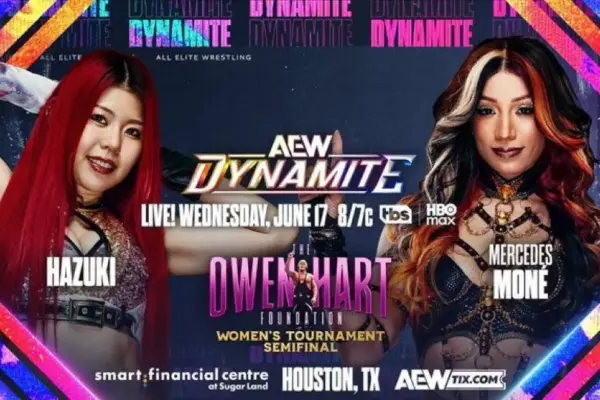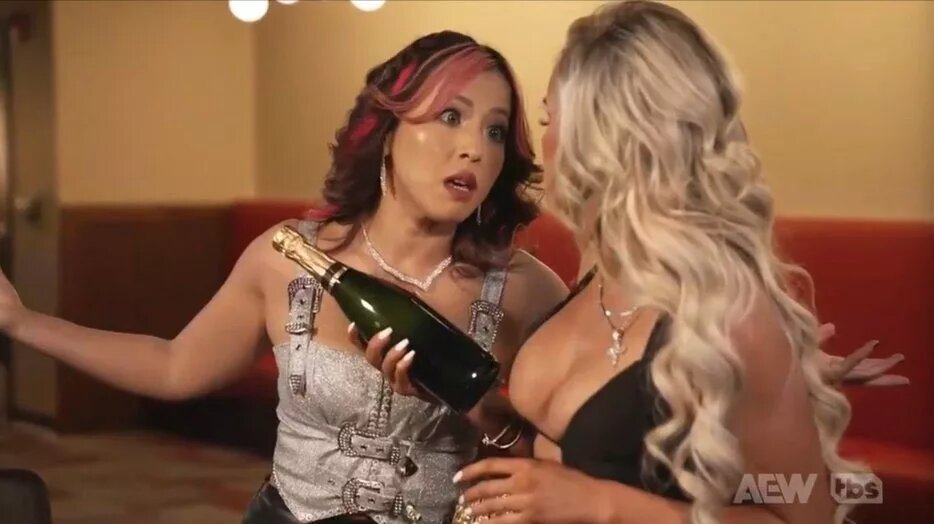

“Nothing is fair in love and wrestling,” Renee Parquette, hype package for Mariah May vs. Mina Shirakawa at AEW Dynamite: Winter Is Coming.
When Mariah May battle Mina Shirakawa at Winter is Coming, the story will be different from any other AEW Women’s World Championship match. While it mirrors May defeating one mentor in “Timeless” Toni Storm, it’s also a new approach to the student must beat their teacher.
In Mariah May’s own words, she is a “complicated woman.” This is not the usual story of a betrayal; love muddles it. Look closely at May’s character; the betrayal is momentary.
“I do a lot of things people don’t understand, and that’s okay. So, when people ask me why I broke up with Mina, I could give the simple answer of jealousy or watching her prance around with the ghosts of my past in Japan, but that’s not true. I never broke up with Mina Shirakawa. In fact, we’re closer than ever.” Mariah May, Collision, 30th October.
Built on history across two companies, this storyline has already broken ground in terms of female and LGBTQIA+ storytelling. It continues to plough further. It’s not the typical representation of a love story.
Sex features heavily in a way that’s more feminine than anything else in Western mainstream wrestling.
Sapphic and Not Lesbian
May’s word choice, “broke up,” makes the characters’ relationship explicit. Whether flirtatiously platonic, teasingly sexual, or both, it’s sapphic.
It’s not “lesbian” in the historical wrestling sense with its restrictive and negative connotations. It’s unlike WWE’s history of presenting lesbian or bisexual women; it’s not for male gratification.
The men involved in the story have taken transactional role and non-sexual roles in proceedings (RJ City and Luther). At best, Nigel McGuinness got a career-resurging kiss gifted by May as the main actor.
You can’t easily compare the women’s presentation with the misogyny and objectification of women from The Attitude and Ruthless Aggression Era.
The sapphic aesthetic focuses on female beauty, strength, resilience, and the complexity of female love. It can be platonic, sexual, or feminist. Feminism is about power dynamics, not controlling skin or sexuality.
Sapphic isn’t a binary opposite to masculine attraction. The concepts are asymmetrical.
Sex as Characterisation and a Weapon
When May or Shirakawa have been sexualized and objectified, it’s been by themselves. They hold the power, even when it’s been used towards men. It’s usually been for two narrative purposes.
First, burlesque in its truest form. Humor, absurdity, and parody of what’s perceived as sexy. Shirakawa’s rack-off with Harley Cameron was funny and character-driven.
It set up Shirakawa’s playful personality, which allowed for intensity with the later tonal shift. May twists the knife into Shirakawa with an insult designed to cut deep.
“Shaking your t*ts only gets you so far.”
May asserted her power by manipulating her and Shirakawa’s relationship and power.
May has warped the parody and playfulness of their relationship as the heel. She has taken the boundaries of their relationship and used them as a weapon against her mentor.
Whether May wants to hurt Shirakawa or get the best from her mentor is debatable. But it’s about May holding the power.
May’s taken the tool of sexuality that Shirakawa taught her during her apprenticeship in Club Venus and their Rose Gold tag team to use against her. The quip also feels like the kind of remark her other mentor, Toni Storm, would use against her opponents.
The issue is that May has targeted a woman who understands this and refuses to be ashamed of her past as a former gravure idol, a pin-up model in Japan. Attacking who Shirakawa won’t work.
“People will try and tell you that you can’t do this or that you can’t do that. You can’t let yourself be fooled by those people. I hate the saying, “This is how a woman should be” … You’re the only person responsible for what happens in your life.” Mina Shirakawa, PWI Online.
Sex and Violence
May’s changed because of the power granted by the championship. May wants to be the one in charge of both the division and their relationship.
It’s a shift in the power dynamic of their relationship. May chose to strike before Shirakawa would because that’s how it goes in wrestling. It’s inevitable.
For Shirakawa, power has corrupted May. She also knew this time would come before being smashed in the head with a champagne bottle. An act May committed with the excuse that it’s what she has to do to be a champion.
May insists that things won’t change, and they will drink all the champagne that Shirakawa wants after Winter is Coming—as long as she wins.
“Every time she came here, it was: “I love America,” “I love AEW, I want to be champion,” so how could I not give her a chance at everything she has ever wanted? You want to be on top; well, this is what it takes to be on top. You beat me, you can have it all. AEW, you want Mina. Here she is. Now let’s see how long she lasts. You can cry. You can beg. You can bleed. But you can never say I didn’t love you.” Mariah May, Collision, 30th October.
Sexual language tinged with violence is not for the male viewer. It’s for Mina Shirakawa. It’s about the reversal in their relationship and dynamic. Through May’s feminine gaze, she wants to be dominant. And like real relationships, dynamics in power shift, and people change. They either get through it, or they break, and their journeys continue separately.
The “Real” Mariah May
“I believe I am the only one who can bring Mariah back. I want the old Mariah back. And I want the two of us to team up again and become the strongest women’s tag team in AEW. I can’t wait to go back to see Mariah.” Mina Shirakawa, PWI Online.
Regardless of gender, everyone in their division wants to be the alpha. Champion. In control. So, is May being authentic, or is she just acting like her other mentor, Toni Storm? Or the same as other heel AEW Women’s World champions before her? Because those methods worked. At least for a time.
Shirakawa has stated this is the “real” Mariah May. Yet, as Roma Faliani of Voices of Wrestling described in “Mariah May: A Tormented Soul,” May’s story is a tragedy. It’s a story about lacking identity, desire for love, and finding one’s place. Is this truly May, or is she acting?
In some way, May’s arc of pretending mirrors WWE’s Roman Reigns’ arc through toxic masculinity. The pursuit of status and position diminishes the personal relationships that matter most to the characters.
May’s challenge to her mentor connects to the deeper cultural and wrestling mythos of the young needing to destroy the past to create their own identity.
It’s subverted with May’s desire. She doesn’t want to end Shirakawa, like she did Storm, because she loves her. She redefines their relationship on her terms. This is a coming-of-age story, and it’s complex. May can’t necessarily get what she wants, or not easily. Shirakawa is her own woman.
It’s an impasse where things either break or change. It’s inevitable.
More From LWOS Pro Wrestling
Header photo – AEW – Stay tuned to the Last Word on Pro Wrestling for more on this and other stories from around the world of wrestling as they develop. You can always count on LWOPW to be on top of the major news in the wrestling world. As well as to provide you with analysis, previews, videos, interviews, and editorials on the wrestling world. You can catch AEW Dynamite on Wednesday nights at 8 PM ET on TBS. AEW Rampage airs on TNT at 10 PM EST every Friday night. AEW Collision airs Saturday at 8pm Eastern on TNT. More AEW content available on their YouTube.