
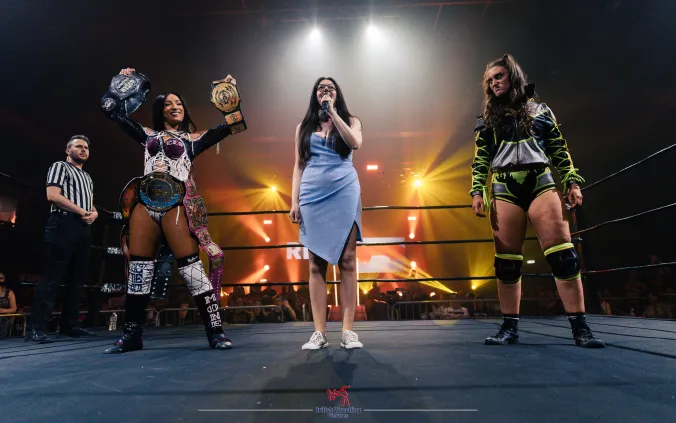

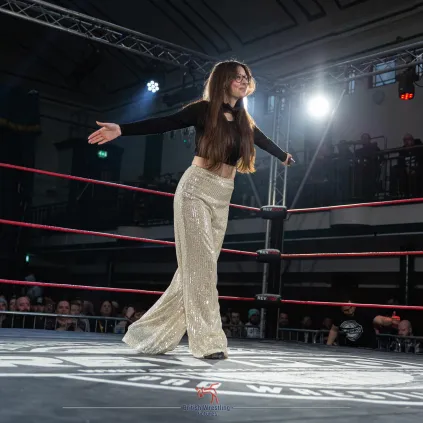
Francesca Oliver, with her distinct vocals, enthusiasm and range of colourful bow ties, is one of the British wrestling scene’s most prominent ring announcers. A staple of Revolution Pro Wrestling, RevPro since 2021 and regularly announced for a range of other UK-based promotions. James recently interviewed her about her career as a ring announcer.
For April and Neurodiversity and Autism Awareness Month, Francesca kindly agreed to discuss her experiences in life and wrestling with Autism and ADHD. Diagnosed with these two co-occurring lifelong neurodevelopmental conditions last year, colloquially/unofficially called AuDHD.
Francesca’s experiences represent one voice in the wider neurodivergent community who work in professional wrestling. Previously, James elaborated on the history of neurodiversity in wrestling and interviewed Australian wrestler Lili Edea about her experiences with autism.
Thank you, Francesca, for taking the time to conduct this interview.
You can follow Francesca Oliver on Instagram at: @this.is_francesca and X at: @fran3sca_mc
When Did You First Consider You Might Be Audhd?
I’ve always known that I was different. My life itself has been a series of events of being different or people using the Q-word (“quirky”). There was a wave around COVID, a lot of people self-diagnosing. I was very much “Well, yes, I identify with that, but everyone probably identifies with that in some kind of way.” But then other people suggest it to me.
So, I was like, I feel like I got these traits, I identify with people who say they have these different traits, but I am not going to diagnose myself until someone else does, and here we are.
AuDHD, Especially Amongst Girls, Can Be Overlooked and Go Undiagnosed Until Later Life. You Mentioned Being Called Quirky. How Did This Impact You Growing Up?
All my school reports, and how they treated me at the school, you [school/teachers] knew I was different, but you didn’t know why. I was in the top sets for a lot of things, but I was also very disruptive and very hard to manage. I had my own mind about me, which I still do now. But I am grateful because if I were in a different situation, they could have taken the root of more discipline and expulsion instead.
My head of year said, “If you don’t want to go to your lessons, come and sit in my lessons.” So, I did because it was a dopamine hit. This is out of the ordinary. I would get more detentions for history, and it was one of my favourite subjects, but I would go to more detentions than the actual history lessons. But I was happy to go to the detention.
Really weird! It’s slightly out of the norm. A bit of a dopamine thing. Now, with the diagnosis, I look back and go, that makes sense.
How Has a Diagnosis Helped You?
Now, post-diagnosis, I think it’s helped a lot. Now I have alternative ways of looking at things and understanding with motivation, or how I process things and react to things, instead of me thinking like “Why am I like this?”, I can go, “Well, I am like this way, what are the tools to help me with this?”
How Has Your AuDHD Impacted Your Wrestling Announcing? Are There Ways It Helps You and Ways It Hinders You?
The diagnosis itself has helped make me more aware of my faults, such as organisation. But also, the condition itself might help when there is chaos. You feel settled, but sometimes the tiniest thing can throw you off. Wrestling is very hectic, very last-minute and very chaotic. I guess it helps me thrive in that kind of situation.
And, people don’t know this, but I am very self-critical. It could be the tinniest thing, and no one else will notice it, but I will. I know I haven’t done it the right way. Yesterday, there was a pronunciation of a word that might have sounded fine; in my head, it sounded like something else.
There will be times I get told just as I’m heading to the ring, “Francesca, could you say this rather than that?” I say, “Yeah, no problem.” Then I go out, do my bit and then I’m like, “Damn it, I’m sorry. I forgot to say that”. Because it’s verbal instructions. I’ve now noticed with the diagnosis that if I write it down. In the short term, I can still picture what it is and engrain it into my brain if I write it down.
How Does It Impact Your Sensory Experiences of a Wrestling Event (i.e., Attention, Noise, Smell)?
Sensory-wise, I’m used to loud noises, but the heat, I’m very much someone, and the cold as well, to be fair- I’m very much someone who likes to be warm. I like to be cosy until you get to a certain level, and I’m like, I can’t cope. There have been times during shows when I have got to that point, and I’m too hot, or I’ve been in venues that have been absolutely freezing cold, where that can distract me.
ADHD and Autism Can Have Conflicting Traits That Can Create Contradictory Feelings and Behaviours. Does This Impact Your Role as an Announcer or Being Backstage?
The only thing I would say about the autism part that affects me is the social anxiety. It can be overwhelming sometimes. I love people. I love people wanting to talk to me. I love speaking to people, but sometimes the social anxiety gets in there – and I can only speak about how it feels on my behalf- but there are times where I can do things like this and chat forever.
There are times when this is the ADHD part, but then the autism part gets in, and I’ve forgotten every single word that has ever existed in humanity.
Then I struggle to form a conversation. So, when you are speaking to a lot of people, it can be overwhelming. Put me in front of 10,000 people with a microphone, and I am away. Put me in front of two people, and I can be quite socially awkward. There are times when people, I absolutely love and see all the time, but when I am focused on something, I will walk past them and not realise I said hello.
You Only Very Recently Announced Your Diagnosis. Has It Impacted Your Relationships With Other Folks in the Business?
I did put it out there at the New Year, just kind of slotting it in there. Nothing has changed since pre-diagnosis or post-diagnosis. Although quite a few of us are diagnosed, a few of us have spoken to each other on a personal level.
In that place, there is someone who got diagnosed a few weeks before me, and we didn’t even realise, so it was nice to check in and see the path they are taking and how they are getting on.
Is There Anything You Would Want Fans to Be Aware of or Understand Better About These Two Differences?
As far as AUDHD itself, it’s not each condition standing alone. It’s both of them simultaneously battling against each other like it’s a main event for the title. As one can be overpowering, then suddenly the other can sneak in for the pin.
I’d like people to understand that knowledge and understanding go a long way. Everyone judges others on how they personally view a situation, but if you’re neurotypical, then your brain might not comprehend how someone who is neurodivergent may act/react and vice versa.
Personally, having AuDHD is not an excuse for my behaviour. I always try to take accountability if I’m at fault, but it can help me, and others understand the path that led me there. For example, my biggest flaw is punctuality.
It was an issue in school, I’ve lost jobs over it, missed appointments, and my family and friends know not to expect me on time, but some throughout my life have taken it as laziness or disrespect. I’ll take that and profusely apologise. It’s a real internal struggle, one that I didn’t know till getting my diagnosis was heavily linked. I never intentionally intend to be late.
There is a huge combination of executive dysfunction and distractions. Even “just get ready earlier” doesn’t fix. Trust me, I’ve tried! But I’m learning new ways to deal with it and to try to overcome it. Living in a neurotypical world based on neurotypical standards can be exhausting, but with knowledge, understanding, and patience for all of us.
Neurodivergent or not, can make all our lives a little bit brighter. My mantra in life is no matter who you are, where you come from, whether you have any disabilities, whether rich or poor, whether you have faith or no faith, we are all humans first.