
The big question about AI and entertainment has come to the wrestling space. There is talk of content creation and artificial dream matches, but is there room for AI in professional wrestling creative roles?
This question is interesting to me; I am a writer, after all. There has been an enormous amount of discourse about AI in writing, and the consensus still is that good writers do not need AI. The argument is a bit reductive, though; no writers need AI.
You can write poorly or fantastically, and neither one requires any external intelligence. So, if you aren’t worried about your skill being questioned, all good writers know that will happen regardless; can AI actually help with the writer’s workload? Can AI actually control “the book”?
Positive Uses for an AI Booker
Booking a show isn’t just about a single feud or match. Whether televised or not, wrestling shows have stories.
AI could very quickly help you make a rundown of your card, and the more details you provide, the more nuanced it will become. So much so that it could theoretically create a script.
For large companies doing multiple televised productions, there isn’t a massive need for that. You can have people for relatively low pay do that for you and keep the human edge on your product.
Smaller promotions, such as those without a front office team, could use that support. There are tons of challenges in putting together a fitting show as a small company. From talent to logistics, promoters have a lot to do apart from booking.
There are other ways AI can help cash-strapped and understaffed promotions produce more of the “expected” materials fast. That means more time for other jobs to pay their bills and fund their passion.
An unpaid assistant is unethical, but an extra set of brains, artificial or not, is totally within the bounds of acceptable. Wrestlers have a lot more freedom to hit talking points that AI can make, which saves sole promoters a lot of time not writing for themselves.
Pitfalls of AI in Professional Wrestling Creative Roles
There are two equally common and seemingly valid pitfalls when using AI to supplement or outright take over creative roles like booking or promoting your show. The first is that the content is terrible, and the second is that it is stealing. Addressing the second issue, AI trains on existing content.
If the content already exists, then somebody has already done the work, and the AI is using it to learn or even parrot that work. A lot of artists call that out as stealing, and there is definitely a point to that.
The methods by which these works train an AI are probably not theft. That doesn’t change the fact that their work is now enriching other people and that they are not getting paid.
The other common refrain is that AI writing isn’t very good. It would be best if you didn’t use it for scripts or ads to book and promote your shows because it can’t do the job. Almost every comprehensive look at AI for writing indeed finds the prose to be lacking.
It is also true, though, that writers are always the ones testing them. Truthfully, AI does just fine for social media copy, summaries, and other top-level writing tasks.
The actual test is, can an AI book a storyline with story beats? Is that any good? Do you need to be a writer to write a wrestling feud?
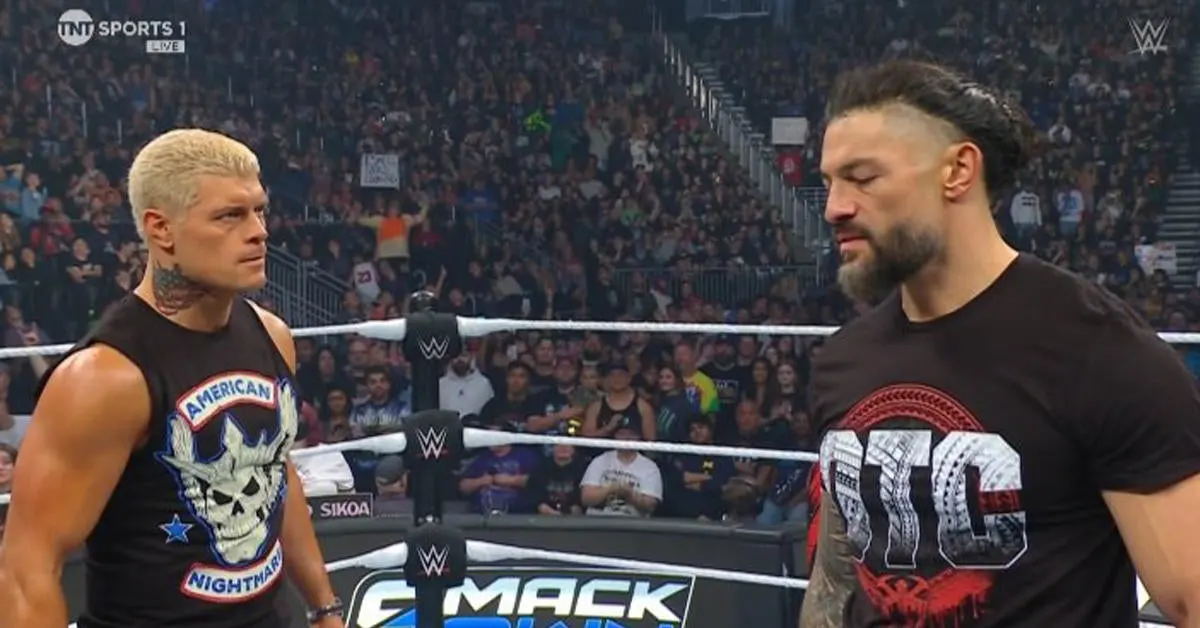
AI Books The Return of Cody Rhodes
In an attempt to test AI in professional wrestling creative against the human mind, I decided to run a few experiments. The prompts did not include any real wrestlers’ names and were told to create any necessary additional characters, and it did.
Both prompts and the AI’s booking are now up on my BlueSky account for more details. The summary and analysis will use the real wrestlers’ names.
When given the prompt information to book Cody Rhodes’s return and year-long run to WrestleMania 39, the AI was informed that Rhodes would need to be out for a third of the year, and it did that. Overall, the story, while simple, followed a lot of the same pivotal beats the real feud did.
Some of the omissions came from limited knowledge, using the same names over and over again. This is the chief criticism of the tool in this context: it can’t know what it doesn’t know.
Different:
Let’s start with what the AI changed. First and foremost, they had Rhodes win at WrestleMania 39. That is a fair ending to the story. In fact, WWE not doing it themselves took heavy criticism at the time.
The following year proved that to be untrue, but it makes sense that an AI would align with the consensus. The AI also did not separate Sami Zayn from the faction at WrestleMania. That is a dramatic change and one most fans would dislike as it removes the Montreal title match.
It also put Rhodes in direct opposition to Roman Reigns right away, and the injury took place in a match with Zayn. You can’t control an injury, but that was a notable choice. The last and most intriguing change was that Paul Heyman played a central role in the feud, far more than he did in reality.
Same:
A lot of the story stays the same, too, showing the potential of technology to enter space. It had Rhodes return to win the Royal Rumble. The prompt included his return in the same month as that match.
It did not stipulate that he needed to win or be involved in it. Also, from the description of “volatile nature” in reference to The Bloodline generally, it correctly pinned Sami Zayn as the first person to turn on Reigns (only to have him rejoin the group like Jimmy Uso did the following year.)
It also knew that Reigns would become a paranoid champion in the face of Rhodes’ challenge. That is a lot of what made the feud we saw so interesting.
AI Books Randy Orton vs. Cody Rhodes
In the same thread, a prompt was given to create the not-yet-received title match between Randy Orton and Cody Rhodes. It knew the two had a mentor-mentee relationship, focusing on that inherently.
Several story beats saw the veteran Orton question his former protegee’s fitness to lead. Kevin Owens didn’t have a role, even though his involvement is implied in the prompt. That may be due to the prompt’s limitations.
One takeaway is that AI always seems to re-establish who and why everyone is doing something. That could be helpful when writing a script or outline for other people.
Despite knowing that the original family was active and not allied with Sikoa’s new family, none of them got involved in the rivalry. Surprisingly, it featured Seth Rollins and a mid-card wrestler the AI created (let’s say it is LA Knight) instead.
AI did develop a cool three-way feud where both Rhodes and Orton served as Sikoa’s enemies. That is not too dissimilar to what we are seeing play out.
It was repetitive but wouldn’t be bad for a wrestling feud, in all honesty. Apart from one glaring inconsistency, it was Vince McMahon’s PG Era booking.
A Future for AI in Professional Wrestling Creative
Anyone who loves writing and pro-wrestling would rather disappear than cede “the book” to Siri or Grok or whomever. Not every promoter likes writing or wrestling, though. AI in professional wrestling creative imagines a world where a seemingly disinterested corporate entity purchases a promotion with a ton of lore, existing content, and a mind for maximizing profits through new deals and cutting costs.
That shouldn’t be all that hard. Could a company like that cut the creative team down to a few people and an AI that can spit out vague ideas and directions with some additional flavor into year-long stories? The answer is technically yes.
Sunday, 3/3#AEWRevolution
Greensboro, NCAEW Women's World Title
Timeless Toni Storm vs @DeonnaPurrazzoThe Virtuosa came to AEW chasing the World Title, calling out the real Toni Storm, not "the delusional sham"
It's official: they'll fight 1-on-1 for the Title at Revolution! pic.twitter.com/POI39D7Zqn— Tony Khan (@TonyKhan) February 2, 2024
However, I influenced the outputs of this experiment heavily. I provided character names and some important context so, without personal knowledge, a booker probably would struggle to get a solid output
Promotions that focus less on scripted promos and moments could see some success with AI. The use of an expansive roster of talent is beyond the capabilities of a machine. It needs passionate people to hold the threads together.
Still, that doesn’t mean that AI is no good for the booker as a tool. Spitting ideas off at an AI can help you clarify your story beats. It can even help you organize the best way to book your card.
For a small promoter, having a quick way to get a short rundown or script could be very helpful. The stories are full of repetition, but fans have seen plenty of that in wrestling. Hopefully, the creative roles will stay with creative people and will not be given to computers, not even the super-capable ones.
More From LWOS Pro Wrestling
Header photo – WWE – Stay tuned to the Last Word on Pro Wrestling for more on this and other stories from around the world of wrestling as they develop. You can always count on LWOPW to be on top of the major news in the wrestling world, as well as to provide you with analysis, previews, videos, interviews, and editorials on the wrestling world. You can check out an almost unlimited array of WWE content on the WWE Network and Peacock.