
The Oilers vs Ducks series has taken a decisive turn after Game 3. What opened as a tightly contested, but high-scoring matchup has shifted into something far more volatile, and far more favourable for Anaheim. With a 7–4 win on home ice, the Ducks now lead the series 2–1 and, more importantly, have taken control of how this series is being played. Meanwhile, Stanley Cup Playoff series typically trend toward tighter, lower-event hockey as they progress. However, this Oilers vs Ducks series has moved in the opposite direction, with each game becoming more open and more favourable to Anaheim’s strengths.
Oilers vs Ducks Series: Chaos, Special Teams, and Control
Through three games, the defining trend is no longer subtle. This series has moved away from structured playoff hockey and into a high-event environment driven by pace and chance trading. Game 1 required a late Oilers goal to secure a 4–3 win . However, Game 2 flipped the dynamic, with Anaheim opening things up in a 6–4 win powered by special teams.
Rotated to right, Anaheim Ducks Logo, Logo
Game 3 confirmed the shift. Anaheim dictated pace from the outset, finishing with a 39–24 shot advantage and seven goals. This is a series being defined by volume, pressure, and sustained offensive sequences. Furthermore, the rising shot volume is not incidental. Anaheim is consistently entering the zone with speed and forcing Edmonton’s defence to turn and defend under pressure. That sequence, repeated over and over, has created sustained offensive zone time rather than one-off chances.
Edmonton Oilers Offence Lacks Control
Edmonton’s offence has not disappeared. In fact, scoring four goals in back-to-back games typically signals a winning formula in the playoffs. However, in this Oilers vs Ducks series, offence alone has not translated into control.
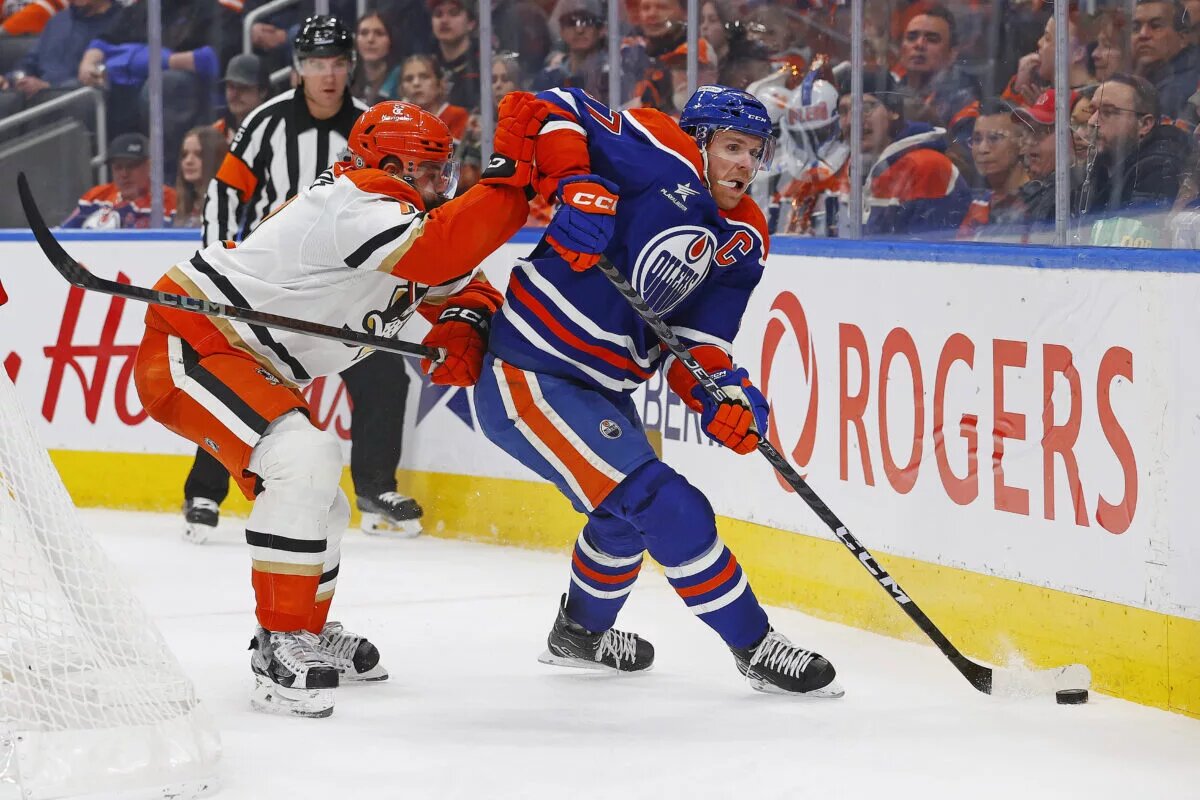
Instead, Edmonton has been pulled into a reactive game state. Defensive breakdowns have escalated each game, with three goals allowed in Game 1 rising to six in Game 2 and seven in Game 3. Even when Connor McDavid and Leon Draisaitl create offence, it has not slowed the pace or stabilized the game. The Oilers are trading chances, and that trade currently favours Anaheim.
Instead, Edmonton’s scoring has come within the same chaotic environment they are struggling to manage. Without territorial control or sustained possession, those goals have not shifted momentum in a meaningful way.
Edmonton goal!Scored by Vasily Podkolzin with 06:48 remaining in the 1st period.Anaheim: 0Edmonton: 1#EDMvsANA #FlyTogether #LetsGoOilers
— NHL Goals (@nhlgoals.bsky.social) 2026-04-25T02:51:01.815663Z
Anaheim Ducks are Dictating the Environment
Anaheim’s response after Game 1 has become the central storyline of the Oilers vs Ducks series. Instead of protecting leads or slowing the game down, the Ducks have leaned into speed and offensive pressure. That approach has produced 13 goals over the last two games and forced Edmonton into a style it has not controlled.
Furthermore, the offence is not concentrated. Leo Carlsson continues to drive play, while contributions from Alex Killorn, Beckett Sennecke, and the blueline underline a layered attack. Anaheim’s willingness to activate its defence has stretched Edmonton’s coverage. When the Ducks bring layers into the attack, it forces difficult decisions and has repeatedly opened space in high-danger areas. Jackson LaCombe has arguably been the Ducks’ MVP through the series so far – both shutting down McDavid and creating offence. Anaheim is generating repeated waves rather than isolated chances, which has prevented Edmonton from resetting its defensive structure.
Anaheim goal!Scored by Leo Carlsson with 16:25 remaining in the 3rd period.Assisted by Troy Terry.Anaheim: 5Edmonton: 3#EDMvsANA #FlyTogether #LetsGoOilers
— NHL Goals (@nhlgoals.bsky.social) 2026-04-25T04:31:40.011853Z
Special Teams as the Accelerator
Special teams have reinforced Anaheim’s edge throughout the series. In Game 2, the Ducks outscored the Oilers 3–0 in special teams situations, including a shorthanded goal. Those moments did more than influence the scoreboard. They accelerated the game into Anaheim’s preferred style.
Meanwhile, Edmonton’s power play has yet to impose itself consistently. In a series trending toward chaos, failing to capitalize on controlled situations only deepens the problem. Instead of resetting momentum, the Oilers have repeatedly fed into the pace Anaheim wants.
Moreover, special teams have become one of the few structured areas of the game, which makes Anaheim’s advantage there even more significant. When the Ducks win those moments, they effectively remove Edmonton’s opportunity to slow things down.
Game 3 as the Inflection Point
Game 3 was expected to be a swing game. Instead, it became a validation of Anaheim’s approach. The Ducks did not rely on a late bounce or a single moment. They controlled the flow, dictated the pace, and extended pressure over the full sixty minutes.
Even when Edmonton responded, Anaheim answered immediately. That inability for the Oilers to reset the game is the clearest sign that the series has shifted. What was once a back-and-forth contest is now being played on Anaheim’s terms.
As a result, Game 3 did not just shift the series. It clarified which team benefits from the current style of play, and which team has yet to adjust.
Looking Ahead to the Rest of the Series
The Oilers vs Ducks series is no longer about who can execute better within a structured playoff environment. It is about whether Edmonton can reclaim control of the game flow itself. If the Oilers cannot slow the pace, tighten defensive coverage, and regain ground on special teams, this trajectory will continue to favour Anaheim.
There is still time for Edmonton to adjust, particularly by tightening neutral zone structure and limiting rush opportunities. However, those corrections must come immediately.
Main photo: Perry Nelson-Imagn Images