
Sports. Honestly. Since 2011

How the Mariners offense suddenly became the worst in baseball.
April 9, 2026 By  Seattle Mariners, MLB, News

How the Mariners’ Offense Became the Worst in Baseball

Following a series sweep by the Texas Rangers, the Seattle Mariners have fallen to a league-worst record of 4–9. The Mariners have been perennial slow starters; even last year, when they won the American League West title, they began the season at 4–8. However, that was a much weaker roster than the one they have constructed for 2026. This year was supposed to be different. With World Series aspirations, this was a team looking to turn the corner and put past trends behind them as they establish themselves as a powerhouse in the AL. Instead, the last time they had a start this poor, back in 2011, they went on to lose 95 games that season.

A Familiar Story in Seattle

An all-too-familiar sight for Mariners fans is the lack of production from one side of the team that continues to hold them back. The Mariners have once again put out an elite rotation, even with one of the league’s worst defenses behind them. They rank second only to the New York Yankees in xERA, FIP, and WAR. George Kirby already has a complete-game loss under his belt, while Bryan Woo, Emerson Hancock, and Logan Gilbert all rank among the top 10 in xwOBA. They are second in WHIP behind the Atlanta Braves and lead the league in K-BB%.
In fact, this is the best ERA through 13 games in franchise history at 2.62. Echoing the 2010’s with Felix Hernández, or even as recently as 2023 and 2024, offensive ineptitude is once again undermining the Seattle Mariners.

A Historic Offensive Collapse

Currently, this Mariners offense is putting up historically poor numbers in almost every category. They rank last in batting average, slugging percentage, OPS, wOBA, and hard-hit rate, while sitting near the bottom of the league in most other offensive metrics. Through 13 games, their AVG, OPS, and runs scored are the worst in franchise history. Simply put, this is not only the worst offense so far in 2026, but one of the worst in team history.

However, the deeper numbers point to a more fundamental issue: contact. The Mariners rank last in zone contact and near the bottom of the league in swinging strike rate, indicating they are consistently getting beaten on pitches in the strike zone. This is not simply a team chasing or expanding the zone. The Mariners are missing hittable pitches, particularly those over the plate, which points to issues with timing and execution rather than approach.

Even when contact is made, the results have been equally concerning. The Mariners rank near the bottom of the league in squared-up contact and soft contact rates, while also leading the league in infield fly balls. Last year, they ranked seventh in hard-hit rate, but they now sit in the bottom five in 2026. The drop in bat speed compared to 2025 has only compounded these issues. Taken together, these numbers show a lineup that is not only missing pitches in the zone but also failing to generate meaningful contact when they do connect.

Impact on the Lineup

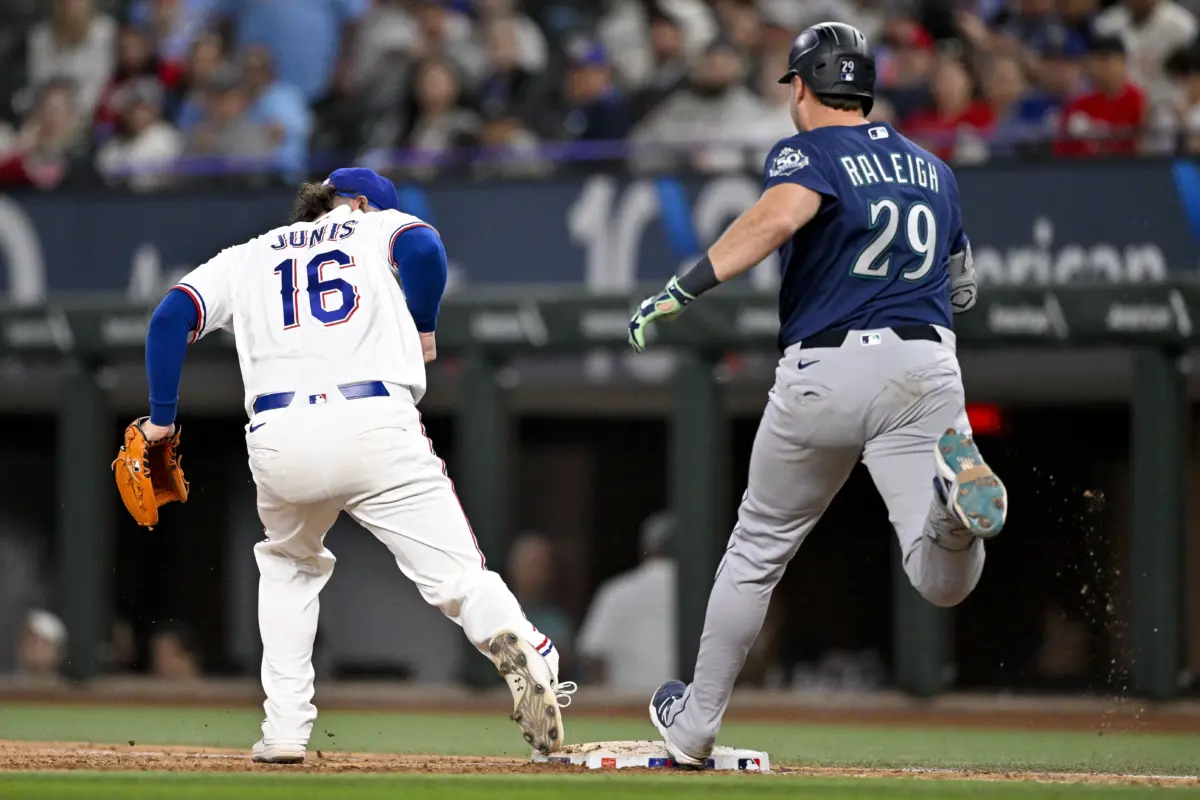
The effects of these issues are evident throughout the lineup. Most importantly, however, the stars, like the runner-up to MVP, in the middle of the order, are struggling. Cal Raleigh, Julio Rodríguez, and Josh Naylor all have OPS figures below .500. While Naylor has been statistically one of the biggest underperformers in the league, even if he matches his expected data, he would still project as roughly league average.

More concerning is that Brendan Donovan, who has been carrying the offense, is one of the biggest overperformers relative to his expected data, outperforming his slugging percentage by nearly 300 points. Any kind of offensive regression from him, and it’s hard to imagine how badly the Mariners offense will perform if they continue at this current rate.

Where This Leaves the Mariners

Taken together, these numbers point to a broader issue than a typical cold stretch. The Mariners are struggling at every stage of the hitting process: they are missing pitches in the zone, swinging through hittable offerings, and failing to square the ball up if they do make contact.
There is no simple answer to this kind of lack of production. The Mariners will have to play their way through it and hope that a few bats can generate enough offense to win close games. So far, six of their nine losses have been by one run; if they can flip those outcomes, they may begin to build some momentum.
Fortunately, or perhaps unfortunately, they have the opportunity to right the ship almost every day. The only way for the Mariners to get out of this offensive slump is to play through it and begin making consistent, quality contact in the zone sooner rather than later.
Main Photo Credit: Jerome Miron-Imagn Images

About Jack Martin

Jack Martin is a contributing baseball writer for LWOS, specializing in Seattle Mariners coverage and international baseball analysis. Based in South Korea, he brings a globally informed, data-driven perspective shaped by his experience studying player development across MLB, NPB, and the KBO. He holds a Master’s degree from the University of Sussex, where he developed a strong foundation in research and analytical writing.

Stay in the Game

Get the latest sports news and analysis delivered to your inbox.

Share This Article