
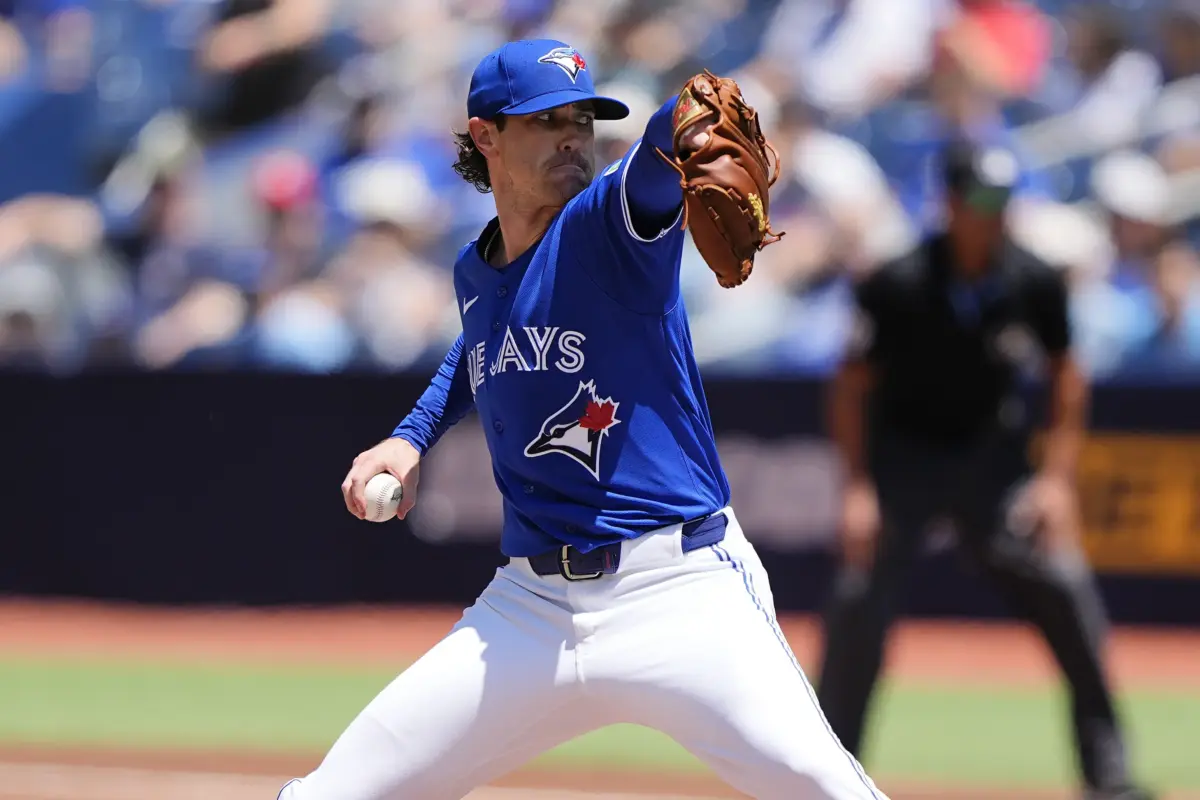

Shane Bieber’s struggles are the latest storyline to hinder the Blue Jays’ rotation. Cody Ponce’s early exit from the rotation, Dylan Cease‘s Cy Young-caliber season, and questions surrounding who will solidify the back end of the rotation have made Toronto’s pitching staff a constant source of intrigue. The Toronto Blue Jays’ rotation has been an endless supply of positive moments and mostly negative developments.
Much like Toronto’s rotation this season, Bieber’s last five years have had their ups and downs. A Cy Young Award in 2020 made him one of the game’s most valuable arms. Then, in 2024, he heard the two words no pitcher ever wants to hear: “Tommy John.” Upon signing with the Blue Jays at the trade deadline last year, Bieber returned as one would hope, striking out nine over six strong innings and allowing just one run on two hits against the Miami Marlins. This set the tone for what would eventually be a solid 2025 postseason, in which he posted a 2-1 record and a 3.86 ERA in five appearances.
What Is Behind Shane Bieber’s Struggles?

Only three days after Toronto dropped Game 7 of the World Series to the Los Angeles Dodgers, he exercised his $16 million player option. However, despite ending the season on a positive note, it was announced that Bieber would start the season on the injured list due to right elbow inflammation.
Since his return from the injured list, the 31-year-old veteran has a 0-1 record, a 9.00 ERA, and a WHIP over 2, raising concerns about his stock heading into the offseason.
With what could be the most important stretch of his career, the coming months will be crucial for Bieber as he approaches free agency. So, what does he need to fix as his recent struggles reshape his free-agent outlook?
Location, Location, Location
Bieber was never a guy who blew batters away with velocity, with an average fastball velocity that sits in the low 90s, but he has and always will be someone who relies on pitch location as his biggest asset. Two things have been clear across his first three starts — his ability to locate in the strike zone is down, and when the ball is in the strike zone, it is getting hit hard.
According to Statcast, opponents have registered a 54.2% hard-hit rate against Bieber, meaning more than half of the balls put in play against him have been struck with an exit velocity of at least 95 mph. Coupled with an in-zone rate of just 42.2%, which indicates he is throwing outside the strike zone more often than inside it, the numbers suggest that Bieber is not only struggling to generate strikes consistently, but when he does work in the zone, opponents are making hard contact.
Bieber’s struggles to locate in the zone have only been amplified by his inability to generate weak contact, and with him having allowed six home runs in his last three starts, including three in a row against Houston in his first start back, he will either have to locate more effectively or generate more chase on pitches out of the zone.
Bieber’s Battle to Set the Tone
Through his first three starts, Bieber has a first-strike percentage of 51.6% — below league average. While the sample size remains small, the command issues are not just showing up in the quality of contact from opposing hitters but also in his ability to consistently get ahead of hitters.
Hitters have a .455 batting average against his curveball, which has always been one of his biggest weapons. When he isn’t able to get ahead in counts, he can’t manipulate his breaking pitches when hitters are trying to protect the plate. His inability to get into pitchers’ counts is neutralizing his biggest asset: his knuckle curve.
Again, the sample size is small, and many variables come into play. However, the underlying numbers tell a similar story. With an Expected Weighted On-Base Average (xwOBA) of .502, the thesis remains much the same — hitters are putting the ball in play and putting the ball in play hard — and part of the reason is Bieber is digging himself into a hole too early in the count.
Shane Bieber’s Struggles Leave Questions Ahead of Free Agency
For many, it came as a shock that Bieber didn’t test free agency given how well he pitched during the latter part of the 2025 season. While his market value had already taken a hit after spending significant time on the injured list, his first three starts this season have only created more uncertainty.
Can he consistently command the strike zone? Can his breaking ball once again generate swings and misses? Can he limit hard contact without relying on elite velocity? Those are the questions front offices will be trying to answer as they evaluate whether Bieber can return to the form that once made him one of baseball’s premier starters.
The good news for Bieber is that there is still time to answer those questions. However, with every start, the margin for error continues to shrink, making each outing increasingly important as he enters what could be the most significant stretch of his career.
John E. Sokolowski-Imagn Images