
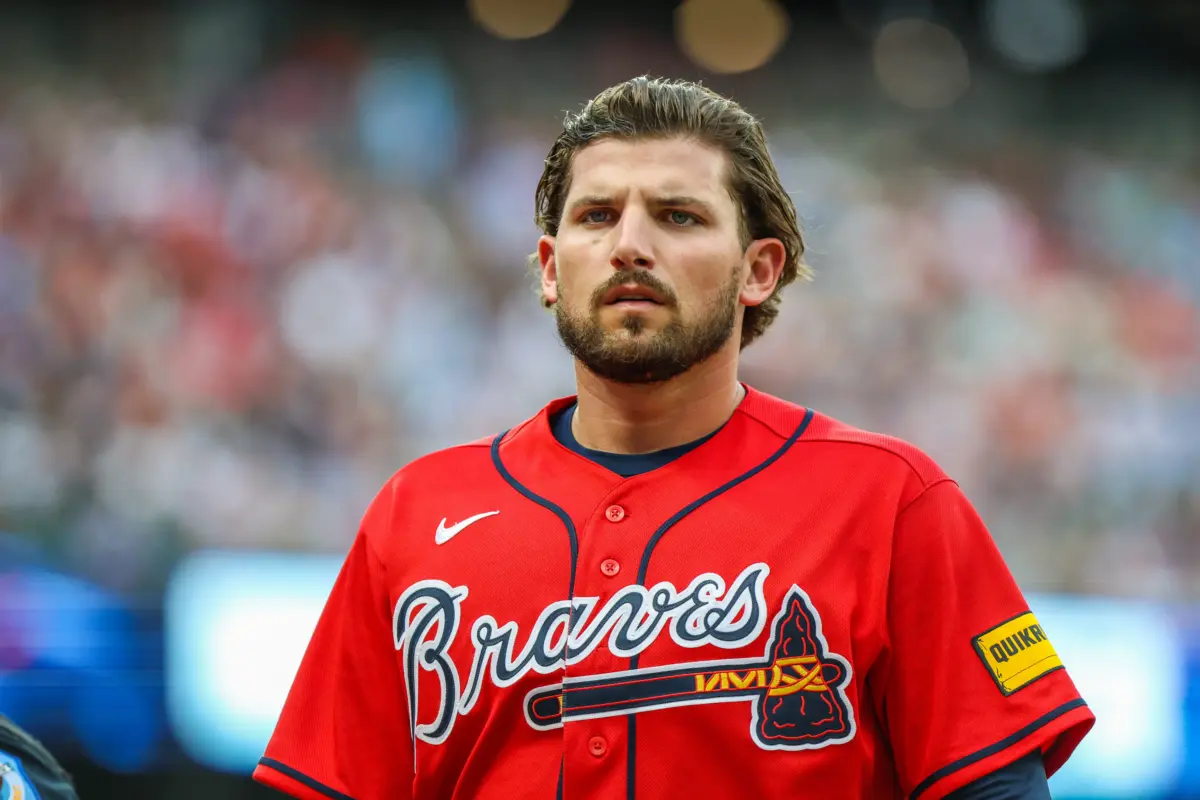

For years, Austin Riley has been one of the Braves’ hitters who could make a cold week feel temporary. Sure, he might chase stuff off the plate, swing through pitches, have stretches where the strikeouts piled up, and the at-bats got messy. Then the payoff would arrive: a screaming line drive into the gap, a game-tying homer that left the yard in a hurry, or a two-week heater that made such a slump feel like old news.
That version of Riley has not vanished, but the 2026 version has been much harder to trust.
Austin Riley’s Struggles Are Hard to Ignore for Braves
Through his first 308 plate appearances, Riley is slashing just .211/.289/.349 with a .638 OPS, eight home runs, a .138 ISO, and a 78 wRC+. For a glove-first utility infielder, that kind of line would be manageable. For Riley, it is a real problem. The underlying numbers do not point to a star simply waiting for better luck. They show a hitter missing more often, making less dangerous contact, and giving Atlanta far less middle-of-the-order force than expected.
The Strikeouts Are the Loudest Alarm
Riley has always been a swing-and-miss hitter; it’s simply who he is. The Braves have accepted it for years because when he’s at his best, the value he provides makes that trade-off worthwhile. A few ugly strikeouts are easier to stomach when they come with 35-homer power, a strong slugging percentage, and the ability to flip a game with one swing.
That bargain looks a lot worse when the strikeouts remain, but the potency disappears.
Riley’s strikeout rate now sits at 28.9%, up from 24.1% in 2023 and 25.2% in 2024. It has also edged past last year’s already concerning 28.6% mark, which makes this feel less like a little slump and more like a notable trend that the Braves need to take very seriously, and potentially, sound the alarm bells. Four or five extra percentage points over a full season means a lot of additional plate appearances ending with a ball sitting in the opposing catcher’s mitt.
For Riley, that matters because he is not making up for the extra whiffs with louder contact. The power is still in there, but the consistent damage is nowhere to be found.
The Contact Quality Has Slipped
Baseball Savant still credits Riley with a 91.0 mph average exit velocity, so this is not a case of the Braves All-Star third baseman losing all thump. He can still hit the ball hard. By comparison, Riley averaged exit velocities of 93.3 mph in 2024 and 92.3 mph in 2025. The issue is that his contact has dropped, even by his own lofty standards. His hard-hit rate has fallen to 44.7%, down from 53.4% in 2024 and 50.2% in 2025.
Those are meaningful declines. Riley does not need to lead baseball in every batted-ball category to be productive, but his offensive value has always depended on impact. When the hard-hit rate dips and the strikeouts stay high, the whole profile starts to wobble.
Roll Out the Barrel
The barrel rate is even more concerning. Riley’s barrel rate is down to 10.1% after sitting at 15.0% in 2024 and 15.2% in 2025, which is a major backpedal for one of the pillars of the Braves’ organization. Barrels have long been the foundation of his offensive value. When Riley is rolling, he is not just putting balls in play. He is punishing them and sending them all over the field.
This year, his launch angle is up at 19.5 degrees, but the contact has not carried the same threat. His sweet-spot rate has dropped to 30.9%, well below last year’s 37.0% mark. More balls are going airborne, but fewer of them are being squared up with the kind of authority that turns Riley into a middle-order menace.
The BABIP Offers Only So Much Cover
Riley’s .278 BABIP does suggest some bad luck. His career BABIP is .322, so there is a fair argument that a few more balls should have found grass. A couple of grounders sneak through, a few liners avoid gloves, and the batting average starts to look less grim.
Still, BABIP does not explain everything. Riley’s expected numbers are a little better than his actual production, but they do not turn this into a hidden star season. His .209 expected batting average, .382 expected slugging percentage, and .297 xwOBA show some underperformance, not a massive correction waiting to happen.
So, yes, Riley has probably been unlucky at times. He has also created plenty of his own trouble. The baseball has not always bounced his way, but he has not hit enough balls with the force and precision needed to drag his numbers back toward his usual level.
That lines up with how many of his at-bats have looked. Too many feel labored. Too many counts tilt in the pitcher’s favor. Too many hittable pitches get fouled off, missed, or put in play without the usual Riley violence. He does not look helpless. He does not look as dangerous as he once did.
The Defense Is Still Holding Up
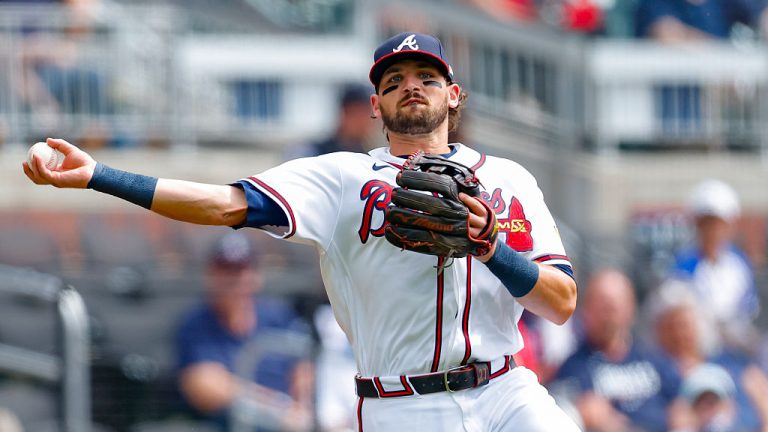
The best news is that Riley has not dragged his offensive struggles into the field. Third base is a demanding spot, and he continues to give Atlanta steady work there. FanGraphs has him at 0.0 WAR overall, which shows how much the bat has dragged down the total package, but his glove has not become the issue. The arm is still an asset. The reactions are still solid. He still makes enough plays at the hot corner to keep his defensive value from collapsing along with the bat.
That matters. A slumping slugger who also becomes a problem defensively can create a major roster headache, but thankfully, Riley has avoided that. Even with the bat lagging, the Braves can still count on him to handle third base at a reliable level – though he definitely shouldn’t be counted among the shoo-ins for the Braves at the 2026 All-Star game.
That solid defense does not erase the offensive concerns, though, far from it. Riley is not in the lineup to make routine plays and chip in the occasional extra-base hit. He is supposed to be one of the hitters that opponents fear facing, which is certainly not the case in 2026, unlike his teammates Matt Olson, whose Iron Man streak continues unabated, and Dominic Smith, a journeyman infielder who has turned his career around in Atlanta.
Can Riley Still Fix This?
There are still reasons to believe Riley can snap out of this. He is still only 29, and he has good bat speed, with Baseball Savant putting him at 75.6 mph, and he still hits the ball hard enough to suggest that the power has not disappeared. His track record is long enough that a rebound would not surprise anyone.
But the Braves should not shrug this off. A 28.9% strikeout rate paired with a sharply reduced barrel rate is a bad mix. The lower slugging percentage is tied directly to what is happening in the box. This is not just a cold batting average or a few weeks of loud outs.
The fix is easy to describe and difficult to execute. Riley needs to get back to punishing the pitches he should punish. He does not need to reinvent himself as a high-contact hitter. He does not need to trade away his power for a few extra singles. He needs to find the zone where he has lived at his best: enough contact to stay alive, enough selectivity to avoid helping pitchers, and enough pop to make opposing mistakes hurt.
The Braves are talented enough to survive a lot during the regular season. They have proven that repeatedly. October is less forgiving. Good pitching finds soft spots, and right now Riley’s bat is one of the obvious pressure points in Atlanta’s lineup.
That means his season has become one of the Braves’ most important problems to solve before the playoffs roll around. And for a team built around championship expectations, the gap between Riley’s reputation and his current production is getting harder to ignore.
Main Photo Credits: Jordan Godfree-Imagn Images