
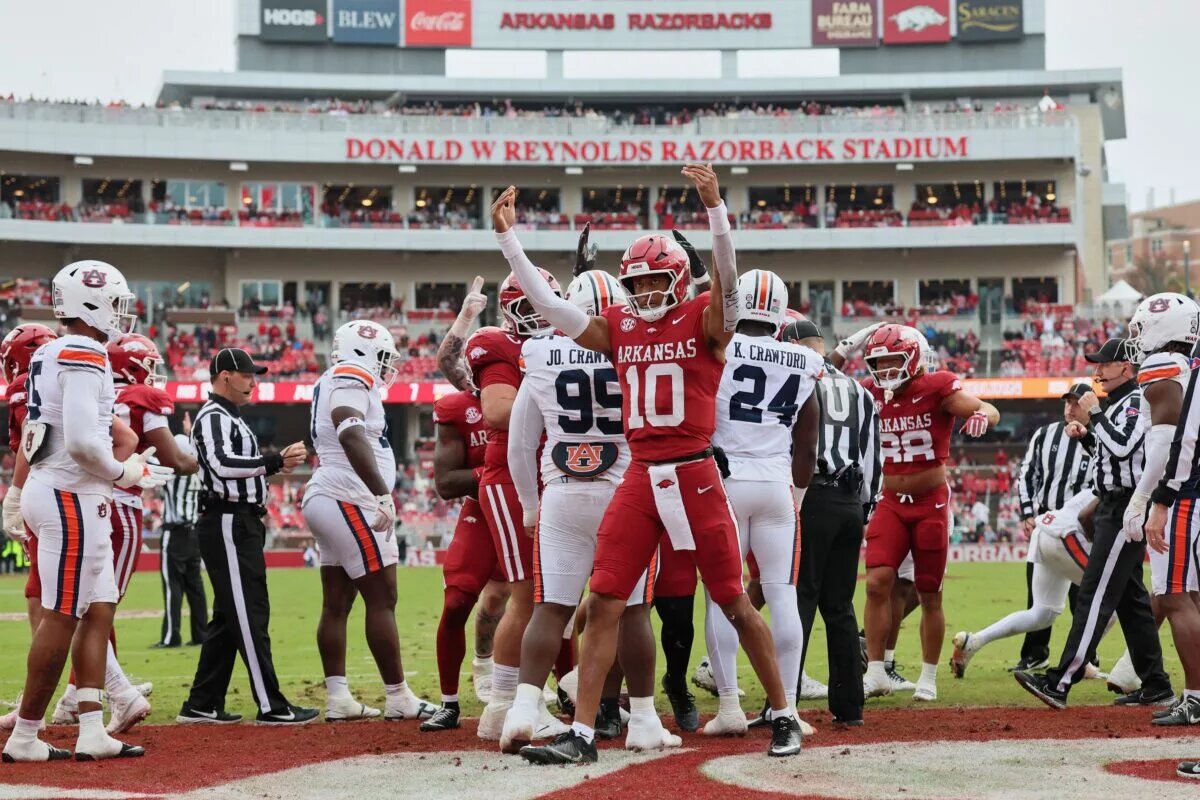
Are the Razorbacks for sale? The conversation Arkansas fans never thought they would have is now unavoidable. If you are going to sell the naming rights to your football stadium, can you at least win the deal? The days when “Donald W. Reynolds Razorback Stadium” felt untouchable are over. The long-naming agreement has expired, the foundation behind it has shut down, and the sign on the hill is no longer sacred. What happens next will say a lot about whether Arkansas plans to chase the SEC’s elite or simply survive in their shadow.
Razorbacks For Sale? The Real Game Behind The Stadium Name
The End of the Reynolds Era
The building on Razorback Road has never really stood still. It opened in the late 1930s under a different name, evolved into Razorback Stadium, and eventually added Donald W. Reynolds to the marquee after a major expansion that reshaped game day in Fayetteville. Each shift in lettering came with the same trade: money for growth, sentiment for naming rights.
The Reynolds era felt different because it tied a modern, expanded stadium to a foundation with Arkansas roots and a civic story that fans could live with. That deal ran its course. The foundation dissolved. The check that once justified the name is no longer there. Now, Arkansas is staring at a new marketplace, one where the next name will almost certainly belong to a corporation, not a benefactor with a legacy plaque. The romance is gone. The math is not.
Why Naming Rights Matter More Than Ever
You can scoff at corporate stadium names, but in this version of college football, naming rights are not a vanity play. They are one of the last clean revenue levers a school can pull without squeezing fans even harder. Ticket prices are already high. Seat donations are built into the cost of belonging. Media money is flowing into budgets that now have to anticipate lawsuits, settlements, and the looming reality of revenue sharing with players.
A serious naming rights package is not just a sponsorship; it is a hedge. That money can keep coordinator salaries competitive as SEC rivals circle. It can cover the next round of facility upgrades that recruits expect as standard, not as a luxury. It can underwrite the infrastructure around NIL: staffers who manage deals, content teams that build player brands, and the back-office work that keeps a roster from drifting into the portal.
In a nine-game SEC world, those are not abstract needs. They become third downs, November depth, and whether a coach has enough bullets left to survive a bad month. You either find every dollar you can, or you watch someone else’s logo celebrate in your stadium.
Can Arkansas’ Brand Command Big Money
Here is the blunt truth that hangs over the whole conversation. Arkansas is a proud brand with a statewide grip and a deeper history than the last decade shows, but it is not Alabama, Texas, Georgia, or Ohio State. That matters when you start asking corporate America to pay top-tier money just to see its name on the broadcast chyron every Saturday.
Companies are not paying for memories of Lou Holtz, Ken Hatfield, or Houston Nutt. They are paying for impressions, reach, and the halo effect of association. Arkansas can offer the SEC shield, a loyal fan base that fills the stands when there is hope and still shows up when there is frustration, and the status of being the one program that truly represents an entire state. What it cannot honestly promise yet is annual playoff contention or a guaranteed spot in the national title conversation.
That gap shapes the market. The Razorbacks will be selling a passionate niche on a massive stage rather than a blue blood with automatic national relevance. The right company will see that as an opportunity. The wrong one will use it as an excuse to lowball. That is the tightrope the athletic department is walking every time a new potential partner picks up the phone.
The Tradition vs. Survival Tightrope
The emotional cost of this move is real. The Reynolds name carried weight because it came with obvious investment, not because it sounded slick in a commercial. Swapping that for a telecom, bank, or energy brand will feel transactional in a way that the old arrangement did not. For a fan who grew up walking into “Razorback Stadium” or “Reynolds,” seeing a corporate logo bolted to the façade will hit like a reminder that nothing in college sports is sacred anymore.
But that is the point: nothing in college sports is sacred anymore. Conferences are flirting with title sponsors. Jersey patches and full-field logos are already trickling into the game. Private money and private equity are circling. Arkansas can plant its flag on principle, refuse to play, and watch richer programs widen the gap. Or it can play the game, try to tilt it, and accept that part of surviving in 2026 means swallowing whatever is printed on the outside of the stadium as long as the team inside is better for it.
What “Winning” the Deal Would Actually Mean
So, can Arkansas really win the stadium-naming rights game? That depends on how you define winning. If winning means signing a single contract that lets the Razorbacks suddenly outspend the heavyweights at the top of the league, then no, that is a fantasy. One branding deal will not flip the SEC’s financial order.
If winning means turning an unavoidable sale into targeted fuel, the answer can be yes. That requires a few non-negotiables. The school has to hold firm on a meaningful annual number instead of grabbing a bargain deal just to get a logo on the wall. It has to choose a partner whose name makes sense in Arkansas, not a company that brings baggage and turns every home game into a punchline. It has to make clear, even if the exact figures stay private, that this money is tied to football’s competitive engine: staff, facilities, player support, and the ecosystem that keeps talent in Fayetteville.
If fans can connect the dots between a new, awkward corporate name and visible improvements on the field and around the program, they will complain, then adapt, then go right back to calling it Razorback Stadium in conversation. If the money disappears into the ether and nothing changes except the sign, the backlash will be deserved.
In the end, this is not just a story about what is painted above the gates. It is a test of whether Arkansas is willing to act like a modern SEC program, even when it offends old instincts. The name may change once, twice, or three more times over the next few decades. The standard should not. If you are going to sell the front door to your house, the least you can do is make sure the money buys your team a better chance to win inside it.
Main Photo: Nelson Chenault-Imagn Images