

While nothing has compared to the buddy-cop blockbuster moves so far this offseason, the Houston Rockets have been busier than some expected. What was known well in advance was that they would have to do something about restricted free agent Tari Eason. Well, now they have, but the Rockets’ Eason deal isn’t the only way the team is showing faith in the young forward. Will the Rockets’ cutting defensive forward depth hurt their chances down the line?
Will Rockets’ Eason Deal Be Enough To Make Up For Losses?
The Rockets have agreed to sign Eason to a 5-year, $81.5 million contract. His salary will start at $14 million next year and rise to $18.5 million by 2030-31, with a player option. If Eason can stay healthy, it should be a great value contract for Houston. If he can improve at all, then it could wind up being an absolute steal.
The Rockets’ Eason deal looks so favorable for Houston, given his struggles in 2025-26. The six-foot-eight wrecking ball forward shot just 41.6% from the field. Perhaps of most concern, his three-point percentage plummeted over the second half of the year. He went from 47.2% from three over his first 30 games to 22.0% over his last 30.
Eason couldn’t find any consistency in his playoff production either. While he averaged 13.8 points on 47.7% from the field, game-to-game, he was all over the place. He had a 7-of-7 game and a 4-of-14 game in the same series.
The good news for Houston is that part of Eason’s inconsistency can credibly be attributed to contract-related anxiety. Eason set out to run a prove-it campaign in 2025-26, and at times it backfired on the court. His shot selection felt forced, like he’d heard one too many Kawhi Leonard comparisons. His within-5-feet field-goal attempts fell from 4.7 per game in 2024-25 to 3.3 per game in 2025-26. Meanwhile, trying to create more of his own shots from midrange last season, his percentage from 8-16 feet was an atrocious 26.5% on 1.1 attempts per game. The year before, he shot 41.9% on the same volume.
With his contract situation now settled, Eason can hopefully go back to contributing within the flow of the offense. Of course, it would help if the flow of Houston’s offense improved from last season’s dysfunctional quagmire. But a less jittery Eason might even help nudge that transition along.
Rockets’ Eason Deal Heralds Slashing Forward Depth
A shiny new contract isn’t the only way the Rockets have shown renewed faith in Eason. They’ve also gutted their forward depth so far this offseason. Dorian Finney-Smith‘s swing-and-a-miss contract was jettisoned from the team for the price of three second-round picks. Josh Okogie, who performed well on a minimum contract last season, was scooped up in free agency by the Utah Jazz.
At six-foot-seven, Finney-Smith played 37 games at 16.8 minutes per game last season. Explaining the desire to dump his salary, he averaged just 3.3 points and 2.5 rebounds on 33.3% from the field and 27.0% from three. But that’s still 620 total minutes of size and defense at the forward position that the Rockets will have to replace.
At six-foot-four, Okogie played 78 games at 17.4 minutes per game. He managed 4.5 points and 2.6 rebounds on a much more efficient 42.5% from the field and 38.5% from three. 1.7 of his 2.1 shots per game were three-pointers. While listed at shooting guard, Okogie has always played more like a “3-and-lower-case-D” forward. His new contract will be $12 million over two years, so it’s not as if the Rockets had a realistic chance of keeping him. Nonetheless, it’s another 1354 such minutes the Rockets will have to find bodies for.
Eason could be one of the principal beneficiaries. Eason played just 25.8 minutes per game last season. That was a career-high for him, but still short of starter minutes.
The Rockets’ Defensive Wing Depth
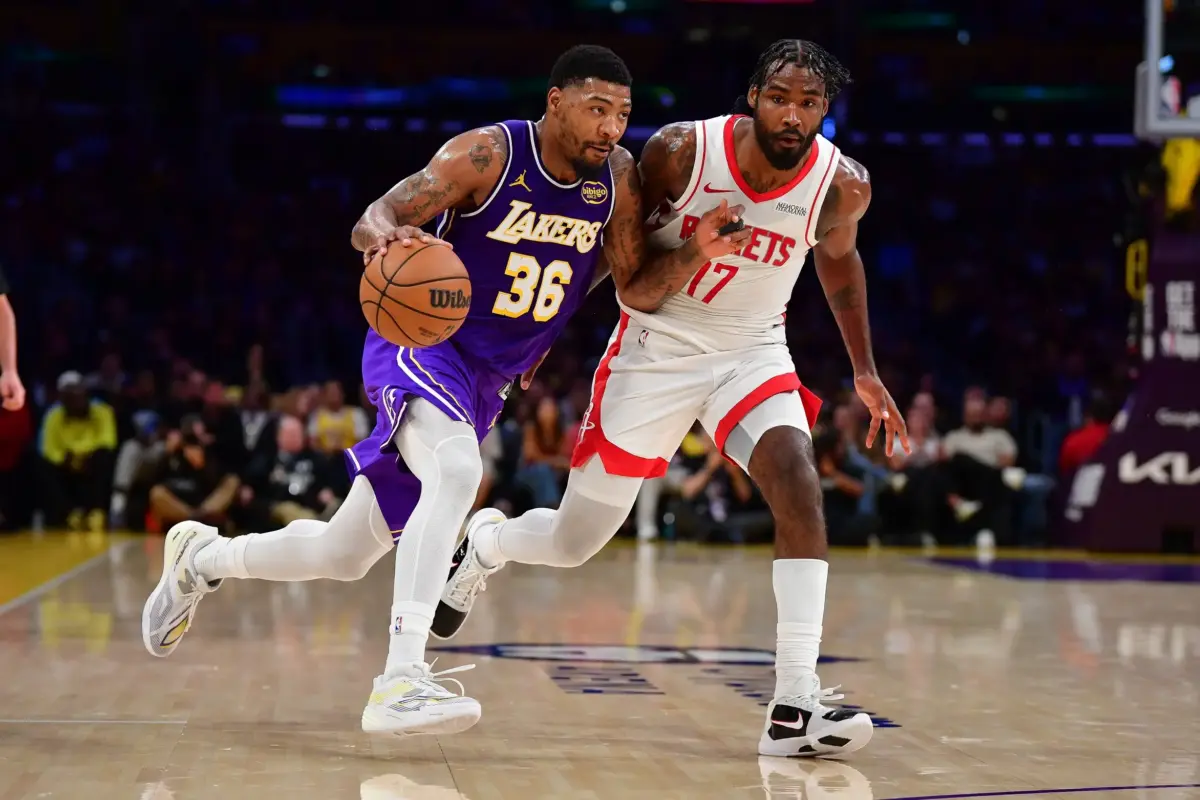
But even with the Rockets’ Eason deal and the loss of other forwards, a minutes increase still isn’t guaranteed. The Rockets are expected to have starting point guard Fred VanVleet back next season. Admittedly, the VanVleet ACL recovery timeline may stretch into the season proper. Even so, the Rockets will also be finding room in the rotation for former Los Angeles Laker free agency acquisition, Marcus Smart. The benefits of Smart to the Rockets are potentially manifold.
For one thing, Smart’s ability to match up with larger players helps compensate for losses on the wing. In fact, Smart would prefer to guard bigger players than twitchy guards at this point in his career. However, even if Smart himself stays at guard, that would bump up 2025 First Team All-Defense trampoline-man Amen Thompson.
Defending the Second Option
Thompson will continue to be the Rockets’ primary defensive boogeyman for opposing scorers of all shapes and sizes. The question is what the Rockets will do about second-option scoring forwards, or in the minutes when Thompson sits. At 32 years old, the six-foot-three Smart is a far better disruptor than a one-on-one defender.
At forward, the Rockets also have Kevin Durant and Jabari Smith Jr. But at six-foot-eleven, neither of those players wants to be chasing around opposing wings. Heavily relying on Eason is the most obvious solution. That’s what the Rockets’ Eason deal implies they intend to do. But is that strategy going to hurt them down the line?
The Rockets just had a season totally derailed by injury. In making themselves too reliant on Eason, they may be setting themselves up for another. Eason only managed to play 60 games last season and a combined 79 over the two seasons before that. The track record of frequent lower-leg injuries is especially concerning.
The Rockets went from overloading on defensive wings last season to potentially leaving themselves vulnerable on that front for 2026-27. The Rockets’ Eason deal looks like a steal right now. We’ll have to see if it still feels that way one grueling regular season later.
© Gary A. Vasquez-Imagn Images