
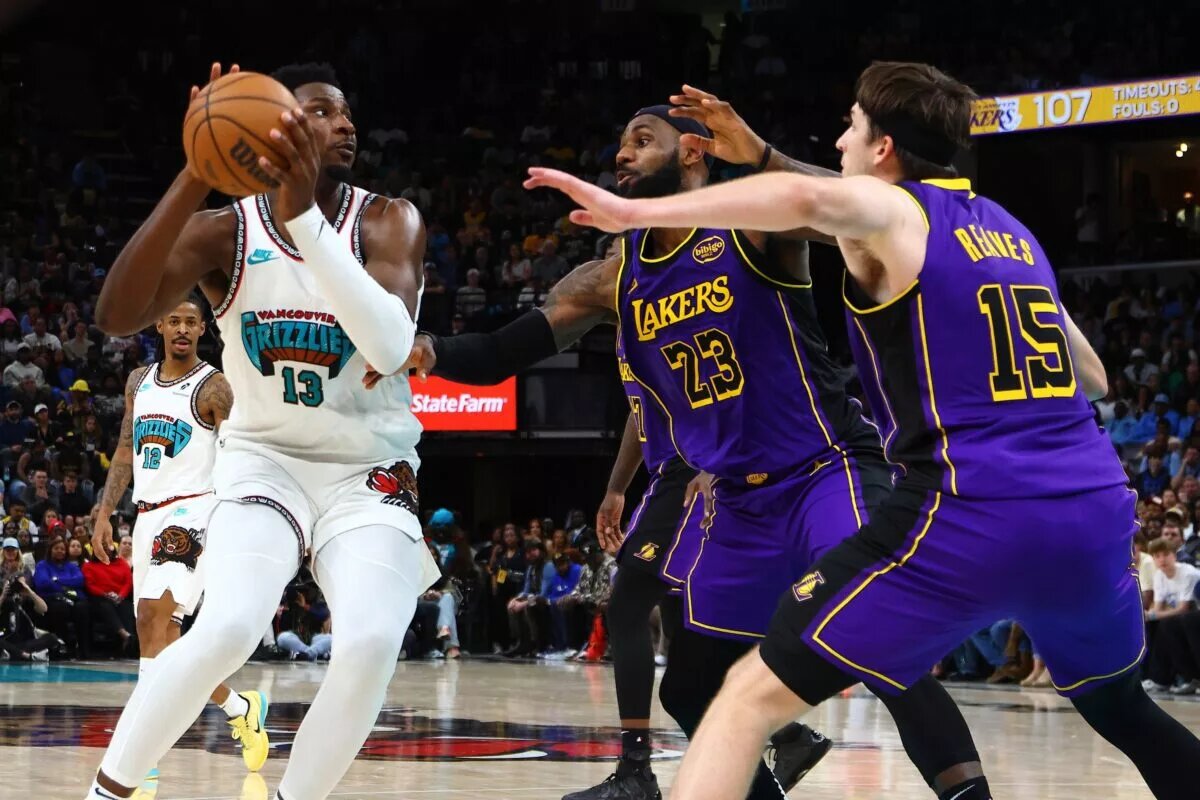
Among JJ Redick’s many experiments and innovations this season is his preference toward a small-ball lineup—a concept he’s had to turn to sporadically but one he’s relied on as of late. In their most recent episode of the “Mind the Game” podcast, LeBron James and Steve Nash broke down the differences between the Lakers’ primary lineup that includes Jaxson Hayes versus their small-ball unit without a traditional center.
LeBron, Steve Nash Have High Praise for Lakers ‘Death Lineup’
James Gives Hayes his Flowers
Before discussing the Lakers’ smaller lineup, James first tipped his cap to Hayes, who became LA’s starting center with the departure of Anthony Davis. In 24 games since the team traded AD, Hayes has averaged 8.9 points, 5.5 rebounds and one block on 77% shooting from the field.
“Him stepping into that void, losing AD, it’s a lot. A lot of scoring, a lot of protection defensively, a lot of rebounding, a lot of blocked shots. But I think Jaxson was like, ‘I can’t make up for that,’ and we didn’t ask him to make up for that. We needed Jaxson to be high-energy, be a force on offense, run [with] the bigs, great screening, lob threat. But he’s just made great decisions. … Jaxson has been unbelievable in his minutes, and we’re gonna need that from him. We know how it unlocks Luka as well when it comes to pick-and-roll with a lob threat. So having those minutes with Jaxson is key.”
James also noted that, with Davis gone, it has forced the rest of the Lakers to step up defensively, which has led to a focus on their center-less lineups.
LeBron on Lakers Going Small
The Lakers’ “position-less lineup” boasts LeBron and Luka Doncic next to Austin Reaves, Dorian Finney-Smith and Rui Hachimura—all five capable of drilling threes and switching on defense like small-ball groups of the past.
In nine games together, the Lakers’ “death lineup” has averaged 18.4 points, 7.4 rebounds, 4.3 assists and 1.3 steals per game on .532/.333/.762 splits. They’ve managed to record a net rating of 10.2 (113.7 offense, 103.5 defense) in that span. And since Doncic’s Laker debut, LA’s small-ball lineup has been one of their best in terms of offensive and defensive rating (min. five games and 35 minutes played together).
“There’s no center out there, but we’re long, we’re big, we’re athletic, we’re tough, and we’re scrappy,” James said. “To be able to be in the gaps, help each other, communicate—even when things break down, we’re able to fly around and help one another.”
James then cited a sequence against the Mavericks where LA’s smaller unit proved effective, when a switch forced a missed layup that turned into a dunk and a five-point lead—all with four minutes remaining in the final frame.
“It’s not about height and weight,” James added. “It’s about the mind, the will, and the process that you have with your teammates out there.”
Nash pointed out the Lakers’ swarming defense on Nikola Jokic as another example where small-ball reigned supreme, but noted the importance of “[reading] off each other” to become “an elite defensive team.”
The unit even fared well Monday against the Rockets. Finney-Smith, at times serving as LA’s “center,” had his best shooting game with 20 points and six threes. As Silver Screen & Roll’s Raj Chipalu explained, DFS’s shooting will be “vital to these lineups’ success.”
Lakers small-ball lineup in last night's win over the Rockets: pic.twitter.com/RqaE6kFVgG
— PivotFade (@PivotFade) April 1, 2025
Playoffs Pose Questions
As solid as the Lakers’ “death lineup” looks, there are legitimate concerns as the team looks toward the postseason. The biggest is that the lack of size could (and likely will) hurt them against contenders with stronger centers (e.g. Jokic, Chet Holmgren, etc.). As such, they’d need to rely on perimeter marksmanship to get by. A 33% clip from distance won’t get the job done, especially if opposing fives can close out and contest those threes. They would also, as James and Nash mentioned, need to be on the same page and constantly switch on defense—something opponents could exploit over time.
However, considering the struggles of Alex Len and the fact that Christian Koloko and Trey Jemison (two-way contracts) are ineligible for the postseason, small-ball is the Lakers’ best hope in sans-Hayes minutes. The group has already proven they can work in spurts against Denver and Houston, but Redick must show the strategy is sustainable and adaptable throughout a five, six, or seven-game series.
The lineup’s effectiveness is something to watch as the Lakers close out the regular season. Their remaining opponents are all in the West, and a select few (Warriors, Thunder, Mavericks, Rockets) are all in prime play-in/playoff positioning. As much as Doncic, James and Reaves hold the keys toward LA’s success, the team’s position-less unit will be the difference-maker in the postseason.
© Petre Thomas-Imagn Images