
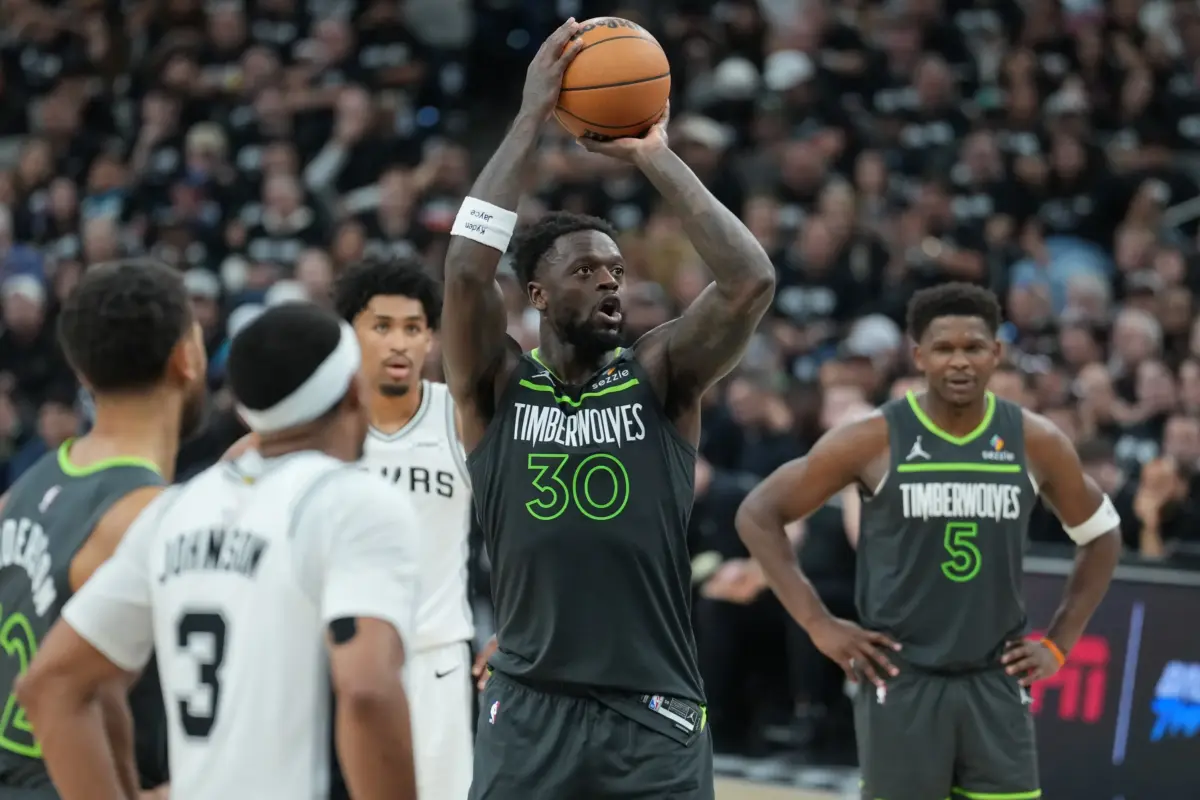

The Minnesota Timberwolves created needed cap flexibility by moving Julius Randle, but the deal did not settle every roster question. Ayo Dosunmu helps, yet Mike Conley‘s future and Don DiVincenzo‘s injury still leave Minnesota searching for clearer backcourt answers around Anthony Edwards.
Julius Randle Trade Doesn’t Fix Wolves’ Point Guard Problem
Julius Randle Trade Fallout
ESPN’s Shams Charania reported that Minnesota sent Randle and the No. 28 pick to the Brooklyn Nets in a three-team trade, with the Timberwolves receiving No. 33 while Brooklyn absorbed Randle’s salary. Charania added that the salary relief gives Minnesota more flexibility to retain Dosunmu and use exceptions this summer.
That part matters. The Timberwolves had to create room somewhere, and moving off Randle’s contract gave them a cleaner path to keep building around Edwards. But clearing money is not the same as fixing the roster. Minnesota still has to answer who runs the offense, who organizes the backcourt and how much creation it can trust from its current guard group.
Ayo Dosunmu Is Not Enough
Dosunmu is a major part of the answer, but he does not solve the issue entirely.
Minnesota did not pay him $112 million over five years to be a placeholder. Dosunmu earned that commitment with his late-season play, and his skill set fits what the Timberwolves need. He can defend, get downhill, keep the ball moving, and play next to Edwards without demanding that the offense revolve around him.
But that does not automatically make him the long-term solution to every point guard question. There is still a difference between being a valuable starting guard and being the player trusted to organize the offense every night, steady the half-court and create more when defenses load up on Edwards. That is why the Timberwolves’ backcourt problem still exists even after locking in Dosunmu.
The Question Over Mike Conley’s Successor
That brings the conversation back to Conley, even after the Randle move.
For the last two seasons, Conley has given Minnesota structure that does not always show up in the box score. He settles possessions, keeps teammates organized and gives Edwards a veteran guard who can control pace without taking over the offense. Whether Conley returns or not, the bigger problem is that the Timberwolves still need a real plan for life after him.
That is where this trade stops short of solving everything. It gave the front office more room to operate during its biggest summer since drafting Edwards, but it did not erase the need for another table-setter. Dosunmu can absorb part of that role. He has not yet proven he should own it all.
Donte DiVincenzo’s Injury Risk
The uncertainty around DiVincenzo only makes the issue harder to ignore.
DiVincenzo tore his Achilles in the first round of the playoffs, which means Minnesota cannot assume a stable backcourt from opening night. Even if he returns at some point next season, the Timberwolves still have to plan for reduced availability, a slow ramp-up, or the possibility that his pre-injury form does not return immediately.
That places a greater burden on everyone else. It raises it on Edwards, who already handles too much of the offense. It raises it on Dosunmu, who now has to prove he can do more than simply complement the star next to him. And it raises concerns for the front office, which still has to keep solving Edwards’ problem rather than assuming one move will fix everything.
Next Move Still Needed
The Randle trade did one important job. It gave the Timberwolves more flexibility to keep shaping the roster.
What it did not do was close the point guard discussion. Minnesota still needs a clearer succession plan for Conley, more creation insurance behind Edwards, and a backcourt structure that does not depend on everything breaking perfectly. The money looks cleaner after the trade. The roster still needs another answer.
© Daniel Dunn-Imagn Images