
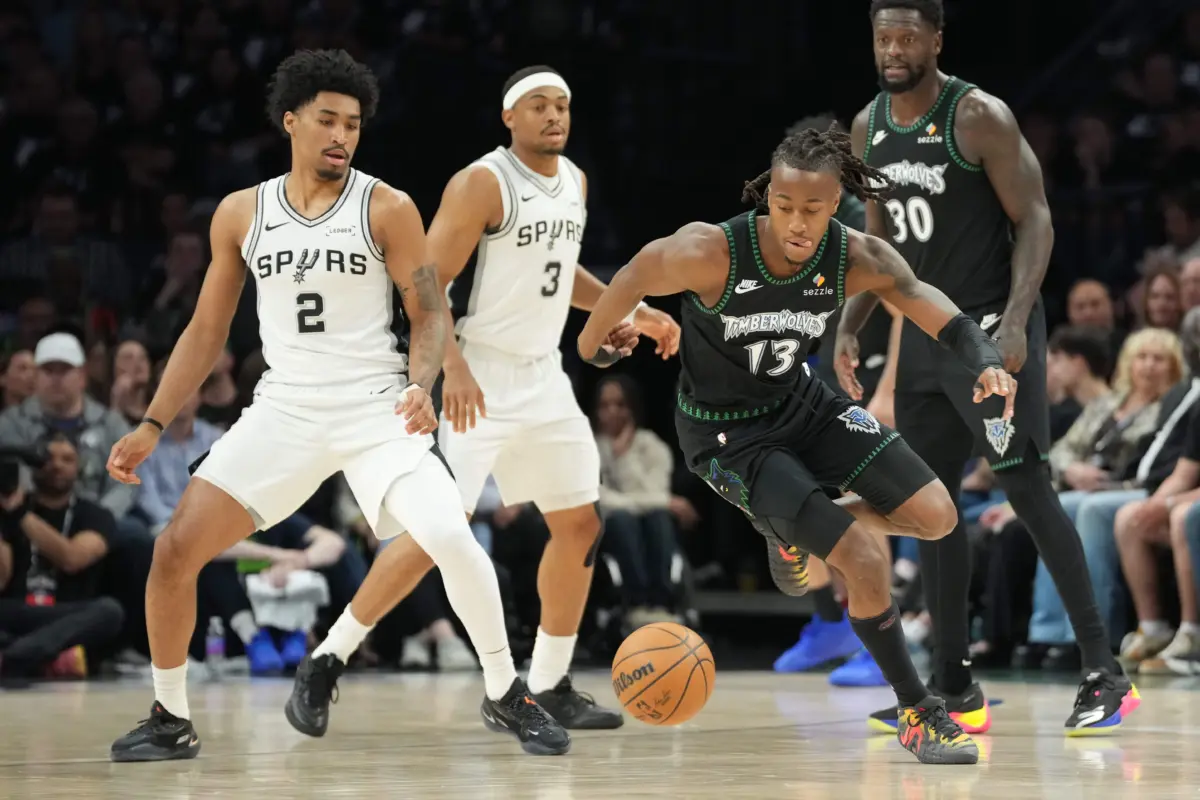

The Minnesota Timberwolves knew re-signing Ayo Dosunmu would cost real money. Now the clearest question is what that price means for the rest of their summer around Anthony Edwards and Rudy Gobert.
Ayo Dosunmu Signing Leaves Timberwolves With Less Cap Flexibility
Ayo Dosunmu’s Contract Clarifies Minnesota’s Cap Limits
Dosunmu’s reported five-year, $112 million deal with the Minnesota Timberwolves always looked like one of the franchise’s biggest summer decisions. Dane Moore’s latest cap breakdown showed why it may also become one of the most important.
Moore detailed on X that if Minnesota structures Dosunmu’s deal with standard 8 percent raises, the contract would escalate from $19.3 million in 2026-27 (about 12 percent of the cap) to $20.8 million in 2027-28, $22.3 million in 2028-29, $23.8 million in 2029-30 and $25.3 million in 2030-31.
If Minnesota structures Ayo Dosunmu’s 5 year, $112M deal with the standard 8% raises, this would be what Dosunmu’s contract looks like by year…
26-27: $19.3M (12% of the cap)
27-28: $20.8M
28-29: $22.3M
29-30: $23.8M
30-31: $25.3MThat would leave $32.5M available below the… https://t.co/uA6f3eWXXz pic.twitter.com/SsVwMktWGa
— Dane Moore (@DaneMooreNBA) June 23, 2026
That projection would leave the Timberwolves about $32.5 million below the first apron with five roster spots still to fill, a number that highlights both flexibility and risk.
That number matters because Minnesota’s flexibility could disappear quickly depending on what comes next. Moore added that the Timberwolves would be hard-capped at the first apron if they use the $33 million Julius Randle trade exception or the $15 million non-taxpayer midlevel exception.
The contract itself was never likely to be cheap after Dosunmu’s finish to last season. ESPN’s Shams Charania reported that “free agent guard Ayo Dosunmu intends to sign a five-year, $112 million contract to return to the Minnesota Timberwolves, with a player option in the fifth season,” while adding that the Wolves made him a major priority after his postseason.
Minnesota’s Summer Financial Outlook
The important part of Moore’s projection is not just Dosunmu’s salary. It is the trade-offs that come with it.
Minnesota can still operate this summer, but it no longer has much room for expensive mistakes. A $19.3 million starting salary for Dosunmu is manageable on its own. The pressure comes from the roster around him, especially with Edwards, Gobert, Jaden McDaniels and Naz Reid already carrying major money.
That is why the first-apron number matters more than the contract headline. The Timberwolves can keep Dosunmu and still build, but every major move from here on out is tied to the hard cap. Using the Randle exception or the non-taxpayer midlevel exception would not just add talent. It would place a financial ceiling on the rest of Minnesota’s offseason.
That is a meaningful development for a front office entering what already looks like its biggest summer since drafting Edwards. Dosunmu’s new deal does not close every path. It just makes the expensive ones harder to navigate.
Rudy Gobert Sits at Center of Timberwolves Trade Math
Moore’s most revealing point may have been the one tied to Gobert.
If Minnesota wants to trade for a player making more than $33 million, Moore noted that Gobert would likely need to be the player who matches the salary. He also added that a deal built that way would not hard-cap the Timberwolves at the first apron.
That instantly brings Gobert back into the middle of any real blockbuster discussion. It also sharpens the stakes around every Ja Morant trade idea that keeps popping up around Minnesota. On paper, Morant or Kyrie Irving sounds like the kind of offensive swing that could raise the Timberwolves’ ceiling. In practice, the money says those conversations are difficult to separate from Gobert.
That is the part Minnesota has to weigh carefully. Trading Gobert for a high-priced guard might solve one problem, but it would also tear into the defense that has carried this roster. The Timberwolves have spent years building one of the league’s toughest defensive identities. Pulling apart that structure for offense is not a small adjustment. It is a franchise-level decision.
Why Ayo Dosunmu’s Deal Still Makes Sense
None of this changes the basic logic behind paying Dosunmu.
Minnesota needed another younger guard who could play with Edwards, defend, move the ball, and attack without hijacking the offense. Dosunmu checked every one of those boxes after arriving from Chicago, which is why letting him walk always risked creating another backcourt problem the Timberwolves would have to solve immediately.
The challenge now is the next move. Re-signing Dosunmu gave Minnesota one answer. The cap sheet says every other answer will be harder.
Jesse Johnson, Imagn Images via Reuters Connect