
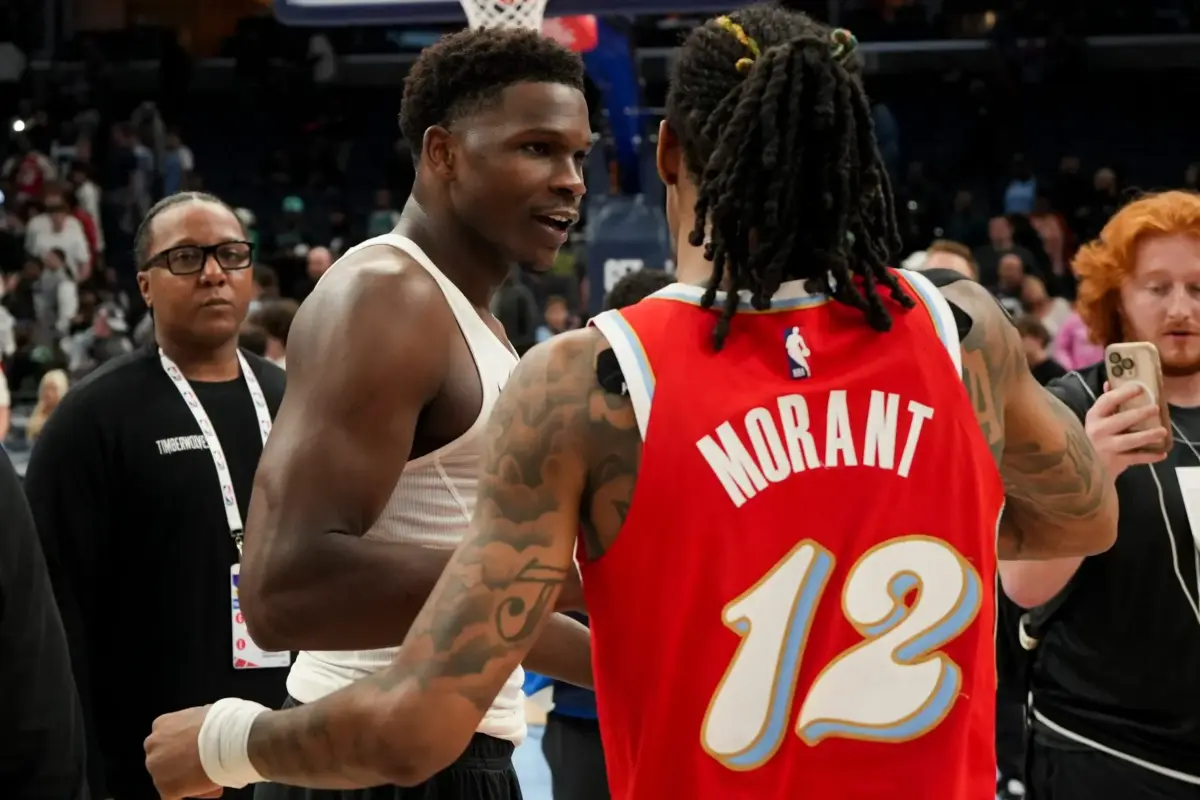

The Minnesota Timberwolves have been linked to several star players since their season ended. Ja Morant remains one of the most intriguing names because he could address a clear offensive need.
Yet the biggest question is not whether Minnesota can trade for him. It is whether the franchise can build a championship roster after paying him. That distinction matters because the financial consequences of a Morant deal could stretch well beyond next season.
A Ja Morant Trade Could Become Minnesota’s Most Expensive Gamble
Morant’s Financial Cost Hinders Timberwolves Trade Talks
The basketball case for Morant is easy to understand. Minnesota often relied heavily on one creator, allowing opponents to focus on Anthony Edwards during key stretches, which often led to the team’s struggling offense.
That is why Morant continues to surface in trade discussions. His ability to pressure defenses and create shots would give Minnesota another top-class offensive engine. It would also ease the offensive burden on Edwards. However, adding a star is only part of the equation. Paying for that star creates an entirely different challenge.
According to Spotrac, Edwards is on a five-year, $244.6 million extension that carries an average annual value of nearly $49 million. His salary climbs to $48.9 million next season and continues to rise afterward.
Morant is also under a long-term maximum contract. Bringing those two deals together would leave Minnesota with more than $90 million in annual commitments to its backcourt alone in 2026-27. That figure becomes more important once the rest of the roster enters the discussion.
The Current Payroll Already Creates Pressure
Minnesota is not entering this situation with a clean cap sheet. The franchise already carries several major contracts across the roster, making the next few months particularly important for the organization’s long-term direction.
According to Spotrac’s 2026-27 projections, Edwards, Rudy Gobert, Julius Randle, Jaden McDaniels and Naz Reid are all scheduled to earn at least $23 million. Donte DiVincenzo — currently out with a torn Achilles — is also under contract for $12.5 million. Together, those commitments place Minnesota among the league’s highest-spending teams before any blockbuster move occurs.
That reality changes how a Morant trade should be viewed. The discussion is no longer about adding one talented player. It becomes whether another max-level contract can fit alongside several existing high-dollar deals.
As payroll rises, roster flexibility shrinks. That relationship has become one of the defining realities of the NBA’s current financial system.
Second Apron Penalty Fears Stall Potential Trade
Many fans focus on luxury-tax payments because those numbers are easy to understand. Front offices spend far more time worrying about apron restrictions.
Bleacher Report recently noted that Minnesota already faces a challenging financial outlook. The club has substantial money committed to its core while operating near the league’s tax and apron thresholds. That context matters because the second apron introduces penalties that extend beyond writing larger checks. Teams lose important roster-building tools once they exceed league spending limits.
As a result, acquiring a star can sometimes make it more difficult to improve the supporting cast. The move that appears aggressive on paper can quietly reduce future flexibility. That risk becomes much larger when multiple players are earning star-level salaries simultaneously.
The Real Cost May Be Depth
Minnesota’s current roster includes several rotation pieces on manageable contracts. Those players help balance a payroll already built around expensive veterans and a franchise cornerstone. If additional salary enters the books, maintaining that balance becomes harder.
That is why the debate extends beyond Morant’s talent. Minnesota would likely survive the immediate financial hit. The larger concern involves the years that follow, when injuries, free agency decisions and roster upgrades require additional resources.
Recent contenders have faced similar problems. Once multiple max contracts occupy the payroll, every remaining roster spot becomes increasingly valuable. Mistakes become harder to correct because financial flexibility disappears.
Ja Morant Trade Does Not Come Without Consequences
None of this means Minnesota should avoid Ja Morant. Players with his talent rarely become available, and contenders often need to take calculated risks to move closer to a title.
The challenge is determining whether the benefits outweigh the long-term costs. Morant could make life easier for Edwards and raise the team’s offensive ceiling. At the same time, his contract would increase pressure on a payroll that is already among the league’s most expensive.
That combination explains why any potential deal deserves scrutiny beyond basketball fit. Minnesota can afford Morant in a literal sense. The franchise has contracts that can match his salary. The harder question is what happens afterward.
If adding Morant eventually forces sacrifices elsewhere on the roster, the true cost of the trade may not be measured by the players sent to Memphis. It may be measured by the depth Minnesota can no longer afford to keep.
© Chris Day/The Commercial Appeal / USA TODAY NETWORK via Imagn Images