
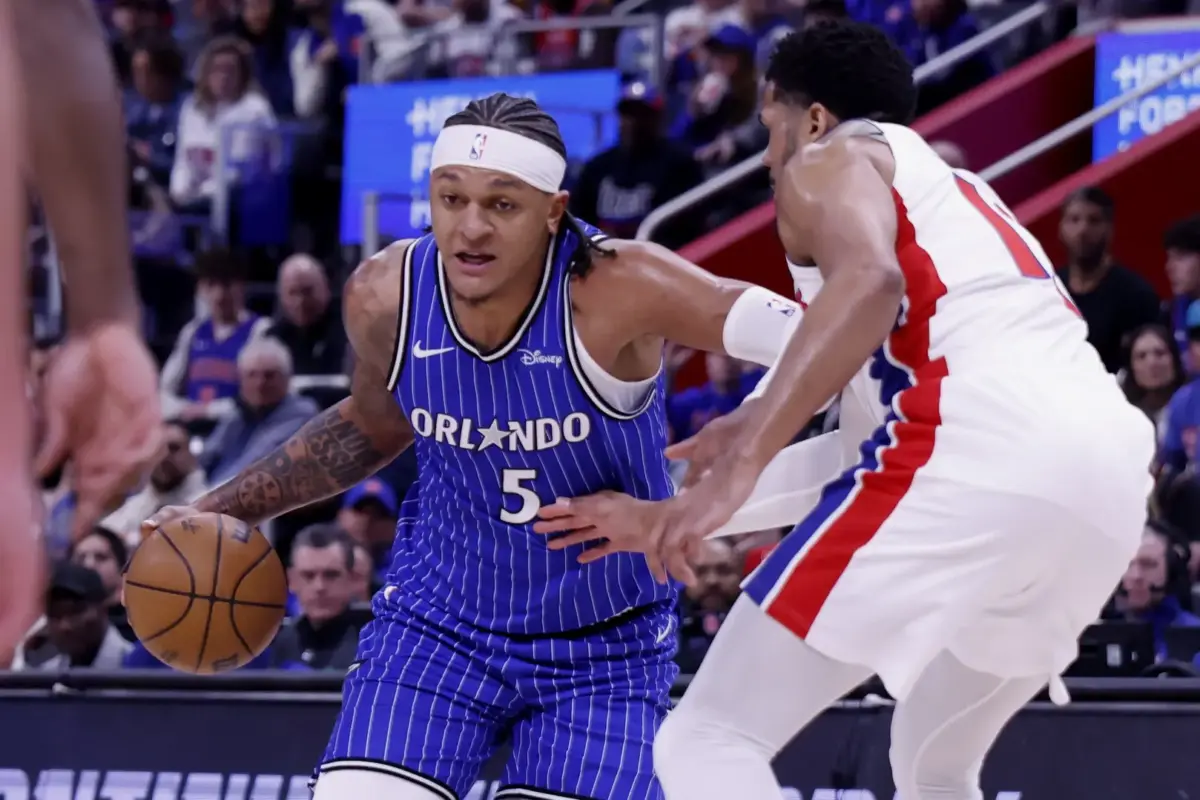

The Orlando Magic’s hard-fought first-round battle against the Detroit Pistons highlighted a clear reality. Paolo Banchero is an elite, foundational piece for the franchise moving forward. His high-level individual play kept the Magic competitive throughout the seven-game series. Headlined by a 45-point Game 5 and a 38-point Game 7, Banchero proved that his playing style translates perfectly to the ramped-up intensity and physicality of the postseason.
The Next Step In Paolo Banchero’s Offensive Evolution
Despite his heroics, the rest of the team could not rise to the occasion and close out the Pistons. Banchero’s promise and the franchise’s shortcomings create an interesting situation for Orlando’s front office and whoever assumes the head-coaching role. Banchero is, without a doubt, the focal point of the Magic’s offense moving forward. However, an offense heavily reliant on his isolation effectiveness limits Orlando’s ceiling.
For the Magic to transform from a low-seeded pesky playoff team into a legitimate contender in the Eastern Conference, Banchero’s offensive role must evolve. Of course, this is not about reducing his impact on the game. It is about readjusting and fine-tuning it. The Magic must find a way to convert Banchero from an isolation-heavy safety net into a fast-thinking offensive asset that makes Orlando’s secondary contributors better.
Isolation-Heavy Stagnation
To fully understand why Banchero must transform his offensive game, one must look carefully at his numbers. During the regular season, Banchero produced 22.2 points, 8.4 rebounds, and 5.2 assists per game. Those numbers looked even better in the postseason, averaging. 26 points, 9.0 rebounds, and 6.3 assists. Of course, these are the kind of numbers one expects from a budding superstar. However, Banchero’s efficiency numbers tell a more complicated story. Banchero shot 45.9% from the floor and just 30.5% from three-point range. This translates into a 56.6% true shooting percentage, which is below average among the league’s high-volume scorers.
Far too often, Orlando’s offense settled into situations where Banchero caught the ball at the mid-post or top of the key. Most of the time, that is where the play ended, causing him to create his own chances. In these cases, the defense receives the advantage, clogging up the paint and daring Banchero to take a contested mid-range shot. In fairness, some of this was due to Franz Wagner’s injury. Missing 47 regular-season games, Wagner’s absence forced Banchero to absorb a massive offensive load. However, the isolation-heavy strategy continued in the playoffs, making it too easy to defend the Magic’s offense for a defensively elite Pistons squad.
Unlocking The Magic’s Core
Adjusting Banchero’s role and usage offensively helps unlock the full potential of Orlando’s other key contributors. Last summer, the Magic parted with a lot of assets to acquire sharp-shooter Desmond Bane from the Memphis Grizzlies. Bane compiled a solid first season with Orlando, averaging 20.1 points per game, hitting 39.1% of his three-point attempts. Additionally, Franz Wagner remains a dynamic 20-point-per-game forward as long as he stays healthy.
When Banchero shares the load effectively, the results are positive for the Magic. In the postseason, lineups featuring both Banchero and Wagner posted a +16.8 net rating. They are an effective duo, but the ball needs to move fluidly between them rather than alternating isolation opportunities.
When Banchero attacks the paint, he commands massive defensive attention. The goal going forward is to use his penetration to draw the defense early in the shot clock. A quicker decision from Banchero out of a double-team changes everything. It turns a desperately contested attempt into a quality opportunity for Bane or others before the defense can recover. Quick decisions and fluid ball movement from Banchero result in more production from other players, in theory also leading to a more high-powered offense.
Making Adjustments
Resolving these issues involves a schematic alteration from Orlando’s new coaching staff. It starts with eliminating stagnant ball movement. Consistent, fluid ball movement and rotation make opposing defenses more active. The Magic must move away from predominantly using isolation ball and become harder to scout and game-plan for.
Instead, Orlando needs to get Banchero the ball in motion. Increasing his frequency as a roll man or a short-roll playmaker in pick-and-roll actions would lead to more effective possessions. If Banchero catches the ball in stride on the move, he can use his court vision to pick apart a defense.
Additionally, the Magic must leverage Banchero’s physicality to push the pace. Measuring at six-foot-ten and 250 lbs., Banchero is a wrecking ball in transition situations. Pushing the pace before the opposing defense can set up its half-court defense will lead to high-quality looks and likely more trips to the free-throw line.
The Last Word
The Orlando Magic are in a fantastic situation. Not only are they young and talented, but the franchise also has its cornerstone player in Banchero. The key is for the coaching staff to make the necessary adjustments to unlock his full potential and push the Magic to the next level.
Featured Image: Rick Osentoski-Imagn Images