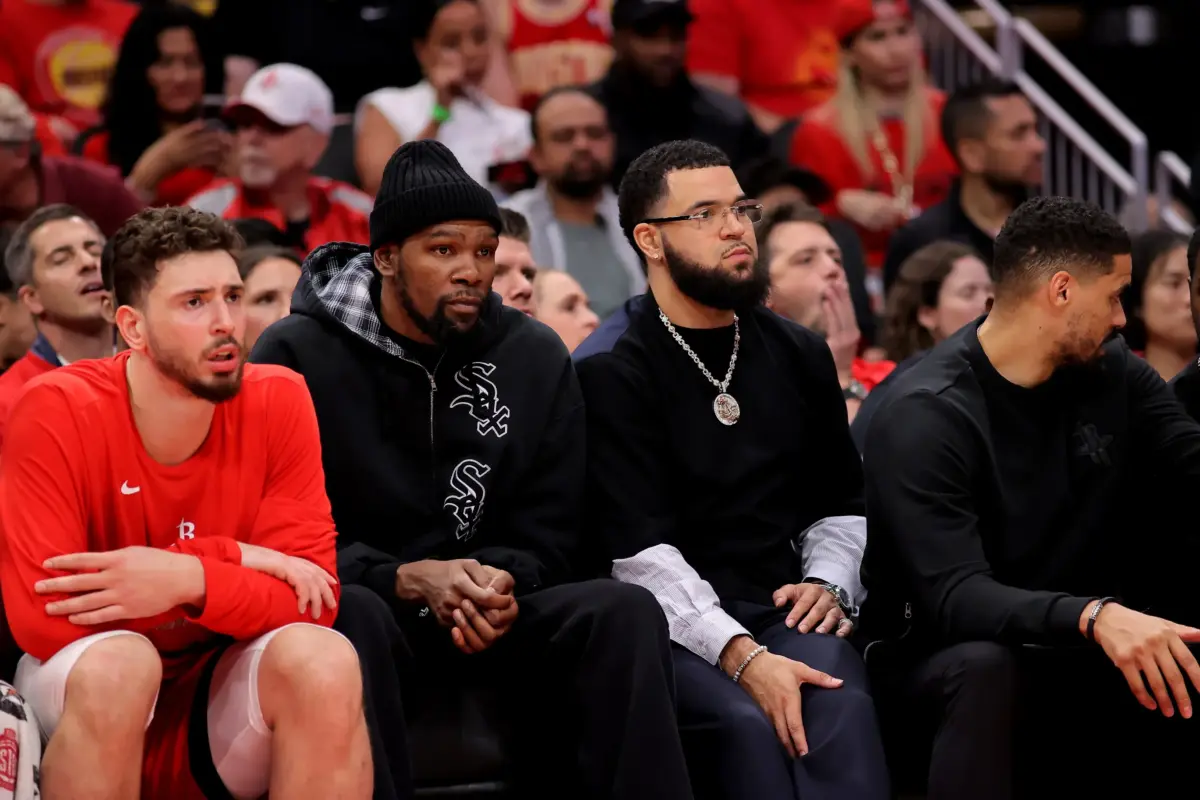

On Friday night, the Houston Rockets’ season came to an end in fitting fashion. The team failed to reach 80 points, losing to the Los Angeles Lakers, 98-78. While the Rockets’ Game 6 collapse was as spectacular as it was unsurprising, the series had a simple through-line. The Houston Rockets need to come back in 2026-27 with at least a token ability to shoot the basketball.
How The Rockets’ Game 6 Should Inform Their Offseason
The series wound up having a few more twists and turns than initially expected. The Rockets’ postseason specialist, Kevin Durant, appeared in only one game and didn’t exactly settle everyone’s nerves like Winston Wolfe from Pulp Fiction. The Rockets lost that game (Game 2), amid Durant’s 9 turnovers. In Game 4, the Rockets’ core duo, Alperen Sengun and Amen Thompson, nonetheless staved off talk of a breakup by avoiding a sweep. Lakers star Austin Reaves made a dramatic return from injury in Game 5. And living legend LeBron James amazed all series long with age-41 brilliance.
But despite the winding road, the difference in the series was pretty straightforward. Perhaps it should come as no surprise, given the regular-season quirkiness of the Rockets’ three-point defense. Each game of the series was a battle between two poor perimeter shooting teams. The Rockets’ Game 6 annihilation was no exception.
Rockets’ Game 6 Completes Three-Point Trend
The winner of each game shot a higher percentage from three. Not only that, but the Rockets’ 33.3% in the series opener was the only game in which the loser shot over 30% from deep. In their other losses, the Rockets shot 24.1%, 28.3%, and, finally, 17.9%.
Of course, neither team attempted a very high volume. The Lakers are last in playoff three-point attempts per game at just 25.5. The Rockets were middle-of-the-pack with 32.2. But volume has been less decisive than efficiency. The Rockets actually lost Game 1 despite making more threes overall — 11-of-33 versus the Lakers’ 10-of-19. But the Rockets shot 30.2% overall compared with LA’s 38.6%, the second-lowest and second-highest percentages in the playoffs, respectively.
Even on such low volume, the lopsided three-point percentages contributed to a lopsided series. There were admittedly only two true blowouts. Those were Game 4, where the Rockets won 115-96 to avoid the sweep, and Game 6, where the Lakers won to avoid a pseudo-historic Game 7 (only four series have gone to seven games after starting 3-0). The other final scores were all within 10. But, even so, the stat lines were surprisingly stagnant.
Only one of all six games had a single lead change in the fourth quarter. That was the Rockets’ heartbreaking loss in Game 3. Not only did losing the game consign them to history as another 0-3 statistic. The Rockets also fought back to take the lead with 5:37 remaining, only to lose it with 14 seconds left and eventually fall in overtime.
But in each of the Rockets’ losses, they were gruesomely inefficient on offense. The games featured field goal percentages of 37.6%, 40.4%, 40.8%, and 35.0%. A lack of spacing was a major handicap that players found impossible to circumvent. The Rockets attempted the third-most wide-open three-pointers in the first round. The Lakers, by contrast, attempted the second-fewest. That goes to show that the Rockets didn’t just suffer from poor shooting luck. Their shooters were systematically ignored on the perimeter, to the detriment of every other component of the offense. The Rockets had no space.
The Problem with Houston’s Spacing
Now, there are plenty of reasons why the Rockets struggled so badly from deep in the 2026 playoffs. The awkward fit between non-shooting stars, Sengun and Thompson, was certainly a factor. But so too was Durant’s untimely absence. Indeed, the entire season-long absence of point guard Fred VanVleet was another. The most frustrating factor of all, however, is the depressingly stagnant offense. It does a great job of generating open threes for its worst shooters. It does a terrible job of creating opportunities for its playmakers with off-ball movement or putting its scorers in positions to succeed.
Durant and VanVleet may return next season. The motionless offense’s “mastermind,” head coach Ime Udoka, should not. Whether the Houston front office will actually be inclined to make any changes is yet to be seen. After the Game 6 meltdown, though, it’s clear that the Houston Rockets need a space-age reinvention of their offense.
© Erik Williams-Imagn Images