
Welcome to the third installment of our “Celebrating 20 Years at Busch III” series. We continue to look at memorable events and individuals throughout the 20-year history of Busch Stadium III. In April, we took a look at the Cardinals’ championships and pennants. Last month, we looked at the numbers retired by the Cardinals at Busch III. This month, we will remember those in the Cardinals’ family whom we have lost over the last 20 years.
Celebrating 20 Years at Busch III: Honoring Those Cardinal Nation Has Lost
The purpose of this installment is to honor the memories of those we have lost. The Cardinals have such a rich history, with many individuals contributing to it. Sadly, many are no longer with us.
Due to many names needing to be honored, we are splitting this into two articles. We will go through this chronologically, starting with a tragic loss that shocked Cardinal Nation.
Josh Hancock
Josh Hancock joined the Cardinals in 2006 and had his best season yet. He posted a career-best 4.09 ERA and was used in multiple situations out of the bullpen. Although he did not pitch in the 2006 World Series, Hancock was on the roster and thus earned a World Series ring.
On April 29th, 2007, Hancock was killed in a car accident. Hancock, while driving intoxicated, hit the rear of a tow truck that was parked to assist another individual. The Cardinals’ game later that day against the Chicago Cubs was postponed.
For the rest of the season, the Cardinals honored Hancock’s memory by wearing a #32 (his number) patch on their sleeves and posting a “JH 32” decal on the bullpen wall.
George Kissell
George Kissell may not be a household name to casual fans, but inside the Cardinals’ organization, he was one of the most influential figures in franchise history. He spent decades as a coach, instructor, scout, and mentor, shaping generations of Cardinals players. His work helped define what people often call “the Cardinal Way,” an unwritten manual on how practices should be conducted and how players should respond to situations during a game. It gradually became a mindset that the organization adopted and continues to maintain today.
Kissell’s impact was less about one season and more about culture. He taught fundamentals, professionalism, and respect for the game. Many Cardinals greats credited him as a teacher and guide, making him one of the quiet pillars behind the organization’s long-term success.
Kissell died on October 7, 2008, from injuries sustained during a car accident.
Marty Marion
Marty Marion was one of the greatest defensive shortstops in Cardinals’ history and a key figure in the club’s 1940’s dynasty. Nicknamed “The Octopus” because of his long reach and defensive range, Marion helped lead St. Louis to multiple pennants and World Series championships. He won the 1944 National League MVP Award, a rare honor for a defense-first shortstop.
His legacy with the Cardinals is built on winning, steadiness, and elite defense. Marion represented an era when the Cardinals were one of baseball’s dominant organizations, and his glove was central to that identity. He later managed the Cardinals as well, adding another chapter to his connection with the franchise.
Marion died on March 15, 2011, from an apparent heart attack.
Stan Musial
Stan Musial is, without a doubt, the greatest Cardinal of all time. “Stan the Man” spent his entire 22-year career with St. Louis, becoming the face of the franchise and one of baseball’s most beloved figures. He was a three-time National League MVP, a 24-time All-Star, a three-time World Series champion, and an amazing hitter, with 3,630 hits in his career.
Musial’s impact went far beyond numbers. He represented consistency, humility, loyalty, and excellence. For generations of Cardinals’ fans, he was the standard by which every great Cardinal is measured. His statue outside Busch III says it best: “Here stands baseball’s perfect warrior. Here stands baseball’s perfect knight.”
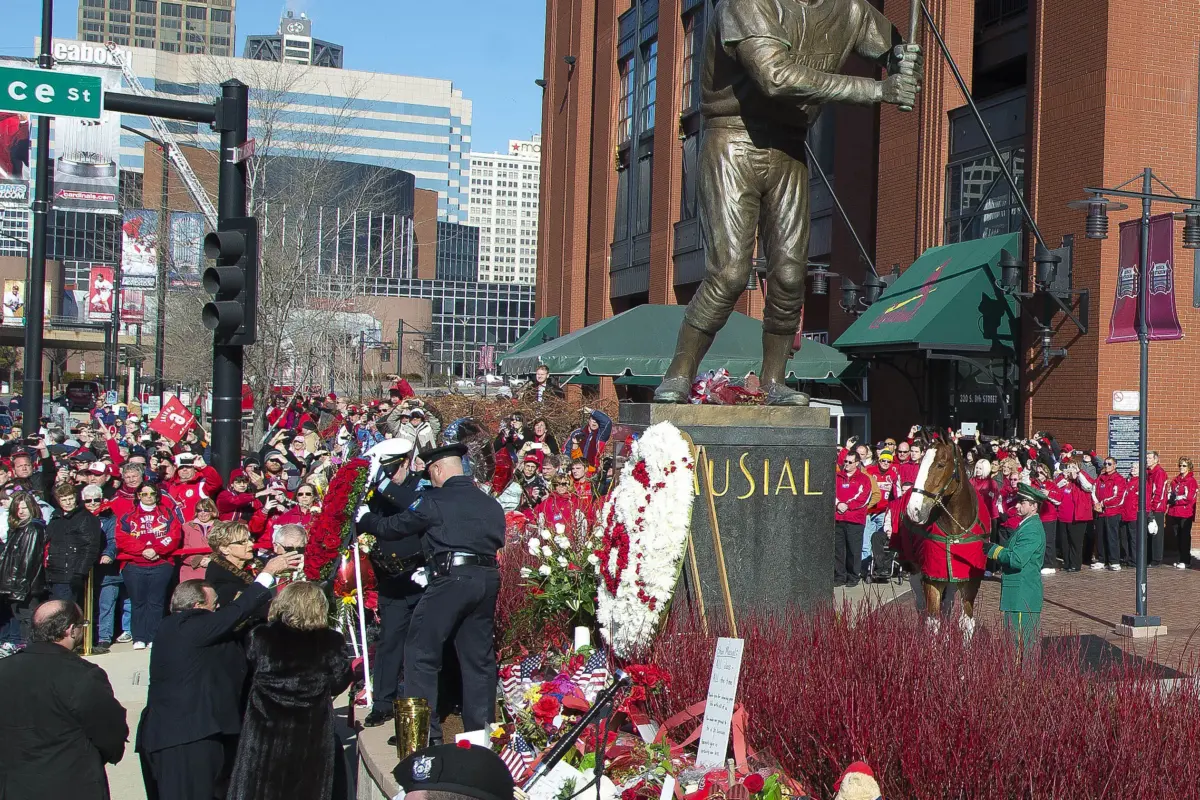
Musial died on January 19, 2013, of natural causes. For the next week, Cardinal Nation celebrated his life. Fans laid flowers at the base of his statue and stories were shared. The celebration of life culminated in his funeral at the Cathedral Basilica of St. Louis, where fans stood outside in cold temperatures to honor “Stan the Man.”
Oscar Taveras
Oscar Taveras was considered one of the brightest young stars in the Cardinals’ organization and one of the top prospects in all of baseball. He quickly rose through the minor leagues thanks to his exceptional hitting ability and natural talent. In 2014, he made his long-awaited Major League debut and immediately showed why scouts had been so excited about his future, memorably hitting a home run in his first big-league game. Furthermore, he delivered a big home run in the 2014 National League Championship Series. To many, he was the next Albert Pujols.
His sudden death at just 22 years old devastated the baseball world and remains one of the most heartbreaking tragedies in franchise history. Like Hancock, Taveras died as a result of drinking and driving. Taveras’s girlfriend, Edilia Arvelo, also died in the accident. The couple left behind a one-year-old child.
Taveras was honored by many following his death. Kansas City Royals pitcher Yordano Ventura wrote “RIP O.T. #18” on his cap, wearing it for his start in Game 6 of the 2014 World Series. Taveras’s teammate, Carlos Martinez, honored him by switching his jersey number to #18 for the following season.
For Cardinals fans, he is remembered not only for what he accomplished but also for the immense promise and potential that he tragically never got the chance to achieve.
Joaquin Andujar
Joaquín Andújar was one of the most talented pitchers of the Whiteyball Era. He played a major role in the Cardinals’ 1982 World Series championship, winning 15 games during the regular season and helping give St. Louis a fiery, competitive presence on the mound. At his best, Andújar was intense, emotional, and extremely difficult to beat. His intensity was put on display during Game 7 of the 1985 World Series, when Andujar was ejected in the fifth inning for arguing balls and strikes. He proceeded to vandalize the clubhouse bathroom with a bat in anger.
His Cardinals legacy is tied to the pitching identity of the 1980’s teams. Andújar brought personality and edge to a club that won one championship and reached multiple World Series during the decade. He remains one of the memorable characters from one of the most beloved eras in Cardinals’ history.
Andujar died on September 8, 2015, from complications of diabetes.
Red Schoendienst
Few individuals have had a longer or deeper relationship with the St. Louis Cardinals than Red Schoendienst. As a player, manager, coach, and ambassador, he spent parts of eight decades with the organization. Schoendienst was a ten-time All-Star second baseman who helped lead the Cardinals to the 1946 World Series championship and later managed the club to the 1967 World Series title and the 1968 National League pennant.
Red became the living embodiment of Cardinals baseball. Generations of fans knew him not only as a Hall of Famer but as a constant presence at Busch Stadium long after his playing days ended. It was common to see him on the field during batting practice, even greeting fans in the stands. His loyalty, humility, and baseball knowledge made him one of the most beloved figures in franchise history.
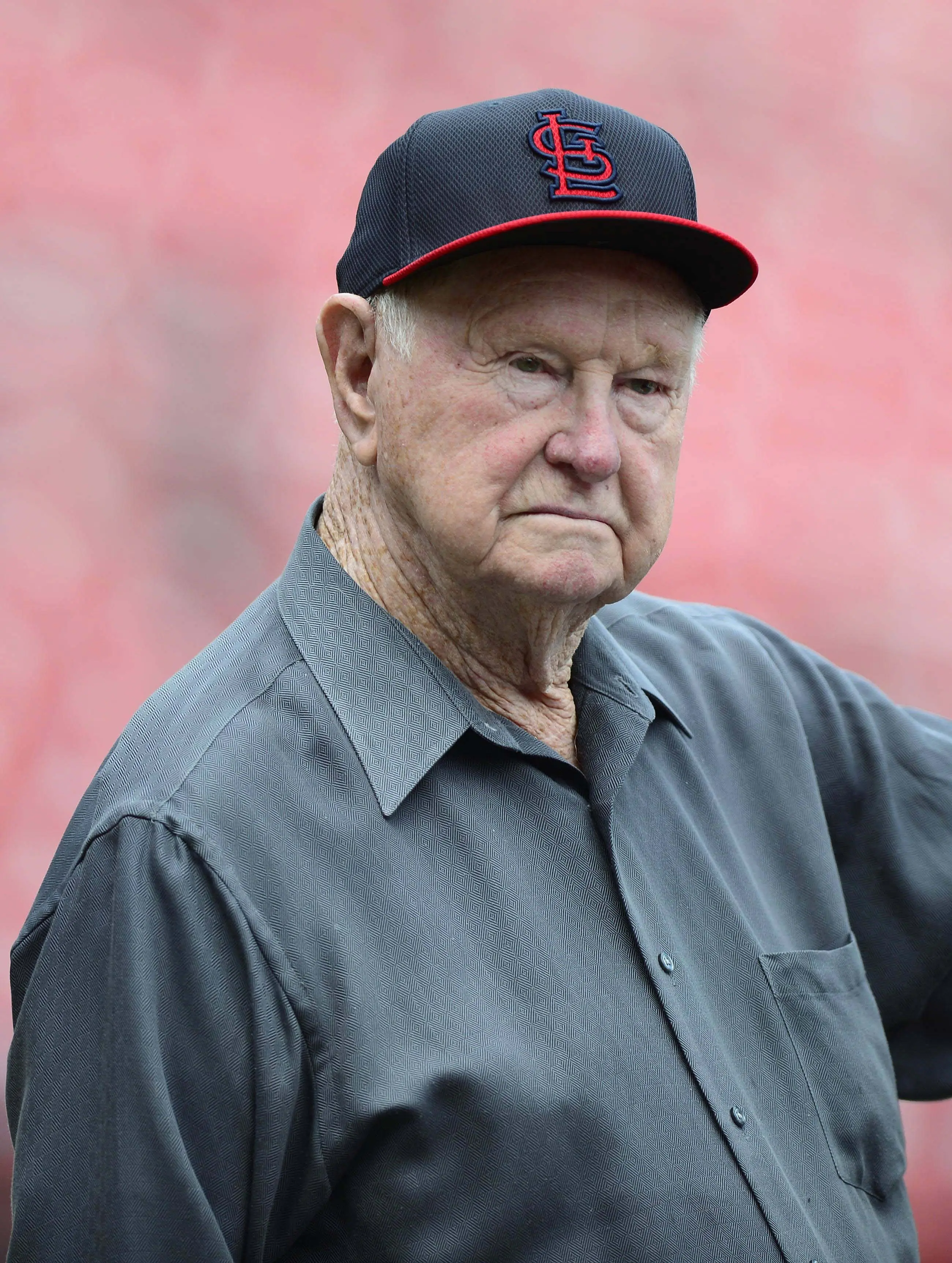
Red died on June 6, 2018, from natural causes.
Chris Duncan
Chris Duncan was the son of longtime Cardinals’ pitching coach Dave Duncan, but he earned his own place in Cardinals’ lore through his contributions on the field. He entered the history books early in his career, hitting the last regular-season home run at Busch Memorial Stadium, which was also his first home run. During the 2006 season, Duncan emerged as a key power bat for a team that would go on to win the World Series. His home runs and timely hitting helped stabilize the lineup during a season filled with injuries.
After his playing career was cut short by neck injuries, Duncan became a popular sports radio personality in St. Louis. Fans appreciated his honesty, humor, and deep connection to the Cardinals’ community. His battle with cancer and his death at just 38 years old drew an outpouring of grief from fans, teammates, and listeners who had come to admire both the player and the man.
Lou Brock
After joining the Cardinals in what became a lopsided trade with the Chicago Cubs, Lou Brock transformed the team. One of the greatest leadoff hitters and base stealers in baseball history, Brock helped power St. Louis to World Series championships in 1964 and 1967 and a National League pennant in 1968. His speed changed the game, and for years he held Major League Baseball’s career stolen-base record with 938.
Beyond the numbers, Brock became one of the franchise’s most respected ambassadors. His warmth, accessibility, and commitment to the St. Louis community made him a beloved figure long after his retirement. For many Cardinals’ fans, Brock represented excitement, excellence, and the winning tradition of the 1960’s teams. Whenever he stepped on the field, Cardinal Nation always greeted him with a similar chant: “Louuuuuuu!”
Brock died on September 6, 2020.
Bob Gibson
Bob Gibson is the greatest pitcher in Cardinals’ history, and a case can be made that he is the best pitcher in MLB history. He won two Cy Young Awards and the 1968 National League MVP Award. He helped lead the Cardinals to World Series championships in 1964 and 1967. His legendary 1.12 ERA in 1968 remains one of the greatest pitching seasons in baseball history. Furthermore, his dominance contributed to MLB lowering the mound and reducing the strike zone to generate more offense.
Gibson’s fierce competitiveness became part of baseball mythology. Opposing hitters feared him, teammates respected him, and fans admired his relentless determination. His impact extended beyond statistics; he helped redefine what an ace pitcher could be. When Gibson died on October 2, 2020, the Cardinals lost not just a Hall of Famer but one of the most influential figures the franchise and the game have ever known.
Part 2 Coming Soon
Part 2 will come out in the next few days, so stay tuned!
Main Photo: Scott Novak- Imagn Images