
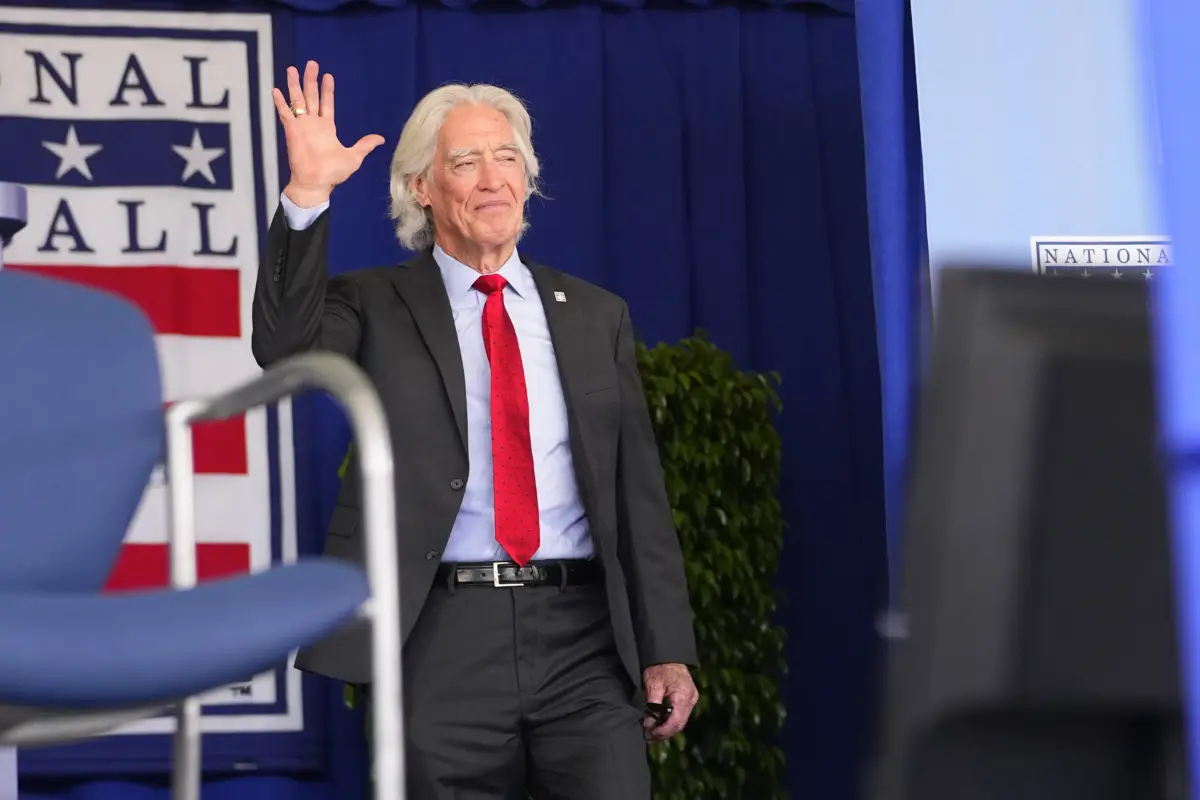
Welcome to the second installment of our “Celebrating 20 Years at Busch III” series. We continue our look at the special moments/players in Busch Stadium III’s 20-year history. Last month, we took a look at the St. Cardinals’ championships and pennants at Busch III. Today, we are going to look at the numbers retired since Busch III opened.
Celebrating 20 Years at Busch III: Retired Numbers
Today, 14 individuals in Cardinals’ history are honored on the left-field wall in Busch III as well as under the right-field scoreboard. Players, managers, owners, and broadcasters alike are honored.
Since Busch III opened in 2006, four new numbers have been added to the list. Today, we are celebrating Busch III’s history by talking about each player and why they are honored in Cardinals’ history. We will go in the order of when the numbers were retired.
#42 Bruce Sutter (2006)
MLB retired Jackie Robinson‘s #42 in 1997 to commemorate the 50th anniversary of Robinson breaking baseball’s color barrier. However, the Cardinals are one of two teams to have #42 retired for an additional player. In fact, they were the first to do it; later joined by the New York Yankees in 2013 (Mariano Rivera).
In 2006, the inaugural season of Busch III, the Cardinals retired Bruce Sutter‘s #42. Sutter was voted into the National Baseball Hall of Fame earlier that year. Sutter pitched for the Cardinals from 1981 to 1984. In his first season wearing the Cardinals’ uniform, Sutter saved 25 games, a then-record for the organization. He recorded 36 saves in 1982, including recording the final out of the 1982 World Series. His 45 saves in 1984 set a new Major League record that has since been broken.
Sutter’s four-year stint with the Cardinals saw him save 127 games. Today, Sutter ranks fourth behind Jason Isringhausen (217), Lee Smith (160), and Todd Worrell (129) in franchise saves. Furthermore, Sutter was part of the organization’s inaugural Hall of Fame in 2014.
#24 White Herzog (2010)
“Whiteyball” is perhaps the most famous stretch of Cardinals’ history. After successful stretches with other teams, Whitey Herzog joined the Cardinals for the 1981 season. A season later, the Cardinals, behind the “Whiteyball” strategy of great defense and baserunning, won the 1982 World Series, ending a 15-year title drought. The Cardinals won the National League Pennant again in 1985 and 1987, but lost the World Series in seven games each time. Furthermore, Herzog won the “Manager of the Year” award in 1982 and 1985.
Herzog was elected to the National Baseball Hall of Fame in 2010. That same season, the Cardinals retired his #24. Like Sutter, Herzog was part of the Cardinals’ inaugural Hall of Fame class.
#10 Tony La Russa (2012)
In 1996, the Cardinals hired Tony La Russa as their new manager. The Cardinals were not enjoying the success they had had in the 80s, but La Russa helped turn things around and usher in a new era of Cardinals’ baseball. In his first season, the Cardinals won the NL Central Division. Under La Russa, the Cardinals would win the division many more times: 2000, 2001, 2002, 2004, 2005, 2006, and 2009. The Cardinals reached the World Series twice: once in 2004 (in which the team won 105 games) and again in 2006. While the Cardinals were swept in 2004, they would dominate the 2006 World Series, defeating the Detroit Tigers in six games. It was the second time in MLB history that a team won the World Series in the inaugural season of a new stadium. Busch III certainly had a great first year.
La Russa had many standout moments as the team’s manager, but the 2002 season may have been the most emotional. The Cardinals suffered the tragic losses of former broadcaster Jack Buck and current pitcher Darryl Kile. Yet, the Cardinals managed to win the division title again, a celebration that included the team holding up Kile’s #57 jersey on the field. La Russa won his fourth “Manager of the Year’ award that season, easily his most deserving.
La Russa’s final season managing the Cardinals was in 2011. He saved his best for last. The Cardinals erased a 10.5-game deficit in the NL Wild Card race to make the playoffs on the last day of the regular season. After upsetting the Philadelphia Phillies and Milwaukee Brewers in the first round, the Cardinals faced the Texas Rangers in the World Series. We know how that story ends. Twice down to their last strike, the Cardinals forced a Game 7 behind many heroics, with David Freese being the most famous. La Russa’s decision to start Chris Carpenter on three days’ rest in Game 7 paid off, as the right-hander pitched six innings of one-run ball. The Cardinals won their 11th championship that night, easily their most improbable.
The Cardinals retired La Russa’s #10 in May of 2012. Two years later, La Russa was inducted into the National Baseball Hall of Fame.
#23 Ted Simmons (2021)
Nicknamed “Simba,” due to his hair, Ted Simmons was a six-time All-Star with the Cardinals. He finished in the top 10 in the NL in batting average and RBI five times with the Cardinals. He was runner-up for the batting crown with a .332 average in 1975. Furthermore, he finished sixth in Most Valuable Player voting that season. Simmons boasted two other top-10 MVP seasons and won a Silver Slugger Award in 1980.
Simmons is one of the best catchers in Cardinals’ history. His expertise behind the plate saw him catch two no-hitters: one by Bob Gibson in 1971 and Bob Forsch in 1978. Furthermore, he caught 122 shutouts, eighth-most in baseball history.
Simmons’ path to the National Baseball Hall of Fame was a rocky one. He was knocked off the ballot after his first year of eligibility. However, in 2020, he was voted in by the Modern Baseball Era Committee. Yet, the world had one more obstacle for Simmons- the COVID-19 Pandemic. The pandemic forced the Class of 2020 to wait until the next summer to take their rightful place in Cooperstown.
For the Cardinals, they got their moment to honor Simmons by retiring his number in July of 2021. Fans gathered in Busch III to see Simmons’ #23 join the elite list of retired numbers. Simmons is the latest number to join the outfield wall, but he will certainly not be the last.
Who’s Next?
There are many candidates to join the outfield wall at Busch III. Scott Rolen, inducted into the Hall of Fame in 2023, is a standout option, even if his #27 is currently being worn. Fans continue to make the case for Willie McGee‘s #51 to be retired. However, the most likely candidates are the two who will likely be voted into the Hall of Fame in 2028: Albert Pujols and Yadier Molina. However, that does not mean their numbers cannot be retired sooner.
The fans are returning to Busch III, with and without shirts. If anyone we just mentioned (or didn’t) gets their number retired, you can believe Cardinal Nation will show up for the event.
Main Photo: Gregory Fisher- Imagn Images