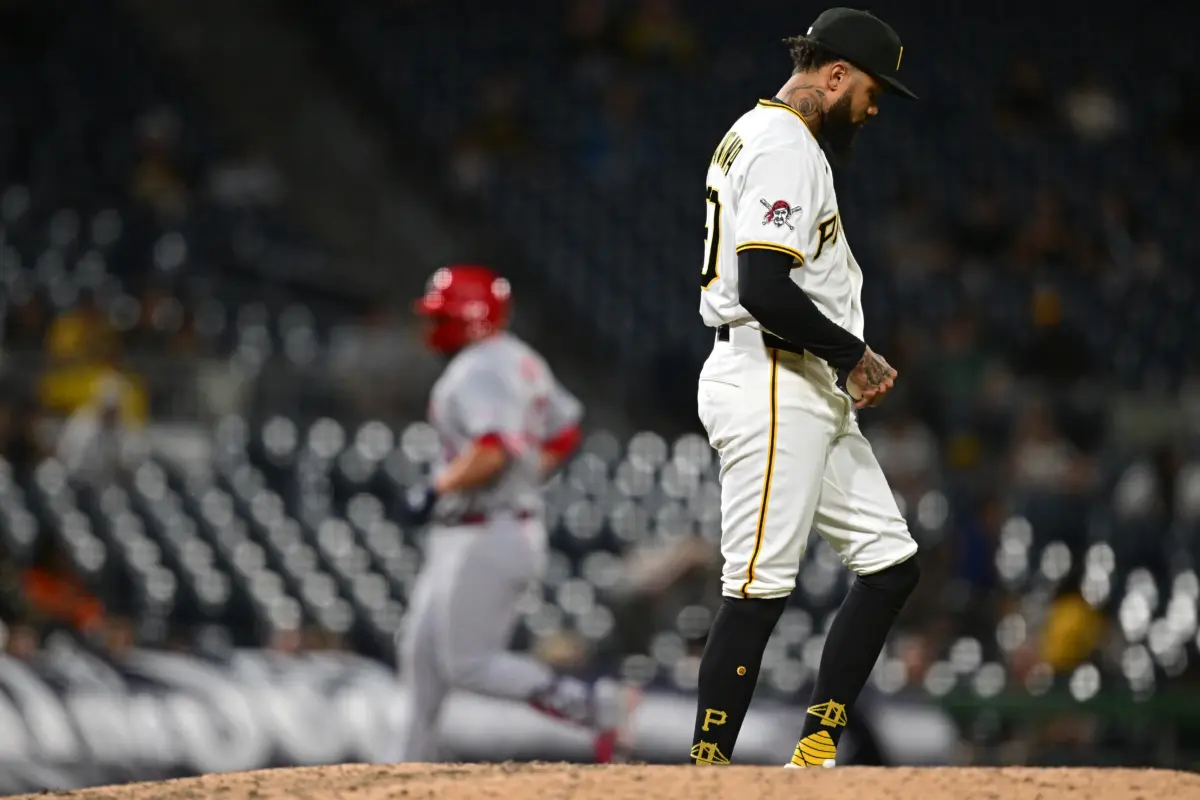
Pittsburgh Pirates right-handed reliever Dennis Santana has been lights out since the Bucs acquired him off waivers in 2024. On the surface, Santana has continued to mow down batters heading into 2026. Prior to his blow-up against the St. Louis Cardinals, Santana allowed just one earned run through his first dozen innings of the year. However, things aren’t all what they seem to be for Santana. While this article may seem like an overreaction after the sort of game he had last time out, I assure you, it’s not. There are far bigger issues at play than one bad game. The question we need to ask is if it is time to start worrying about Dennis Santana?
From waiver claim to closing pitcher
Santana joined the Pirates after they acquired him in mid-June from the New York Yankees. While Santana struggled in his second game in black and gold (which was in Coors Field), he suddenly became one of the Pirates’ best relievers. His final 42.2 innings of the year yielded a 1.27 ERA, 1.97 FIP, and 0.82 WHIP. Santana got 31.1% of opponents to strikeout. He made opponents look silly at the plate. He induced a 33.3% whiff rate and 37.3% chase rate. On the rare occasions opponents were able to put the bat on the ball vs. Santana, he held them to an 84.3 MPH exit velocity and a 2% barrel percentage. Santana also rarely allowed walks, with a 5.6% BB%.
Dennis Santana. Nails.
He now has a 0.69 ERA this year. #nice pic.twitter.com/7Us5teT0IM
— Platinum Key (@PlatinumKey13) April 26, 2026
That earned Santana a high-leverage role in 2025. He pitched an impressive 70.1 innings while posting a 2.18 ERA, 3.21 FIP, and 0.87 WHIP. Santana also walked only 6.3% of opponents and posted a 0.64 HR/9 ratio. However, this is where multiple red flags began appearing. The first was his K% and whiff rate dropping significantly. His 22.2% K% was only league-average, and while his 27.3% whiff rate was still above-average, it was a significant drop from last year. Not only was he getting fewer swings and misses, but he was also letting up more hard contact and getting opponents to expand outside the zone less frequently. Santana put up an 88.9 MPH exit velocity and a poor 10.5% barrel percentage. His chase rate of 34.6% was still in the 96th percentile, but once again, it was a step back from 2024.
Continued decline in important metrics…
Heading into Monday’s game, Santana’s whiff and chase rates took yet another step back. He is only getting opponents to go outside the zone 32.2% of the time, and getting a whiff 25.5% of the time. Unsurprisingly, fewer whiffs and swings outside the zone have led to worse strikeout (20%) and walk rates (12%). At the very least, his exit velocity and barrel rate improved to an 85.9 MPH, and 6.1% rate, respectively.
The biggest issue regarding Santana is his decrease in velocity. In 2024, Santana’s first season with the Pirates, his fastball averaged out at 95.8 MPH, and his sinker came in at 95. In 2025, his fastball lost about a tick of velocity, down to 94.7 MPH. His sinker mostly stayed consistent at 94.6 MPH, though. However, 2026 has so far looked very worrisome for Santana. His fastball is now down to 93.7 MPH, and his sinker has fallen to 93.5 MPH. His max fastball velocity so far into 2026 is 95.8 MPH, the same as he averaged just two years ago. That’s not the only pitch that has lost a significant amount of zip. Santana’s slider also fell from 87 MPH in 2025 to only 85.3 MPH so far this year. The drop in velocity hasn’t been accompanied by more spin or different movement. Velocity loss has caused his FanGraphs Stuff+ to go from a quality 105 mark in 2024 to just 91 in 2026
It is certainly a worrisome development for Santana. He is steadily losing velocity year after year and is progressively becoming easier to hit and less deceptive. Santana still has a chance to be an effective pitcher. However, the Pirates need to start thinking of an emergency parachute, whether that means Gregory Soto (who has experience closing games), Mason Montgomery, and Isaac Mattson start getting more save opportunities, or they start keeping tabs on relievers who will be on the trade market this summer.
(Top Image Credit: David Dermer-Imagn Images)