
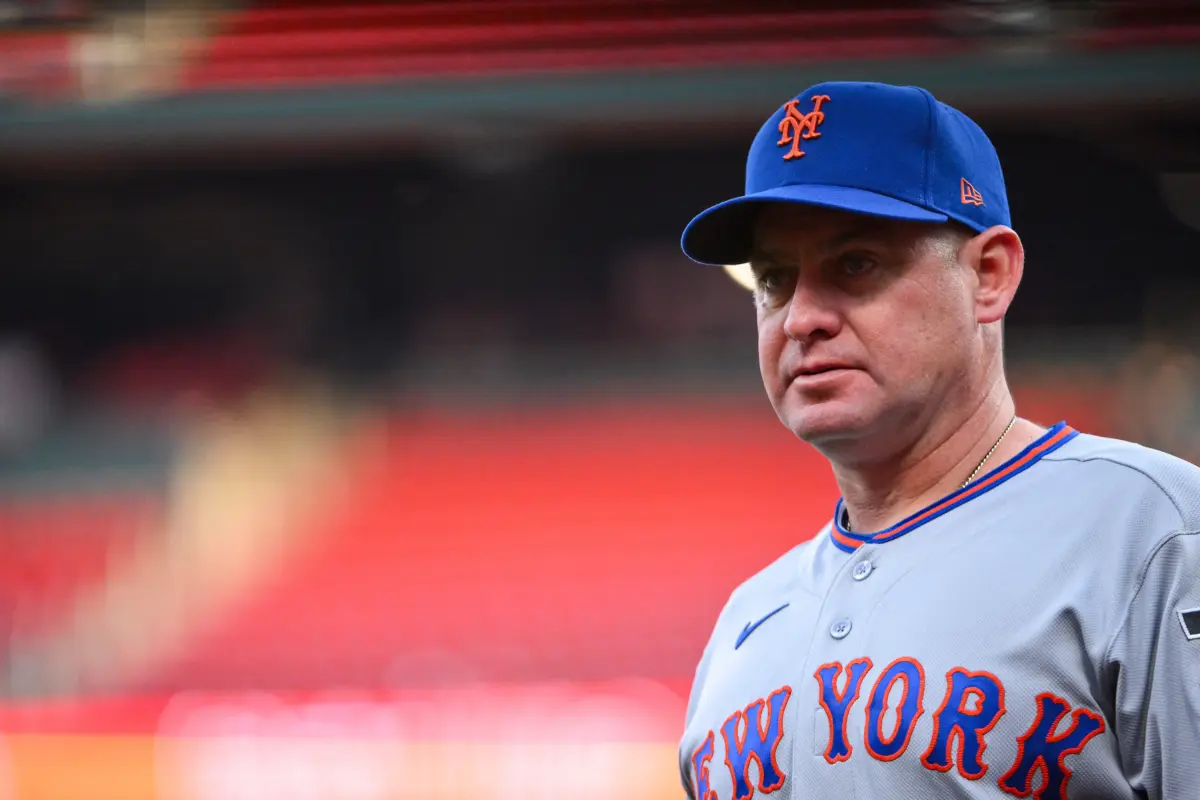

The writing was on the wall. Carlos Mendoza’s firing wasn’t simply another managerial change. It was the clearest indication yet that the New York Mets’ 2026 season had reached a point of no return. Publicly, team officials may continue insisting they intend to compete. But organizations don’t dismiss managers in late June expecting to contend. Whether they admit it or not, the decision acknowledged what the last several weeks had already made painfully obvious: this season had slipped away.
How It All Came Crashing Down for Carlos Mendoza
There was a period from June 12 through June 21 when Mets officials hoped the team could turn their season around. New York had three series lined up against three National League teams in a row, including two NL East rivals in the Atlanta Braves and Philadelphia Phillies. It was a pivotal stretch for them, one in which they could have regained some ground. Instead, the Mets lost ground and ended up going 4-5.
Those losses were ugly, especially the Mets falling 12-0 in Cincinnati and 15-3 in Philadelphia. Their struggles stemmed from a combination of poor defense, inconsistent starting pitching, and an overall lack of urgency.
The next series against the Chicago Cubs was even worse. It had gotten so bad that it became the ultimate tipping point in Mendoza‘s Mets managerial career. The shoddy defense had become too much to ignore. The Mets committed a total of nine errors over a four-game series, including six in one single game. The pitching was no better either, as they allowed 33 Cubs to cross home plate.
Sure, Mendoza had made some mistakes as manager, but make no mistake, the Mets’ failure of a season is not on him. It’s on the team’s architect and President of Baseball Operations, David Stearns. He himself admitted it during Friday’s press conference following Mendoza’s departure. “I take responsibility for our record on the field [and] I take responsibility for [our entire] baseball operations group,” Stearns said.
And even if it is partly on Mendoza, the organization easily could have dismissed him back in late April. The Mets, who were 9-19 at the time, saw the 9-19 Phillies and 10-17 Boston Red Sox fire their own managers (Rob Thomson and Alex Cora). Instead, New York stood pat and decided to keep Mendoza at the helm.
“He’s probably the least culpable of everybody that has contributed to this morass of a season that the Mets are in…but they had to do something. This is the move that teams make.”
Gary Cohen reacts to the Mets firing Carlos Mendoza pic.twitter.com/Xd7BjKwtOy
— SNY Mets (@SNY_Mets) June 26, 2026
The belief, from the team’s standpoint, was that Mendoza could lead a turnaround for the second time in three seasons, the first being in 2024. That’s why the Mets decided to stand pat and not fire him when they could have and probably should have, if they wanted any real chance at a turnaround.
The noise had gotten immense, so much so that Stearns publicly went out on May 1st and said Mendoza would be staying. The POBO was giving Mendoza until the summer to save the season. After that, the Mets actually went on a hot streak, winning 11 of their next 16 games. Then it all crumbled away. After weeks of deteriorating play, the organization finally reached its breaking point.
The Breaking Point
By Friday morning, Stearns and other Mets executives had called Juan Soto, Francisco Lindor, Bo Bichette, and the rest of the team, informing them that Mendoza is no longer their manager. The players, who have grown to love him, were hit hard by the news.
“It sucks, I was really close with him,” Soto said. “I talked to him a lot. … “There’s moves every day here. You see bullpen guys going up and down, trades and starters moving to the bullpen. You’re always expecting those moves. Seeing Mendoza [get fired] is just tough.”
“Mendy was good to me,” Bichette said. “I guess sometimes the manager has to take the fall when a team is underperforming.”
“I was shocked,” Lindor said. “It hurts. He’s a great man and a great family man and someone who we appreciated and cared for. It was shocking news.”
While Mendoza remained respected throughout the clubhouse, respect alone could not reverse the Mets’ slide. Ultimately, the team’s mounting defensive mistakes, inconsistent pitching, and continued losing proved too much to overlook. And in the end, Carlos Mendoza was the one to pay the price.
Main Photo Credit: Jeff Curry-Imagn Images