
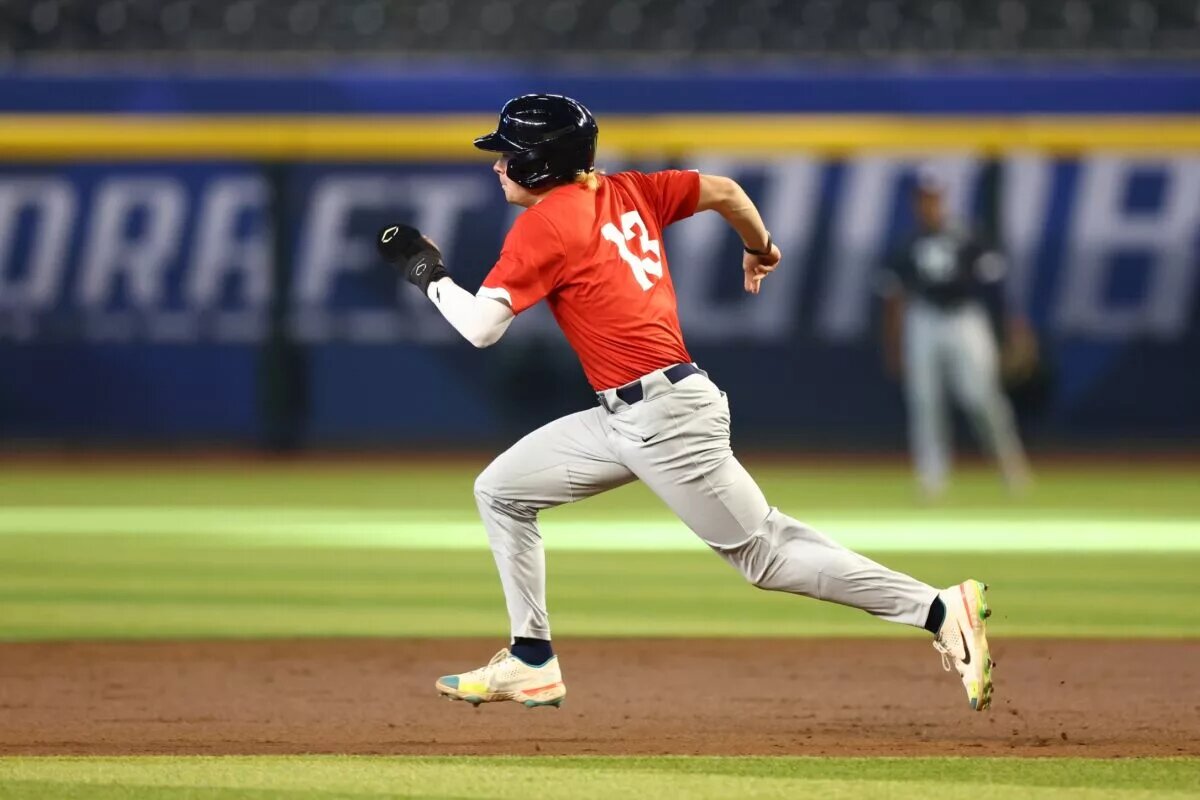

The MLB Draft Combine is underway at Chase Field in Arizona this week. It gives players a chance to work out in front of MLB front office personnel. Draft prospects go through batting practice, bullpens, strength workouts, and other drills and activities. Teams also meet with select draft prospects to get to know them better. While it may not be as big as the NFL’s Draft Combine, the MLB Draft Combine can affect players’ draft stocks come July, though not as much as their performances during the College World Series.
Notable MLB Draft Combine Attendees
The MLB Draft Combine is attended by high schoolers and college players who aren’t necessarily at the top of the draft class. Most players are Top 250 players trying to gain more visibility with scouts. Other guys are coming off injury and are trying to get in front of scouts one last time. From the college arm ranks, Logan Reddemann and Carson Wiggins will both throw bullpens. Reddemann is coming off a flexor strain that limited his availability for UCLA. Wiggins did not pitch this year due to Tommy John surgery. Tyler Spangler, a high school shortstop, worked out after missing the spring due to a back injury.
Some of the top standouts so far are from baseball families. Peyton Bonds, the nephew of Barry and grandson of Bobby, was pounding balls across Chase Field with 7 exit velocities over 100 mph. CC Sabathia’s son, Carsten, did the same, hitting 7 balls at 104.9 mph or higher during his round of batting practice. On the mound, Reddemann and Wiggins showed that there was still plenty of life in both arms. Neither guy was at their max fastball velocity, but they still impressed scouts and front-office executives.
Peyton Bonds, Barry’s nephew, taking some hacks at the MLB Draft Combine 💪
“[His bat] has a different sound.” pic.twitter.com/xdOdTBP5Xx
— MLB Network (@MLBNetwork) June 23, 2026
Past MLB Draft Combine Effects
The most notable piece of the MLB Draft Combine is the ability for draft prospects to take a physical while at Chase Field. For teams and players, it gives some insight into any lingering health issues or serves as a green light for others. Players obviously are not required to take one, but it is in their greatest interest, at least, for the top guys. If a player takes a physical at the MLB Draft Combine, no team can sign that player for less than 75% of the slot value of the pick where he is selected.
Last year, most notably, Eli Willits did not take a physical at the combine, and the Nationals were able to sign him at a discount. The discount ended up being slightly less than the 75% that would’ve been guaranteed had he taken a physical or had the Nationals selected a player who took a physical.
Ironically, at the MLB Draft Combine, great results don’t necessarily mean a player will rise up MLB draft boards. Teams have seen these players in games and on the showcase circuit, so opinions aren’t going to change overnight because of a good combine. For draft prospects, the most important part of the MLB Draft Combine is how they perform in their personal interviews. This allows teams to find out the intangibles of players better.
Overall, there were only two of the top performers at the MLB Draft Combine that really improved their draft stock. Both Jordan Yost and Tate Southisene were top performers at day one of the Combine and ended up getting drafted higher than their MLB Pipeline Draft Ranking. For Yost, the MLB Draft Combine solidified what scouts saw from him in the spring, after he was more of a pop-up prospect after an unproductive summer showcase circuit a year prior. As for Southisene, the combine proved how physically advanced he was at the time. He hit 12 balls over 100 mph during his round of batting practice.
Main Photo Credit: Mark J. Rebilas-USA TODAY Sports