
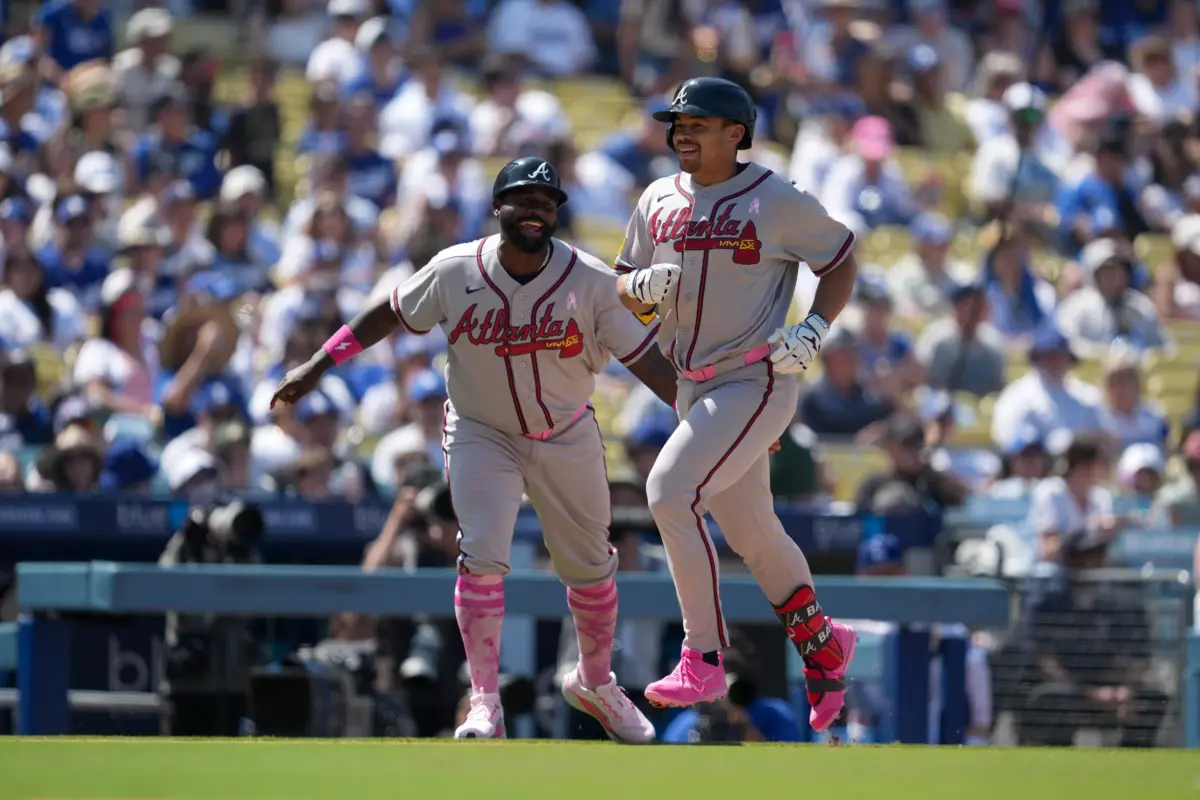

The Atlanta Braves MVP candidates are each delivering incredible seasons to start the 2026 campaign. Still, not all MVP cases are created equal. Some are fun. Some are credible. Some are “please stop laughing, I brought spreadsheets.” And some are Matt Olson standing over the whole conversation like a redwood tree with designer stubble that knows exactly how to mash a baseball.
So yes, Michael Harris II, Drake Baldwin, Ozzie Albies, and Olson all belong somewhere in the Atlanta Braves MVP conversation. MLB.com made the case recently that all four had laid early groundwork for MVP candidacies during Atlanta’s best 35-game start of the Modern Era, and the Braves have only kept rolling since then. After beating the Dodgers on May 10, Atlanta improved to an MLB-best 28-13, leading to “The Chop” returning to the team.
Just who are the Atlanta Braves MVP candidates?
But if we are ranking them by actual MVP viability, which means production, narrative, playing-time certainty, stat-sheet loudness, and whether voters will be able to ignore them without looking foolish, there is a clear order.
Here is the Atlanta Braves MVP candidates ladder, from “great start, tough case” to “this might actually happen.”
4. Michael Harris II
Michael Harris II being fourth on this list is less an insult than a reminder that this Braves lineup is rude. On a normal team, Harris would be treated like the engine. In Atlanta, he is somehow the fourth name in the MVP discussion, which is how you know the Braves are operating with a slightly unfair amount of offensive nonsense. His role was become even more important after losing Jurickson Profar to another PED suspension.
The case is real. Through 38 games, Harris is hitting .313/.341/.516 with seven home runs, 23 RBI, 15 runs, five doubles, and two stolen bases. That is a strong surface line, and Baseball Savant likes what is happening underneath even more: Harris owns a 95.2 mph average exit velocity, 59.4% hard-hit rate, .424 xwOBA, and 17.0% barrel rate. That is not “nice little center fielder having a moment” contact. That is “the ball is leaving the bat like it has somewhere better to be” contact.
The fun part of Harris’ profile is that he does not need to become some completely different hitter to stay valuable. He can run. He can defend center field. He gives the Braves athleticism in a lineup with plenty of thump already. When he is driving the ball like this, he becomes one of the more complete players on the roster.
The problem is the shape of the MVP case. Harris has the tools, but the counting stats are not quite obnoxious enough yet. His OPS is excellent, but it trails Olson, Baldwin, and Albies among this group. He has the best expected-contact argument of the non-Olson candidates, but MVP voters are not usually handing out hardware because someone’s xwOBA looks like it took pre-workout.
Harris also has the kind of athletic ease that makes the numbers feel more believable, not less. When he is right, everything about his game looks fluid and natural. The defense sparkles. The speed is stunning. The bat speed looks sharp. The MVP issue is not whether Harris looks like a star. He does. The issue is that Atlanta has three other candidates currently making louder arguments, and “very good at almost everything” can get drowned out when Olson is swinging a telephone pole and Baldwin is trying to rebrand catcher offense in real time.
3. Ozzie Albies
Albies is No. 3 among Atlanta Braves MVP candidates, though he feels easiest to underrate because we already know him. That is dangerous. Familiarity is where good baseball discourse goes to put on sweatpants and make lazy assumptions.
Through 41 games, Albies is hitting .306/.356/.506 with eight home runs, 25 RBI, 30 runs, 49 hits, and an .862 OPS. FanGraphs has him at 1.5 WAR with a 140 wRC+, which means he has been 40% better than league average at the plate after adjusting for park and league context. That is the clean version of the case: Albies is producing, playing second base, striking out at a low rate, and looking like a major piece of the Braves’ early-season machine.
The messier version is that the underlying data is not quite as convinced. Baseball Savant has Albies at an 86.4 mph average exit velocity, 28.4% hard-hit rate, .376 wOBA, .307 xwOBA, and 4.3% barrel rate. In normal human English, that means the results have been excellent, but the contact quality is not screaming “MVP monster” in quite the same way Olson, Harris, or Baldwin are, which does not kill the case. It just makes it more complicated.
Albies has always been a slightly odd statistical creature. He is compact, aggressive, switch-hitting, occasionally streaky, and capable of looking like he has solved baseball for three weeks at a time. His MVP argument is not built on raw punishment the way Olson’s is. It is built on balance: average, power, middle-infield value, lineup presence, and the bounce-back narrative after a frustrating 2025 season.
That rebound angle matters. Albies hit just .240 with a .365 slugging percentage in 2025, so this version looks like a player who has very much found the missing parts of himself. Reuters noted after last season that Atlanta picked up his 2026 option after a year in which he played 157 games, hit 16 home runs, and drove in 74 runs, but this season’s early production already has a different charge to it.
Albies is also already a fan favorite, which helps, because Braves fans do not need much convincing to get back aboard the Ozzie ride. But this is not just nostalgia wearing a tiny helmet. He is putting together one of the finest seasons of his career and, at this pace, is at least flirting with the shape of his tremendous 2021 campaign, when he finished with 30 home runs, 106 RBI, 103 runs, 40 doubles, and a Silver Slugger. That does not mean he has to duplicate every number to stay in the MVP conversation. It does mean this version of Albies looks much closer to peak Albies than last year’s slightly unplugged model.
The reasons Albies is on this list are simple: the surface stats, the position, the run production, and the bounce-back story are all real. The reason he is not higher is even simpler: Olson and Baldwin are doing louder, cleaner, and scarier versions of the whole MVP thing.
2. Drake Baldwin
Drake Baldwin is the weirdest candidate here, which also makes him the most fun. A second-year catcher forcing his way into the Atlanta Braves MVP candidates conversation is not how these things usually work. Catchers are supposed to be respected, bruised, occasionally applauded, and then politely escorted away from the glamour stats. Baldwin is making that difficult.
Through 41 games, Baldwin is hitting .297/.383/.509 with 10 home runs, 32 RBI, 35 runs, 49 hits, and an .892 OPS. FanGraphs has his offensive profile sitting at a 125 wRC+, while Baseball Reference has him at 2.1 WAR. Baseball Savant is buying the bat, too, with Baldwin carrying a 91.9 mph average exit velocity, 50.4% hard-hit rate, .393 xwOBA, and 13.8% barrel rate.
The Braves are resplendent with Rookie of the Year winners, as well as others who just missed the ROY mark like Spencer Strider, which is a very nice problem to have. The catch, of course, is that the sophomore slump can sneak up on promising young players fast. Young players get adjusted to, pitchers find the holes, and suddenly the shiny new franchise piece is staring at breaking balls as they sail by for strike three. Baldwin has mostly skipped that nonsense. He looks like he learned everything he needed to learn in one year so he could become the Braves’ backstop cornerstone for years to come, with a little Brian McCann energy in the profile: left-handed bat, real middle-order damage, and the kind of catcher stability that quietly changes an entire roster.
The real argument for Baldwin is positional value. A catcher hitting like a middle-of-the-order masher is the baseball equivalent of finding out your accountant also fronts a very competent stoner-metal band on weekends. It changes the whole room. Baldwin’s offensive production is already strong enough on its own, but when it comes from behind the plate, it gets heavier.
He also has the narrative. He was the 2025 NL Rookie of the Year, and now he looks like he has skipped the “prove it again” stage and gone directly to “problem for the National League.” That matters. Voters like a young star arriving ahead of schedule, especially when the numbers are not being held together with vibes, duct tape, and a favorable BABIP prayer.
The reason he sits second is not because his case lacks juice. It is because MVP viability is also about workload, perception, and whether the stat line stays loud across six months. Catching is brutal. The position can grind down legs, timing, swing paths, sleep patterns, and probably the human soul. Baldwin also has to fight the “young catcher having a hot start” skepticism, fair or not.
Still, this is no longer a cute story. Baldwin is a real candidate. If he is still hovering near an .900 OPS in July while catching regularly, this conversation is going to get much less theoretical.
1. Matt Olson
Olson is the clear No. 1 among Atlanta Braves MVP candidates because there is no need to get cute here. Sometimes the obvious answer is obvious because it is correct. Olson is currently the Braves’ loudest, strongest, easiest-to-understand MVP case, and pretending otherwise feels like trying to explain away a thunderstorm with vibes. And for all the coaches out there who love to say, “The best ability is availability,” boy, do we have the player for you.
Olson is not just available. Olson is historically available. As of May 10, he had played in 823 consecutive games, passing Gus Suhr for sole possession of the 10th-longest consecutive games played streak in MLB history. Next up is Eddie Yost’s ninth-place streak of 829 games, which Olson can tie against the Red Sox on Sunday and pass against the Marlins next Monday if the streak continues.
That is absurd in the modern game. Players get regular rest days now. Teams monitor workloads. Front offices talk about recovery like they are managing astronauts. Olson just keeps showing up, clocking in, playing first base, and ruining someone’s evening. If Olson’s No. 1 ability is availability, though, his No. 2 ability is “crushing baseballs,” and the gap is not exactly Grand Canyon-sized.
Through 41 games, Olson is hitting .296/.377/.654 with 14 home runs, 36 runs, 36 RBI, 15 doubles, 29 extra-base hits, and a 1.031 OPS. FanGraphs has him at 2.4 WAR with a 181 wRC+, while Baseball Reference has him at 2.5 WAR with a 187 OPS+. Translation: pick your nerd church, and Olson is still sitting near the front pew.
Beyond the analytics, Olson simply looks the part. His swings feel threatening before the ball even gets there, his presence in the Braves lineup is forceful, and his value is not confined to spreadsheets, even very handsome spreadsheets. He has also delivered the kind of signature moment MVP cases need, blasting his first walk-off homer as a Brave against the Detroit Tigers on April 29. It was his fourth career walk-off homer, but his first since joining Atlanta before the 2022 season, and it came off former Braves closer Kenley Jansen.
The old-school numbers are exactly what MVP voters like to see, too. ESPN lists Olson tied for fourth in MLB in home runs, tied for second in RBI, and fourth in OPS. He leads the Braves in homers, runs, RBI, doubles, slugging, and OPS. He is second in the National League in home runs behind Kyle Schwarber, and he has been one of the most productive hitters in either league.
Then there is the extra-base hit pileup, which is where Olson’s case starts to look less like a strong start and more like controlled property damage. Add the 15 doubles to the 14 homers, and he is already at 29 extra-base hits. That is the sort of number that makes a season feel loud before Memorial Day.
The Baseball Savant profile is even more wonderfully impolite. Olson has a 93.5 mph average exit velocity, 52.1% hard-hit rate, .435 wOBA, .406 xwOBA, and 19.7% barrel rate. He is not just getting results. He is earning them in a way that makes regression less of a boogeyman and more of a mild administrative concern.
Reuters noted that Olson and Baldwin both homered in Atlanta’s May 10 win over the Dodgers, with Olson’s ninth-inning shot marking his 14th homer of the season as the Braves improved to 28-13. That is the headline version of the case: baseball’s best team, its most reliable everyday player, and a first baseman hitting like he is trying to dent the moon.
There is also a defensive component here that should not be treated like garnish. First base defense usually gets discussed only when someone is bad enough to make every throw across the diamond feel like a hostage negotiation. Olson is not that. He is one of the more valuable defensive first basemen in the sport, and while nobody is voting a first baseman MVP because of glove work alone, it absolutely strengthens the file. He is not merely standing near the bag waiting to hit again. He is helping the Braves win in multiple ways.
That is the separator. Olson has the best WAR case, the biggest power case, the strongest traditional MVP case, the durability case, and the easiest narrative. He is an Iron Man slugger on baseball’s best team, producing like one of the top handful of players in the sport. That is not a complicated pitch. That is the pitch.
The Braves Have Four Real MVP Candidates
The Braves have four real candidates. Harris is the five-tool riser. Baldwin is the catcher chaos agent. Albies is the polished all-around star playing himself back into the national conversation. But Olson is the guy.
Right now, the Atlanta Braves MVP candidates ladder does not end in mystery. It ends with Matt Olson standing at the top, hitting baseballs very hard, very far, very often, and very rudely.
If the Braves keep winning and Olson keeps playing every day while hitting like this, we may not just be looking at the Braves’ MVP. We may be looking at an MVP Iron Man.
Main Image Credit: Kirby Lee-Imagn Images