
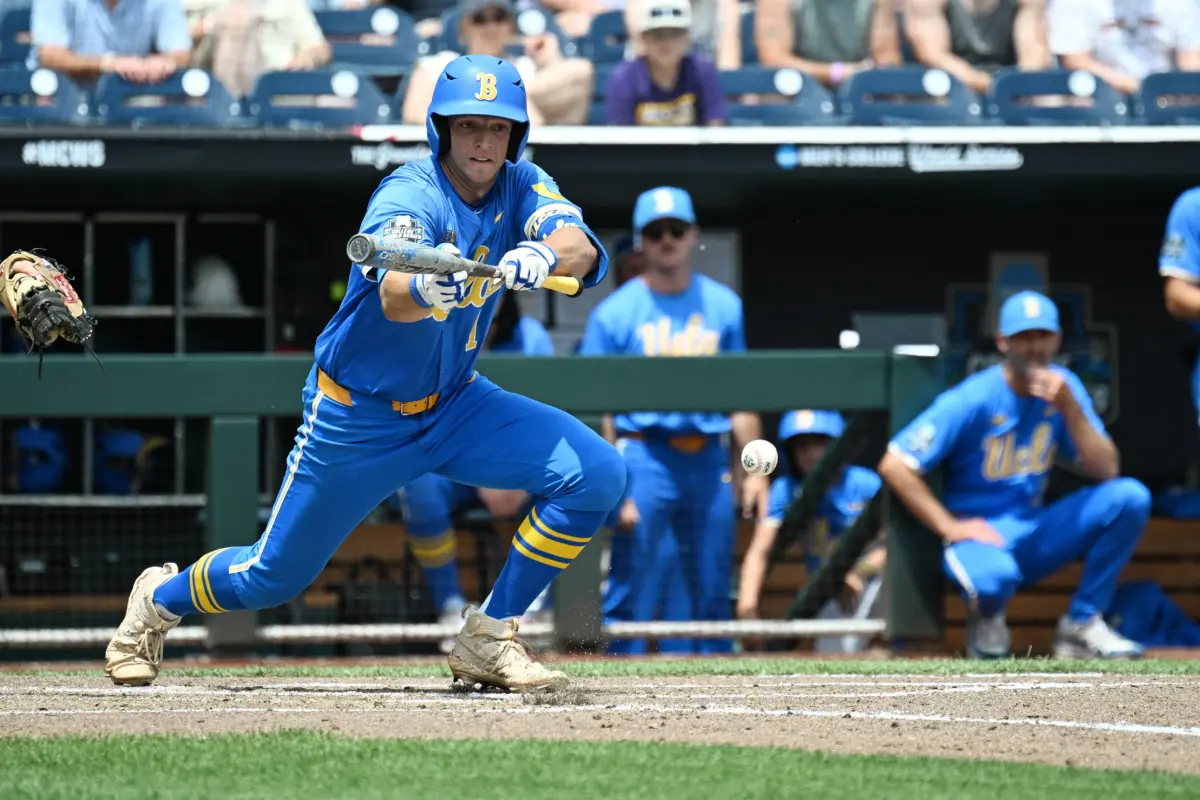

Imagine batting .331 with 13 home runs, a little over halfway through the college season, and being a disappointment. This is the reality for Roch Cholowsky. Going into the season, he was the top college draft prospect, and he has remained that way ever since, even as others improved their draft stock.
Who Is the Big Cholowsky
Before the start of the 2026 baseball season, Cholowsky was the most surefire number one overall pick since Adley Rutschman in 2019. Similar to Rutschman, Cholowsky plays a premium position on the dirt, manning shortstop for the UCLA Bruins. Cholowsky comes from a baseball family where his dad was drafted 35 years ago by the St. Louis Cardinals and continues to work as a scout. On the field, Cholowsky has dominated during his time at UCLA. He’s won Big Ten Player of the Year, ABCA/Rawlings Player of the Year, and been named an All-American, all in the span of two seasons in college. These awards and baseball background only begin to demonstrate why Cholowsky is a top college prospect.
Why He’s the Best College Prospect
Cholowsky has played since day one at UCLA. As a Bruin, he has highlighted four plus tools. To go along with the aforementioned awards, he has also won a College Gold Glove award. This, along with his advanced instincts, is the reason he will stick at shortstop long term. At the dish, Cholowsky has long distinguished himself from his peers as a college prospect. From a power perspective, he can lift the ball to all fields, but he really shows strong raw power to left field. He also rarely whiffs and walks as much as he strikes out.
With four plus tools, Cholowsky is one of the best college prospects of this century. Troy Tulowitzki is the closest potential to what Cholowsky can produce from a college bat going into the draft. However, Cholowsky looks to be ahead of Tulowitzki as a prospect. From a power perspective, Cholowsky hit more home runs in two seasons than Tulowitzki did his whole career at Long Beach State. Cholowsky also shows a more advanced approach, striking out less than Tulowitzki and walking at a much higher rate. This is even more impressive when you consider that Cholowsky is facing tougher competition than what Tulowitzki did. Cholowsky’s baseball bloodline is just another reason to put him ahead of Tulowitzki at this point in their careers.
Draft Outcome
Cholowsky is likely a lock for the number one overall pick come July for the Chicago White Sox. Obviously, there are a few things that can change for a college prospect as the draft comes around. Paul Skenes moved to the top of his draft thanks to a strong College World Series performance. Additionally, if an injury were to occur, the college prospect could fall. Finally, there is a new phenomenon that occurred in last year’s draft. Eli Willits was taken number one overall, much to the surprise of industry professionals. Under the current system, if a player takes a physical at the draft combine, the lowest amount of money they can sign for is 75% of the slot value of the pick. Therefore, Willits was able to sign at a discount compared to his peers last July.
The White Sox’s other alternatives are led by Grady Emerson and Jackson Flora. Emerson is the best prep hitter in a weak class and also a shortstop. He also has the potential to be a five-tool player. The high school standout is seen to be equivalent to Cholowsky on the hit, power, arm, and defensive tools, and a better runner than the Bruin. However, Cholowsky has a proven track record in college against more advanced competition. Meanwhile, Flora is the best arm in the class. He is a right-handed starting pitcher for UC Santa Barbara. He profiles to have a top-end fastball and currently throws two different sliders and a changeup. Even though these players are both top-end prospects, Cholowsky still profiles as the best college prospect and best player available in the draft.
Main Photo Credit: Steven Branscombe-Imagn Images