
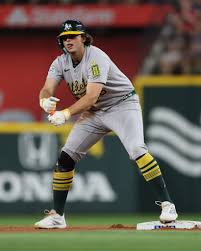

The A’s have quietly rewritten their long-term blueprint. Instead of allowing elite young talent to drift toward arbitration and eventual free agency, the organization has made it clear: the core is being built to stay. If that philosophy continues, Nick Kurtz is the most important extension candidate on the board.
This wouldn’t be an arbitration-year negotiation or a free-agent bidding war.
This would be a pre-arbitration extension, where belief, timing, and structure matter more than raw market value.
Kurtz already looks like a franchise cornerstone. His combination of advanced plate discipline, left-handed power, and mature approach is rare — the type of offensive profile that evaluators believe will age well and anchor a lineup for years. The word “generational” is used sparingly around baseball, but Kurtz is inching into that conversation based on skill, not hype.
For the A’s, the challenge is clear: how do you pay a potentially generational player without abandoning financial discipline?
The Hometown Discount Reality

Here’s where this gets interesting.
Kurtz would almost certainly be willing to take a hometown discount.
He understands the opportunity to become the face of the franchise, values early financial security, and knows what stability means in a sport where careers can change overnight. That willingness gives the A’s rare leverage — the chance to go bigger than a standard extension without crossing into risky territory.
Why Pre-Arbitration Changes the Math
Because Kurtz hasn’t reached arbitration, the A’s hold meaningful leverage. In return, they can offer what young stars value most: guaranteed money and long-term commitment.
Rather than a conservative deal that simply buys out arbitration years, the A’s could aim higher — closer to generational territory, but still well below true superstar free-agent pricing.

A Fair, Aggressive Framework
A realistic pre-arbitration extension could look like this:
9 years, $115–125 million guaranteed
Maximum value: $160–175+ million with incentives
This structure:
-
Buys out all pre-arbitration and arbitration seasons
-
Secures four to five free-agent years
-
Keeps average annual value manageable
-
Protects the club while rewarding elite performance
Sample Breakdown:
-
Years 1–3: $2–3M annually
-
Years 4–6: $7–12M annually
-
Years 7–9: $18–22M annually
-
Vesting option Year 10: $25M+
That places the guaranteed AAV around $12M, a number that fits the A’s model while still signaling full belief in the player.
Incentives Close the Gap
Incentives are what elevate this from team-friendly to fair.
Possible escalators include:
-
Plate appearance thresholds
-
All-Star selections
-
Silver Slugger awards
-
MVP top-10 finishes
-
Team postseason appearances
If Kurtz becomes a perennial All-Star or MVP candidate, his earnings naturally climb into the $20M+ range during his prime — still below open-market value, but reflective of true impact.
The Last Word
A pre-arbitration, incentive-heavy extension in the $115–125M range, supported by a hometown discount, is the ideal middle ground for Nick Kurtz and the A’s. It’s bold without being reckless, ambitious without breaking precedent.
If the A’s are serious about building around elite talent,
This is the bet that defines the next era — and Nick Kurtz is worth it.