
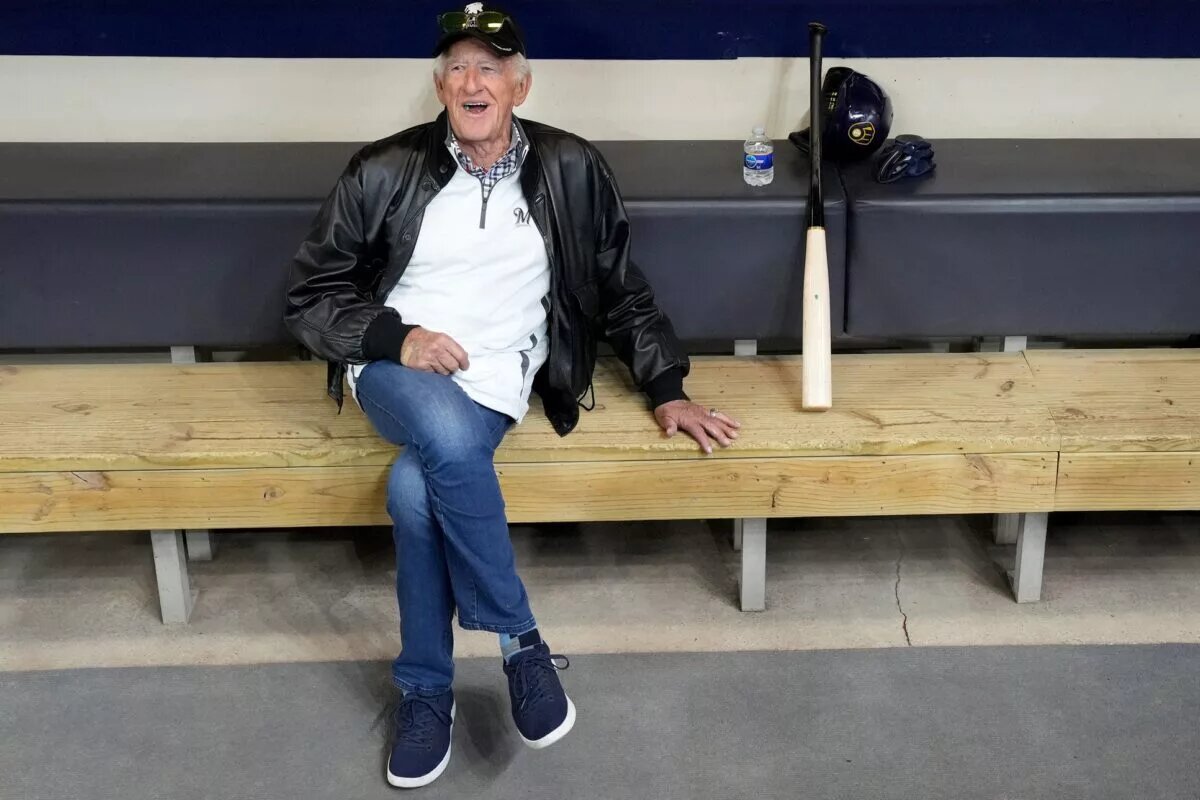

Did you hear the one about the time Bob Uecker propelled the St. Louis Cardinals to the 1964 World Series? First, let’s set the scene before we get too far ahead of ourselves.
Bob Uecker Was Once a Hero for the Cardinals
Wanted: A Good Defensive Catcher
In 1963, the Cards were 93-69 but finished in second place in the National League, six games behind the eventual World Series champion Los Angeles Dodgers. One of the reasons for their second-place finish was their 6-12 record against the Dodgers. One of the reasons for that 6-12 mark, according to Cardinals general manager Bing Devine, was his catchers’ inability to stop the Dodgers’ Maury Wills from running rampant on the base paths. (Wills, who died in 2022, led all baseball with 40 stolen bases in 1963.)
Thus, to shore up the defense behind the dish, on April 9, 1964, Devine traded Jimmie Coker and Gary Kolb to the Milwaukee Braves to obtain seldom-used catcher Bob Uecker for the Cardinals. Yes, that Bob Uecker. The same Bob Uecker who passed away recently and had a successful post-playing career spent largely ridiculing his baseball abilities. Indeed, the 30-year-old Uecker had caught six of nine would-be base stealers in 30 games with Milwaukee. The right-handed batter was just a .250/.326/.338 career hitter up to that point. The Cardinals’ starting catcher would be 22-year-old left-handed batter Tim McCarver, who hit .289/.333/.383 in 1963. It was thought Uecker would occasionally spell McCarver against left-handed pitching while providing good defense.
Uecker Walks It Off
Fast forward to September 1, 1964. The Cardinals entered the day in fourth place in the NL, seven-and-one-half games behind the first-place Philadelphia Phillies. At home in Busch Stadium against the Braves, St. Louis fell behind, 4-0, in the third inning. A two-run homer by Ken Boyer off Denny Lemaster in the bottom of the inning cut the lead in half. Later, in the fourth inning, Uecker, who walked in his previous plate appearance, shocked the 8,079 in attendance by crushing a long solo home run into deep left field. It was Uecker’s first home run of the year and second of his career. With the score tied 4-4 in the bottom of the ninth, Julián Javier hit a one-out double off Lemaster. Lemaster then walked Carl Warwick intentionally to get to Uecker. The strategy backfired when Uecker lined a single into left field, scoring Javier to give the Cardinals what would today be called a walk-off win.
After the game, Uecker declined to gloat over his old team. He told the St. Louis Post-Dispatch, “I was just happy to get some hits. I’d been hitting the ball good [sic], but right at somebody.” In his post-playing standup routine, he’d never give himself credit for as much as “hitting the ball good.”
The Phillies in Panic Mode
After Uecker delivered, the Cardinals went 21-10 to close out the regular season. Meanwhile, the Phillies were imploding in one of the most epic collapses in sports history. On September 20, they were six-and-one-half games ahead of the Cardinals and Cincinnati Reds, who were tied for second place, with 12 games left in the season. The Phillies then proceeded to lose 10 in a row. Their manager Gene Mauch, a highly regarded tactician and “small ball” proponent who could never get out of his own way whenever there was a pennant to be won, panicked down the stretch and started pitchers Jim Bunning and Chris Short in eight of 11 games, often on just two days’ rest. Over that stretch, Bunning’s ERA was 4.45. Short’s was 4.56.
The 1964 Phillies still wonder what could have been 60 years after a collapse cost them the pennant.
“Just imagine if we would’ve been in the World Series. Today, they would still be honoring that. That would’ve been unbelievable. It wasn’t to be.”
— Matt Breen (@matt_breen) September 26, 2024
The Cardinals on a Roll
The Cardinals were rolling. They won four of five games, all in walk-off fashion, from September 4-7. On the 4th, it was Boyer’s three-run homer that beat the Chicago Cubs, 8-5. On the 6th, it was a bad-hop single by former Cub Lou Brock in the 11th inning that defeated the Cubs, 5-4. The next day, St. Louis won both games of a Labor Day doubleheader against the Reds, by identical 3-2 scores. McCarver was the hero with the winning single in the first game. Curt Flood’s single won the second game.
On September 13 at Wrigley Field, the Cards became the second team in baseball history, and first since 1923, to score in every inning of a game when they trounced the Cubs, 15-2. They just about sewed up the pennant with an eight-game winning streak from September 24-30. That included a five-game sweep of the Pittsburgh Pirates at Forbes Field and a three-game sweep at home vs. the Phillies. They wrapped up the pennant on October 4 with an 11-5 win over the New York Mets. The Cardinals then went on to win the World Series in seven games against the New York Yankees.
The Last Word
After Uecker’s big hit, he was 5-for-26, but with a .344 OBP, during that 21-10 stretch. In subsequent retellings over the years, his Cardinals teammates credited his hit for being the catalyst for what followed. (Meanwhile, the Yankees credited a harmonica for inspiring their late-season pennant run.) One wonders whether those Cardinals were engaging in revisionist history. After all, the Cardinals had won six of seven games before Uecker won the September 1 game. Then again, they were there, and I wasn’t, so I’ll take their word for it. It makes for a nice story.
Photo Credit: © Mike De Sisti / USA TODAY NETWORK via Imagn Images