
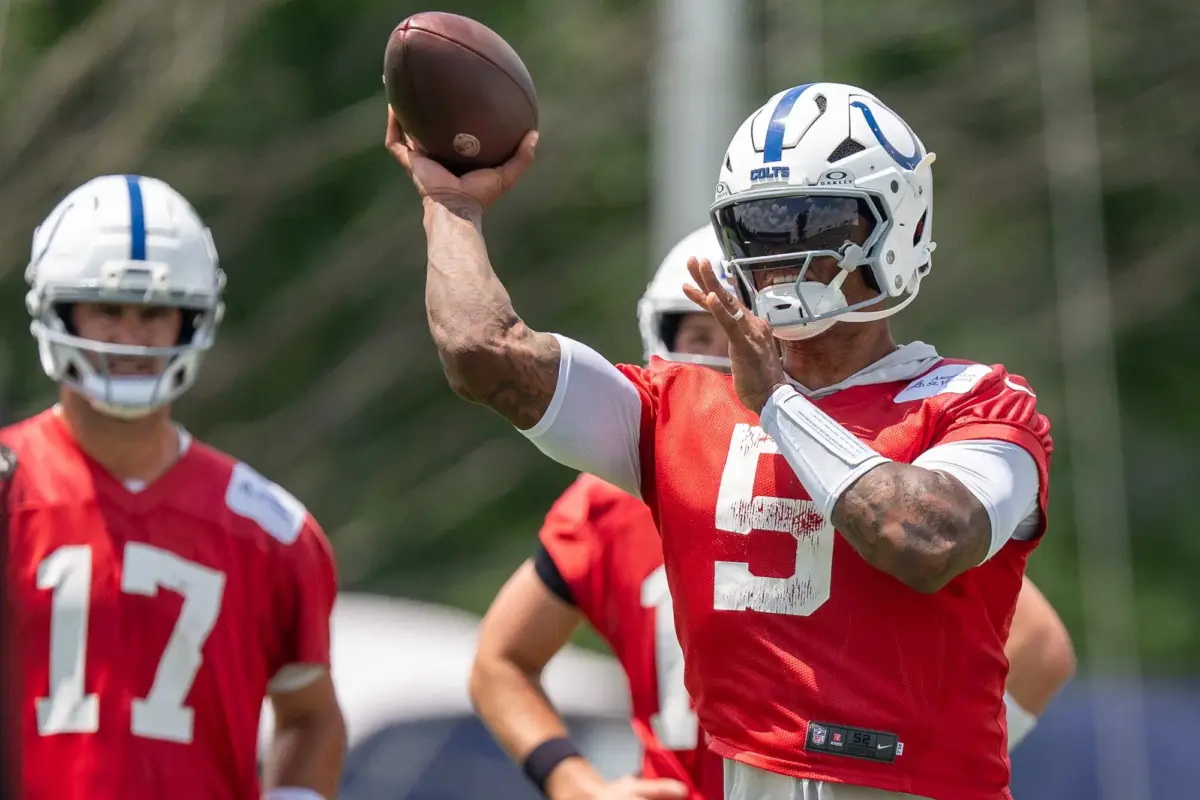

The reasons why Anthony Richardson failed to become the quarterback the Indianapolis Colts thought they were drafting is a more complicated story than a simple case of bad luck. It starts, oddly enough, with a near-identical bet that worked out for someone else.
Every draft class has a player who tempts evaluators to ignore the stat sheet. In 2018, that player was Josh Allen — 6-foot-5, a cannon arm, and a completion percentage so low that some scouts compared him to first-round bust Kyle Boller. Buffalo took Allen seventh overall anyway, and he became the MVP of the league.
In 2023, that player was Richardson — 6-foot-4, 244 pounds, a similarly alarming accuracy profile coming out of Florida. Indianapolis took him fourth overall anyway. Three years later, the Colts have declined Richardson’s fifth-year option, found almost no trade interest around the league, and handed the starting job to a quarterback the Giants didn’t want anymore.
Same bet. Same flaw on the scouting report. Wildly different outcomes. The interesting question isn’t whether the Colts gambled — every team that drafts a raw, toolsy quarterback is gambling, especially with a top-10 pick. It’s this: Why did the gamble that paid off in Buffalo collapse in Indianapolis?
Why Colts QB Anthony Richardson Failed To Become Josh Allen
Same Bet, Different Outcomes
Set the scouting reports side by side, and the overlap jumps off the page.
Allen started two seasons at Wyoming and completed 56 percent of his passes both years — a career mark so low that some draft analysts compared him to Boller, the prototypical big arm who never developed touch after going to the Baltimore Ravens in 2003. Scouts flagged the same root issues that would later show up in Richardson’s profile: accuracy that broke down under pressure, questionable footwork, a tendency to rely on arm strength instead of placement. One study found Allen completed barely half his passes once pressured and didn’t crack 42 percent on deep throws. The knock wasn’t subtle; it was the headline.
Richardson’s red flags were nearly identical. One full season as a starter at Florida, a 53.8 percent completion rate, 17 touchdowns against 9 interceptions in a 6-6 campaign. Like Allen, the physical traits jumped off the screen — 4.43 speed at 244 pounds, an arm that made scouts compare him to peak Cam Newton — while the accuracy and decision-making lagged years behind the rest of his game.
Both the Bills and Colts made the same argument to their fanbases: the flaw is real, but the upside is worth gambling that it will get fixed.
For one of them, that bet has paid off. For the other, that bet appears lost. The only question is what made the difference.
How Allen Fixed His Flaws
The Allen breakthrough wasn’t magic. Despite the fact that Allen’s mountain of talent is undeniable, it wasn’t really about talent, either. It was specific, mechanical, and traceable.
Working with private throwing coach Chris Hess, Allen rebuilt his throwing motion around his hips and lower body instead of relying on his arm alone — the exact flaw scouts had flagged at Wyoming. The result was a 17 percent jump in completion percentage between his rookie season and his third year, believed to be the largest two-year accuracy improvement in NFL history, per NFL Films. Allen’s personal offseason quarterback coach, Jordan Palmer, was blunt about where the fix lived: “He drastically changed his base that he played with.” Not his arm. His feet.
That fix needed two other things to hold: an athlete being able to absorb a mechanical overhaul quickly, and a stable football environment to repeat it in. Allen had both. He played under the same offensive coordinator, Brian Daboll, for four consecutive seasons, building one continuous system rather than restarting under a new staff or scheme. Even as the people around him on offense changed nearly every year, the structure he was operating inside of did not.
Why Anthony Richardson Failed: Troubles Persist
Richardson has played for only one head coach, Shane Steichen, in his three NFL seasons, but he’s never had a year free of disruption to actually work on what’s broken.
— His rookie year ended after four games due to shoulder surgery.
— His second year included a benching for Joe Flacco after he was criticized for removing himself from a game. Richardson completed just 47.7 percent of his passes, one of the lowest completion rates recorded by a starting quarterback in the modern NFL. He threw for 1,814 yards with 8 touchdowns and 12 interceptions. He battled injuries all year, and his season ended with a back injury.
— His third and most recent season began with Daniel Jones being named starter and ended in October when a malfunctioning resistance band snapped and struck him in the face during pregame warmups, resulting in an orbital fracture. He threw only two passes in a game all season.
There was never a stretch of healthy, uninterrupted reps long enough to rebuild a throwing motion the way Allen did. Richardson has started only 15 NFL games since being drafted. And he started only 13 games in his entire college career at Florida. It’s a bit mind-blowing to consider he’s heading into his fourth NFL season, and he’s started only 28 NFL and college games combined.
At one point rumors surfaced that he would work with Allen and Hess, but Richardson confirmed to The Athletic that it didn’t end up happening.
None of this guarantees Richardson would have followed Allen’s path with better luck. Quarterback development isn’t purely mechanical, and Allen may have possessed traits that are difficult to measure or project — processing speed, adaptability, consistency, or simply an unusual ability to translate coaching into on-field improvement. That’s part of what makes Allen’s rise so rare. But Richardson never really reached the point where evaluators could find out whether he had those same developmental qualities. The injuries, interruptions, and lack of playing time arrived first.
What Comes Next for Richardson
Clearly, if Richardson’s going to find an arc of improvement that’s anything close to Allen’s, he needs a lot more reps. Many more starts. That’s extremely unlikely to happen in Indianapolis, because the Colts just gave Jones a two-year, $88 million contract.
Jones arrived in Indianapolis in March 2025 as a low-cost, low-expectation signing. He ended up beating out Richardson and leading the Colts to an 8-2 start before suffering a torn Achilles. Jones finished 2025 completing 68 percent of his passes — the second-best mark in Colts history, behind only Peyton Manning — for 3,101 yards, 19 touchdowns, and a 100.2 rating.
Richardson is only 24, which is exactly why some team, somewhere, will probably take a flier on him — a contender that loses a starter in camp, a rebuilding roster with nothing to lose, a coach convinced he can find what Florida and Indianapolis couldn’t. The Allen comparison will get made again, by someone, as the reason to bet on him.
But the real lesson of the Allen comparison cuts the other way. Allen didn’t arrive in Buffalo and simply outgrow his flaw with reps and patience. He fixed a specific, diagnosed mechanical issue, with a specialist hired to fix exactly that, inside four straight years of offensive continuity. Richardson never had the uninterrupted runway for that kind of project.
For now, Richardson is in Indianapolis fighting Riley Leonard for a backup job he never expected to need, with a $10.8 million cap hit the Colts will likely have to eat part of just to find him a new home.
The Colts took a gamble when they drafted Richardson. Now, the quarterback needs luck of his own.
Main Image: Mykal McEldowney/IndyStar / USA TODAY NETWORK via Imagn Images