
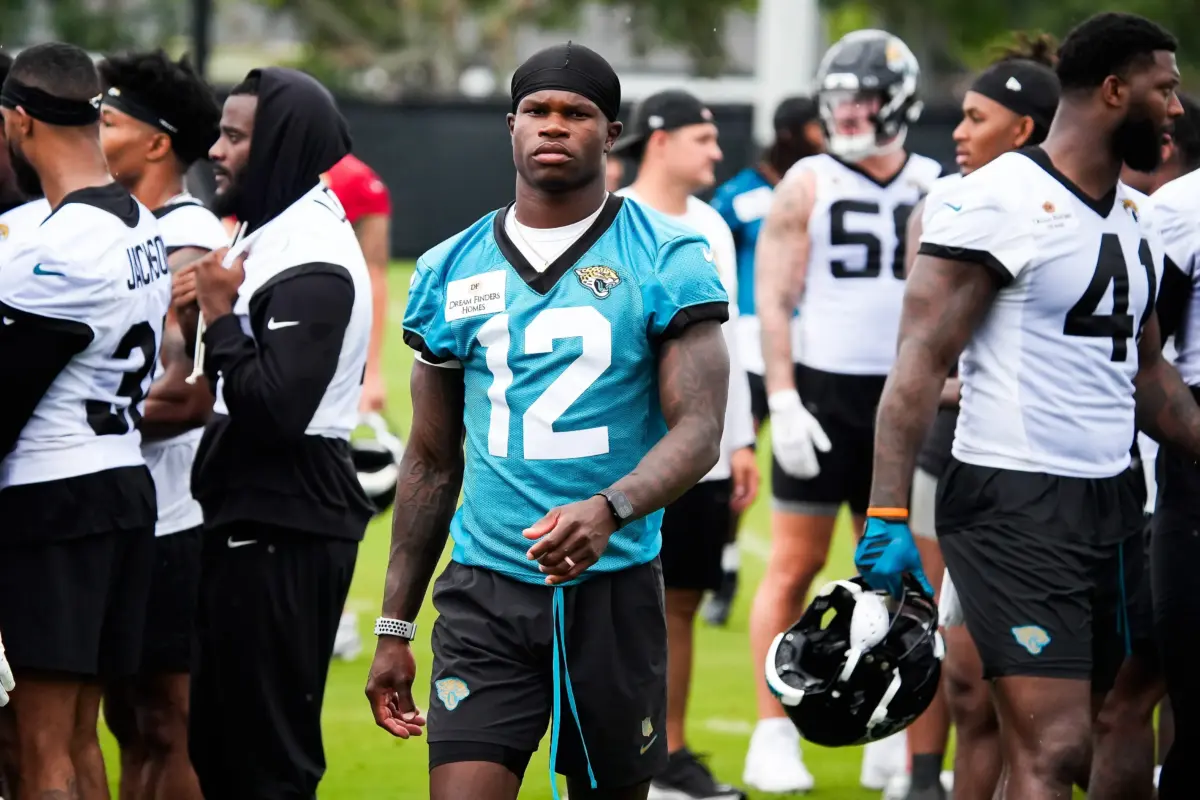

Travis Hunter’s rookie campaign was a confusing mess for large parts of his season. Some weeks, he would play the majority of his snaps at wide receiver, and others he would play the majority at cornerback. There never seemed to be an effective plan for the young rookie, and it showed in the team’s rhythm every week.
After his season was over in just seven games, the Jacksonville Jaguars traded for wide receiver Jakobi Meyers. The offense took off, and the defense remained one of the top units in football despite Hunter’s absence. The Jaguars’ needs at wide receiver have been fully addressed, and the defensive back room is in need of improvement. With reports coming out discussing Hunter’s expected usage being primarily on the defensive side of the ball, the question about Hunter’s ceiling as a player brings a variety of possible answers.
What Is Travis Hunter’s Ceiling?
Defensive back
As a defensive back, Travis Hunter’s time on this side of the ball is extremely limited. Hunter played in just seven games and played just 36% of the defensive snaps during this time. He allowed a 50% completion rate, a 68.3 passer rating, and deflected three passes. He has fluid hips and rarely gets fooled or beaten down the field.
His small frame raises questions as a tackler, but as a cover corner, he has shown a lot of promise in his limited playing time. The Jaguars run a zone-heavy defense that relies on jumping routes and timing passes to create incompletions or turnovers. Hunter has excellent burst in and out of routes, but also gives the Jaguars the option to run more man coverage and be more unpredictable.
In 2026, Hunter can greatly improve the Jaguars secondary and become a Pro Bowler. The Jaguars have been looking for their next Jalen Ramsey since 2019, and Hunter very well could become that. He is ready to take the next step and become a long-term option that anchors the secondary and makes multiple All-Pro teams.
Wide receiver
In 2025, Hunter played 67% of the offensive snaps and was trying to quickly fit in with Trevor Lawrence in a crowded wide receiver room. He had flashes of huge talent at the wide receiver position, but could not consistently produce. His fit in the offense was clunky, and his production was often limited to forcing him to the ball through screens and quick passes.
Hunter has shown the ability to make plays in space, but is not yet an extremely fluid route runner. Still, there is time for improvement, and with another year of meshing with quarterback Trevor Lawrence and coach Liam Coen, he should be able to find his footing as the Jaguars’ fourth option in the offense.
He will draw most teams’ worst defensive back, and will likely play most of his snaps on critical third downs and in the red zone, where he can make the most impact on a game. Against the Los Angeles Rams and Kansas City Chiefs, he showed what he is capable of when he receives targets in the flow of the game and how he can open up the offense. Due to his part-time role on offense and being more raw at the position, he will likely never put up eye-popping numbers. But his impact and natural skill will be a key part in how far the Jaguars’ offense can go.
Main Image: Doug Engle/Florida Times-Union / USA TODAY NETWORK via Imagn Images