
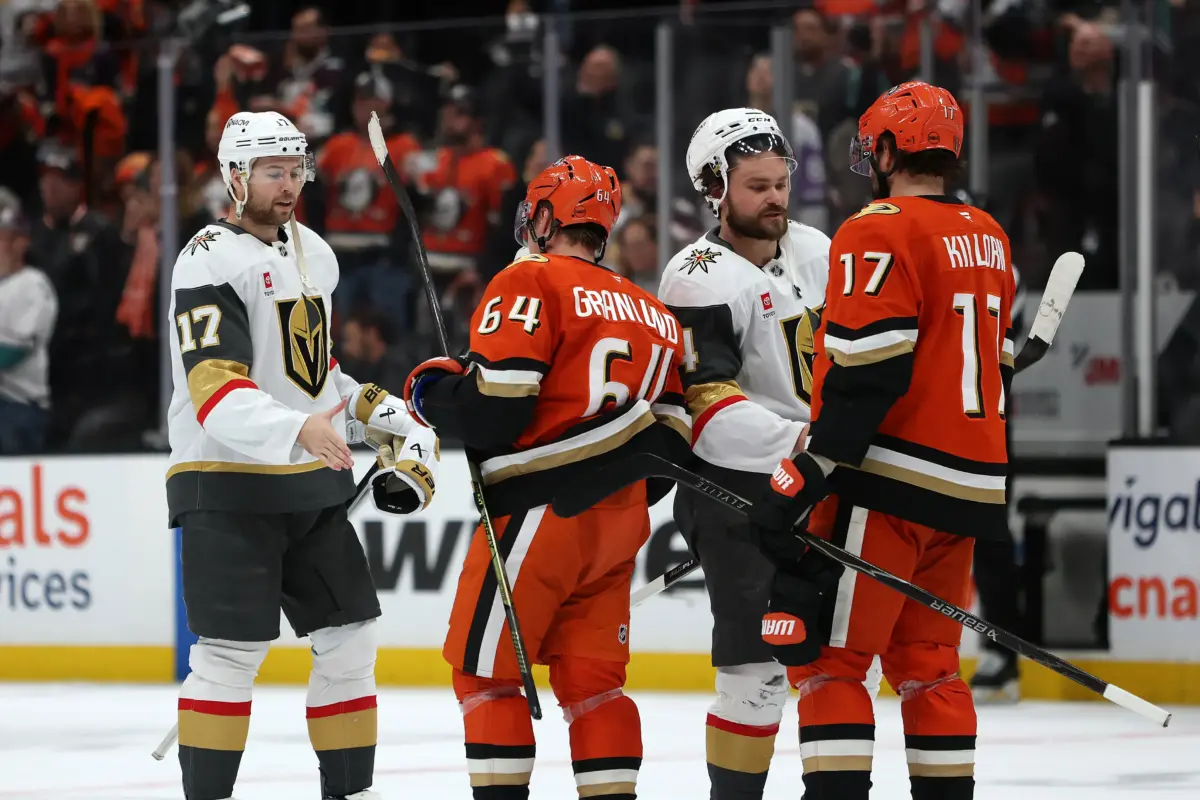

It’s over. The Vegas Golden Knights have eliminated the Anaheim Ducks in six games, advancing to the Western Conference Final after a composed 5–1 victory in Game 6 at Honda Center. Vegas entered the series as the more experienced and structurally complete team, and over six tightly contested games, that difference increasingly showed itself in the sport’s highest-leverage moments. This Ducks vs Golden Knights recap highlights how Anaheim’s rapid playoff growth collided with the ruthless precision of a true Stanley Cup contender.
Moreover, the series evolved far beyond the expectations surrounding Anaheim entering Round 2. The Ducks were no longer viewed as a young team simply happy to be there. Instead, they pushed Vegas territorially for long stretches, matched the Golden Knights structurally at times, and consistently threatened to swing games with their pace and transition offence. However, Vegas repeatedly found cleaner answers in the moments that mattered most.
Series Review: Anaheim Ducks vs Vegas Golden Knights
Series Summary
Game 1: Golden Knights 5, Ducks 2 | (1–0 VGK)
Game 2: Ducks 3, Golden Knights 1 | (1–1)
Game 3: Golden Knights 6, Ducks 2 | (2–1 VGK)
Game 4: Ducks 4, Golden Knights 3 | (2–2)
Game 5: Golden Knights 3, Ducks 2 (OT) | (3–2 VGK)
Game 6: Golden Knights 4, Ducks 1 | (4–2 VGK wins)
Anaheim Ducks Series Review: A Young Contender Learns the Margins of Playoff Hockey
Anaheim’s playoff run may have ended in the second round, but the broader takeaway from this series was not failure. It was acceleration. The Ducks entered the postseason as an exciting young team built around speed and transition offence. By the end of this series, they looked far closer to a legitimate future contender.
Importantly, Anaheim adapted throughout the matchup itself. Earlier in the postseason, the Ducks thrived in high-event hockey against Edmonton. However, Vegas forced them into a far tighter and more disciplined style of game. As the series progressed, Anaheim increasingly showed it could survive and even control stretches of structured playoff hockey against one of the NHL’s most experienced teams.
The Ducks are no longer trying to outscore playoff hockey. They are learning how to win within it.
That evolution became visible across the lineup. Beckett Sennecke emerged as one of the breakout stories of the postseason, scoring in four consecutive games and tying Bobby Ryan’s franchise rookie playoff goal record with five. Meanwhile, Cutter Gauthier’s offensive game became increasingly interior-focused, with more net-front presence and power-play impact as the series continued. Mason McTavish also elevated into a legitimate playoff driver, consistently helping Anaheim push play physically and offensively.
Furthermore, the Ducks continued receiving contributions from throughout the roster. Olen Zellweger’s story perfectly captured Anaheim’s resilience. After being healthy scratched for the first nine playoff games, he scored a massive late tying goal in Game 5. Jackson LaCombe continued to post elite underlying numbers throughout the series, while Leo Carlsson quietly drove strong territorial play despite not fully exploding offensively.
Additionally, Lukas Dostal rebounded impressively after a difficult Game 3 but struggled again in Game 6. Although Vegas ultimately solved him often enough to win the series, Dostal repeatedly kept Anaheim competitive in high-pressure moments.
Ultimately, the Ducks proved they belong in this tier of hockey. The difference was not effort or talent. The difference was precision.
Vegas Golden Knights Series Review: Veteran Composure Wins the Dangerous Moments
While Anaheim’s growth defined much of the series narrative, Vegas demonstrated why championship-level playoff teams remain so difficult to eliminate. The Golden Knights did not dominate possession for six games. Instead, they consistently controlled the most dangerous moments.
That distinction mattered.
Vegas repeatedly generated cleaner interior offence, capitalized on broken coverage quickly, and maintained composure whenever games threatened to swing emotionally. Even when Anaheim controlled territorial stretches, Vegas remained dangerous because of how efficiently they attacked leverage moments around the net and off the rush.
Jack Eichel constantly pressured Anaheim’s defensive structure through transition, while Mitch Marner repeatedly manipulated coverage and created dangerous offensive sequences. Importantly, Vegas won Game 5 despite Marner recording zero points, underscoring the depth and balance that made the Golden Knights so dangerous throughout the series.
Vegas goal!Scored by Mitch Marner with 18:58 remaining in the 1st period.Assisted by William Karlsson and Shea Theodore.Anaheim: 0Vegas: 1#VGKvsANA #FlyTogether #ForgedInGold
— NHL Goals (@nhlgoals.bsky.social) 2026-05-15T01:59:57.555543Z
Meanwhile, Pavel Dorofeyev emerged as a critical offensive weapon late in the matchup, including his overtime winner in Game 5. Shea Theodore also quietly controlled major portions of the series from the backend through puck movement and neutral-zone control; someone who has haunted his former franchise ever since he was made available during Vegas’ expansion draft.
Most importantly, Vegas looked increasingly composed as the pressure rose. Game 6 became symbolic of the series’ ultimate difference. Facing elimination, Anaheim pushed emotionally and aggressively. Vegas absorbed the pressure, controlled game state early, and calmly protected its structure for most of the night. That is championship maturity.
What’s Next After the Ducks vs Golden Knights
Vegas now advances to the Western Conference Final looking every bit like a legitimate Stanley Cup contender. Their combination of structure, depth, composure, and offensive efficiency continues to make them one of the NHL’s most difficult playoff matchups. Furthermore, this series reinforced how dangerous the Golden Knights become once games tighten and mistakes carry greater consequences.
Meanwhile, Anaheim exits the postseason with its long-term outlook transformed. The Ducks did not simply arrive ahead of schedule. They evolved during the playoffs themselves. Their young core proved capable of matching one of the league’s best teams for significant stretches, and several players accelerated their development under playoff pressure.
Eventually, the next step for Anaheim will not be learning whether it belongs. It will be learning how to consistently execute at the precision Vegas displayed throughout this series.
Main Photo Credit: Kiyoshi Mio-Imagn Images