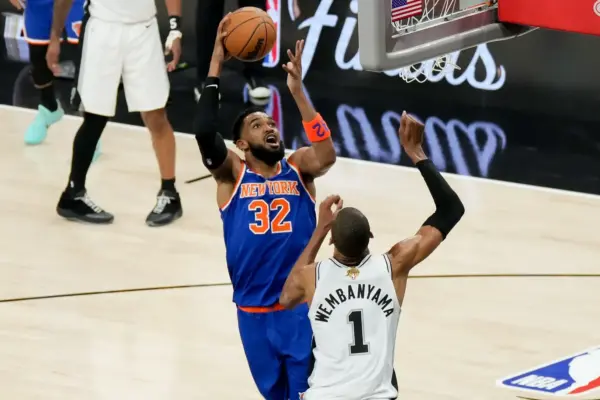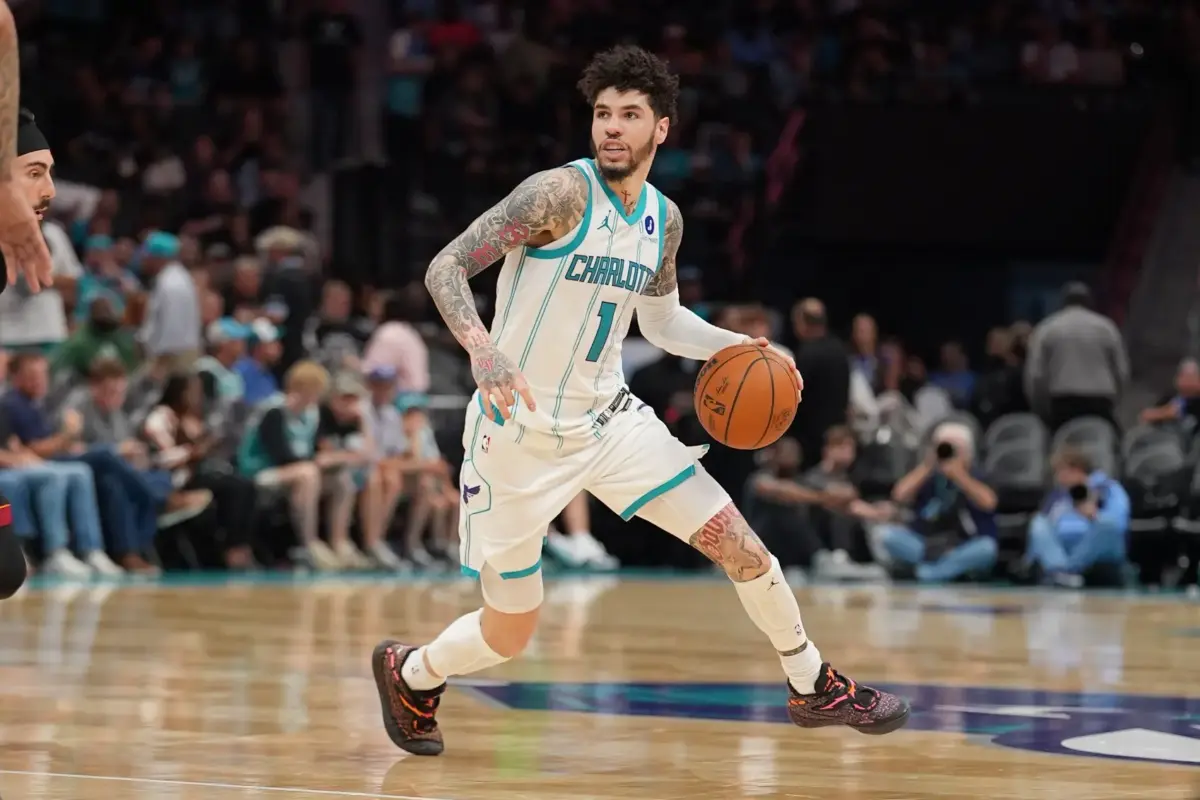

The argument for replacing LaMelo Ball collectively is seductive. Coby White covers the scoring. Kon Knueppel covers the shooting. Brandon Miller absorbs the usage. Christian Anderson develops into the playmaker. Spread the responsibilities across a roster and, statistically speaking, the numbers add up. Replacing LaMelo Ball and the Charlotte Hornets’ offensive identity is absolutely possible on a spreadsheet. The problem is that basketball is not played on a spreadsheet.
Ball averaged 20.1 points, 7.1 assists, 4.8 rebounds and 1.2 steals across 72 games this past season. Those numbers are replaceable in the aggregate. What is not replaceable — at least not through roster construction alone — is everything Ball did that never showed up in those numbers. And that is the conversation nobody is having honestly enough.
Moneyball Won’t Solve Charlotte’s Biggest Problem After Trading LaMelo Ball
The Numbers Are the Easy Part
Yes, White averaged 15.6 points in 19 minutes off the bench last season. Miller should take a significant offensive leap as the primary option. Knueppel finished the regular season with 273 made three-pointers, topping the entire league and making history as a rookie. Add those contributions together, account for increased usage, and Charlotte probably gets close to Ball’s raw production. That argument is legitimate and the math mostly holds.
But here is what that argument skips entirely. Ball ranked among the league’s elite in assist percentage — meaning a higher share of his teammates’ baskets came from his passes. More importantly, Ball ranked in the 94th percentile in isolation scoring, according to Synergy Sports. He was one of the most efficient late-clock creators in the entire league. No combination of players on Charlotte’s current roster replicates that. Not one of them.
Late-Clock Situations
Every NBA offense stalls. Sets break down. Defenders rotate correctly. The shot clock drains. And in those moments, every team needs someone who can create a quality look from nothing — not through predetermined action, but through individual skill, improvisation and the confidence to take a difficult shot with consequence attached to it.
Ball was elite at precisely that. His combination of handle, vision and creativity in unscripted situations made him one of the most reliable bailout options in basketball. When Charlotte’s offense broke down — and every offense breaks down — Ball bailed it out. The aggregate approach does not solve this. You cannot distribute late-clock shot creation across five players. One person has to do it. White is a scorer, but so is Miller. Neither profiles as an elite isolation creator in broken-play moments. That gap is real and it will show up in the fourth quarter of close games.
Tempo and Offensive Organization
Beyond shot creation, Ball controlled the pace and feel of Charlotte’s offense in ways that are almost impossible to quantify. He decided when to push in transition and when to slow things down. He read when teammates needed a touch and when they needed to cut. He organized the half-court offense without any play being called — simply by how he handled the ball, where he positioned himself and what decisions he made before the ball even left his hands.
White is an excellent scorer. But White’s instinct is to score, not to orchestrate. Miller’s instinct is also to score, not to distribute. Knueppel’s instinct is to shoot, not to organize. Anderson is 20 years old and has never played an NBA regular-season minute. Charlotte’s offense next season will have more pieces but less direction — and that distinction matters enormously in the second half of close games when everything becomes harder.
The Last Word
None of this means Charlotte made the wrong decision trading Ball. The cultural shift, the financial flexibility and the assets acquired all carry genuine long-term value. And it is entirely possible that Miller’s leap, combined with Charles Lee’s coaching, limits the damage more than pessimists expect. Charlotte is not walking into next season with a broken roster.
But the Moneyball theory of replacing Ball collectively has a ceiling — and that ceiling appears the moment the game gets tight and the offense needs someone to solve a problem that no predetermined system can solve for them. The front office almost certainly knows this too, which is why the search for a true lead guard has not stopped. Replacing Ball’s production was always the easy part. Replacing what he actually did when Charlotte needed someone to take over a game — that is the problem still waiting for a solution.
© Jim Dedmon-Imagn Images