
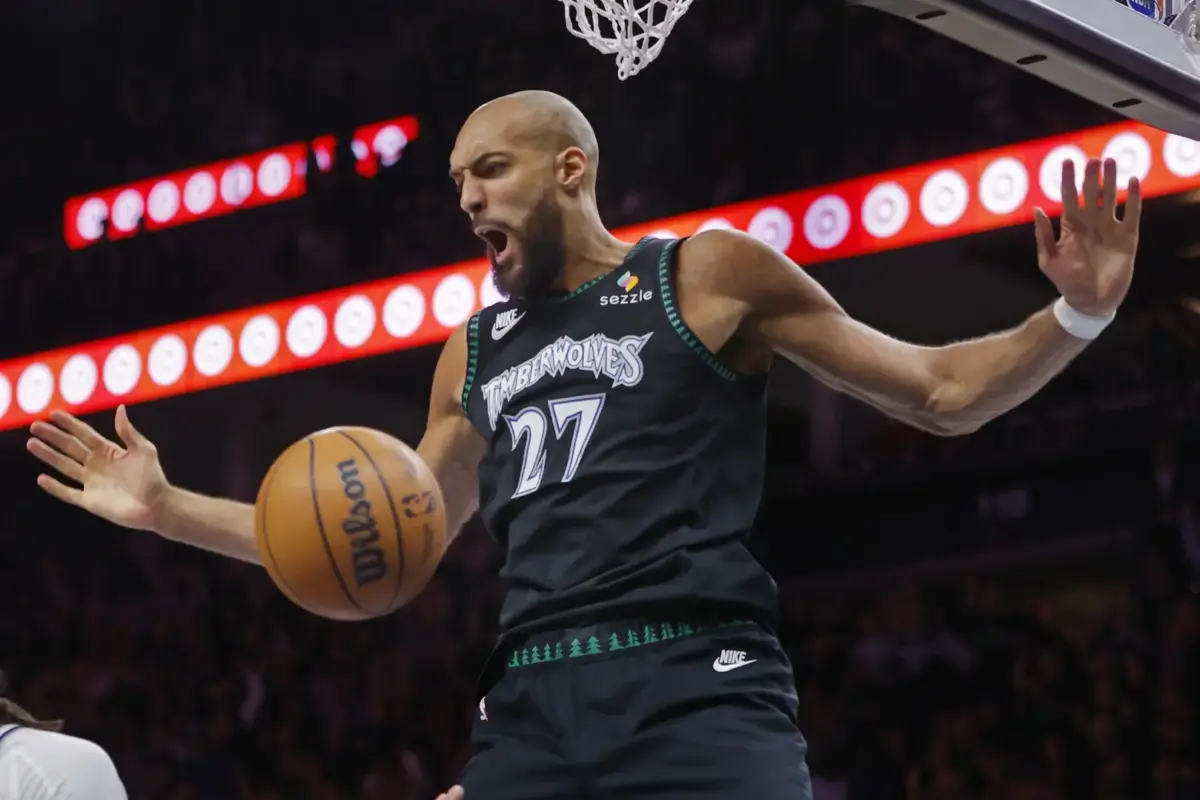
Trade rumors involving Rudy Gobert appear every offseason. Most disappear quickly because Minnesota still relies heavily on his defensive ability. But a recent proposal involving the Charlotte Hornets stands out for a different reason. It raises a larger question about Gobert’s place in the franchise’s future.
The discussion is not really about Charlotte. It is about understanding how much value Gobert still holds as the Timberwolves continue building around Anthony Edwards.
Why the Timberwolves Can’t Afford to Sell Low on Rudy Gobert
Minnesota Built a Contender Around Gobert’s Strengths
When Minnesota acquired Rudy Gobert, the franchise expected him to be the defensive anchor that could push a talented roster into championship contention. Team leaders believed his rim protection, rebounding and playoff experience would help turn potential into postseason success.
That vision eventually became reality. Minnesota developed into one of the league’s strongest defensive teams during Gobert’s tenure. His rim protection allowed teammates to defend more aggressively on the perimeter. That impact helped create an identity that carried the team deep into the postseason.
Because of that success, any Gobert trade discussion must begin with roster construction. Minnesota is not looking to move a declining role player. The Wolves would be evaluating whether moving a foundational piece could create a stronger long-term path.
Anthony Edwards Changes the Equation
Anthony Edwards is the biggest factor in every Timberwolves decision. His rise from promising young star to franchise cornerstone has accelerated Minnesota’s timeline and reshaped how the front office must evaluate every major move.
Edwards is entering the stage of his career when star players expect a roster capable of competing for championships. That reality increases the importance of every contract, rotation spot and long-term decision. Minnesota cannot afford moves that solve one problem today while creating a bigger one tomorrow.
That is what makes Rudy Gobert’s future so difficult to discuss. The debate is not about whether Gobert remains a valuable player. The real question is whether his impact on the court outweighs what Minnesota could gain from a trade package built to strengthen the roster around Edwards.
Gobert Remains More Valuable Than Many Assume
Trade speculation often creates the impression that a player has become expendable. In Gobert’s case, the opposite may be true.
Gobert remains one of the NBA’s most accomplished defenders. He has won four Defensive Player of the Year awards — tied for the most in league history — and continues to anchor elite defenses with his interior presence. Opposing teams still account for him whenever they attack the paint.
That level of defensive impact is difficult to replace. The NBA has plenty of productive centers, but very few are capable of serving as the foundation of an entire system.
That scarcity helps explain why Gobert still holds significant trade value. Teams searching for immediate defensive improvement would likely view him as one of the best options available if Minnesota ever chose to explore the market. Rather than being an unwanted contract, Gobert remains the type of player capable of generating meaningful interest and assets in return.
Why the Hornets Proposal Matters
The Game Theory podcast’s trade proposal would send Rudy Gobert to the Charlotte Hornets for picks No. 14 and 18, Moussa Diabate, Josh Green, Tidjane Salaün and Grant Williams. It’s an interesting scenario, but not because of the specific players or picks involved.
Instead, it highlights an important reality: Gobert would have a legitimate market if Minnesota ever decided to move him. That distinction matters because many trade discussions begin with the assumption that the Timberwolves would simply be looking to clear salary.
The evidence suggests otherwise. Gobert remains productive enough to generate meaningful interest across the league. As a result, any conversation about his future is less about financial relief and more about determining whether Minnesota can extract greater long-term value through a trade. Gobert’s standing as one of the NBA’s premier defensive centers only strengthens that position.
Even then, the Timberwolves should proceed carefully. Future flexibility has value, but flexibility alone does not make a team better. Draft picks, younger players, and salary savings only matter if they eventually help Minnesota build a stronger contender around Anthony Edwards.
The Biggest Risk Is Selling Low
There is also a strong case for keeping Gobert. Minnesota’s defense would almost certainly take a step backward without him, and that consequence cannot be ignored. The Timberwolves have spent years building a defensive identity around Gobert. Replacing that impact would be one of the front office’s biggest challenges. Gobert helped anchor the league’s top-ranked defense in 2023-24 and remains the foundation of Minnesota’s defensive system.
At the same time, Gobert’s trade value may never be higher. He remains one of the NBA’s most respected defensive centers, and teams looking for immediate help on that end of the floor would likely have significant interest. That reality creates a difficult balancing act for Minnesota’s decision-makers. Waiting too long carries risk, but so does moving too soon.
The answer is not to reject every offer. It is to understand the difference between receiving fair value and maximizing it. If Minnesota ever moves Gobert, the return must do more than create flexibility. It must improve the franchise’s chances of building a strong title contender.
Minnesota Must Protect Its Leverage
The Hornets’ proposal confirms that Gobert would still command serious interest around the league. It also reinforces why Minnesota should avoid rushing into a decision.
The Timberwolves should listen if teams call about Gobert. Anthony Edwards’ rise has made it essential for the front office to explore every avenue for improving the roster. Listening, however, is very different from accepting the first reasonable offer.
If Minnesota ever decides to move Gobert, the return must meaningfully improve the franchise’s long-term outlook. Anything less would weaken one of the NBA’s most reliable defenses without providing a clear path to a better team around Edwards. Gobert remains a central piece of Minnesota’s defensive identity with a resumé that speaks for itself.
That is the real takeaway from the latest trade discussion. The Timberwolves do not need to trade Gobert. But if they do, the deal must leave the franchise in a stronger position than it is today.
© Bruce Kluckhohn-Imagn Images