
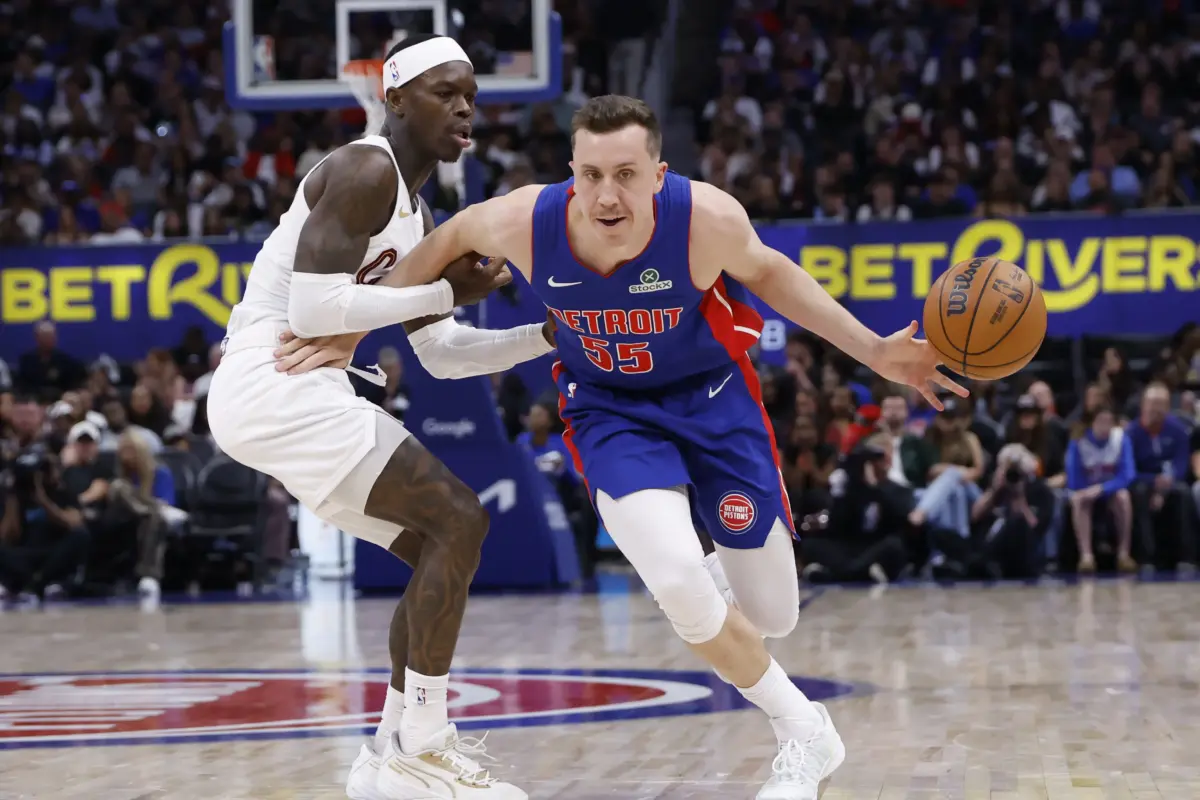

Coming into the 2025-26 season, the Detroit Pistons’ shooting guards were one of the most intriguing positions on the roster. Last season’s rotation relied heavily on floor spacing and three-point shooting, but offered limited shot creation and defense beyond that. This year’s group added more versatility, featuring players capable of creating off the dribble, attacking closeouts, and contributing on the defensive end, all while providing perimeter shooting.
With expectations elevated and the roster carrying greater depth than a year ago, how did the Pistons shooting guard rotation perform? And as the offseason approaches, is the position strong enough to stand pat, or should the Pistons still be looking for an upgrade? Let’s dive in.
Grading Every Detroit Pistons Shooting Guard From The 2025-26 Season
Duncan Robinson
The 2025-26 season was a prove-it year for Duncan Robinson. After struggling during the 2025 playoffs, Robinson arrived in Detroit via a sign-and-trade for Simone Fontecchio with the goal of reestablishing himself as one of the league’s premier shooters. He did just that, knocking down 220 three-pointers, the fourth 200-plus three-point season of his career and his highest total since 2021-22.
Robinson’s shooting remained a major weapon throughout the season and into the playoffs. He averaged 12.2 points per game while shooting 45% from three across 13 postseason contests, providing the Pistons with a reliable floor spacer and secondary scoring option. His ability to stretch defenses opened up driving lanes for Detroit’s playmakers and helped keep the offense flowing.
Grade: B+
Caris LeVert
The Pistons’ biggest free-agent addition, Caris LeVert, was brought in to provide scoring, playmaking, and secondary ball-handling for the second unit. While he had his moments throughout the season, consistency was often an issue. LeVert was occasionally careless with the ball, leading to unnecessary turnovers, and his shot selection could be frustrating at times. Those inconsistencies prevented him from fully settling into the role Detroit envisioned when it signed him.
Despite the ups and downs, LeVert provided value off the bench with his ability to create offense for himself and others. There were stretches where his shot-making and playmaking gave the second unit a needed spark, and he showed a willingness to compete on the defensive end. While he contributed in several areas, the turnovers and inconsistent decision-making ultimately kept his season from reaching a higher grade.
Grade: C
Javonte Green
A late offseason signing, Javonte Green entered the season viewed more as a depth piece than a consistent rotation player. As the year progressed, however, Green proved to be one of Detroit’s most valuable role players. His defensive versatility, energy, and veteran leadership helped solidify the second unit, while his knack for making timely plays earned him the coaching staff’s trust.
Green’s impact was evident on both ends of the floor. He appeared in all 82 games and ranked among the league leaders in steals, finishing in the top 20 with 102 while ranking fourth in steals per 36 minutes (2.5) and steals per 100 possessions (3.4). Offensively, he enjoyed the most efficient shooting season of his career, posting career highs in field-goal percentage, three-point percentage, and free-throw percentage.
Grade: A-
Jaden Ivey/Kevin Huerter
Coming into the season, Jaden Ivey was viewed as a potential bounce-back candidate and an important part of Detroit’s future. Unfortunately, he never looked like the player Pistons fans had grown accustomed to seeing. The burst, confidence, and downhill aggression that once made him a dynamic offensive weapon were inconsistent, leading Detroit to make the difficult decision to move him at the trade deadline.
Kevin Huerter arrived in Detroit looking to rediscover his shooting touch, but struggled to find consistency. While there were flashes of the player who had been a valuable contributor in previous seasons, injuries and streaky shooting prevented him from making a significant impact.
In the end, neither Ivey nor Huerter provided the stability Detroit hoped for at the position, leaving questions about the long-term outlook of the shooting guard spot.
Grade: D+
Chaz Lanier/Wendell Moore Jr./Colby Jones
Lanier was drafted for his shooting, but it did not immediately translate to the NBA, as he shot 28.4% from three in 34 games. However, his 37.2% mark from deep in the G League suggests the shooting potential is still there.
Moore appeared in just six games but impressed in the G League, averaging 19.8 points on 53/41/81 shooting splits. Jones played one game for Detroit before being waived, leaving too small a sample size to evaluate either player.
Grade: INC
The Last Word
The Detroit Pistons’ shooting guard position had its highs and lows this season. Duncan Robinson and Javonte Green proved to be valuable additions, while Caris LeVert, Jaden Ivey, and Kevin Huerter left plenty to be desired. The Pistons have solid contributors in place, but if they want more production from the position, an upgrade could still be on the table this offseason.
Overall Grade: C
Rick Osentoski-Imagn Images