
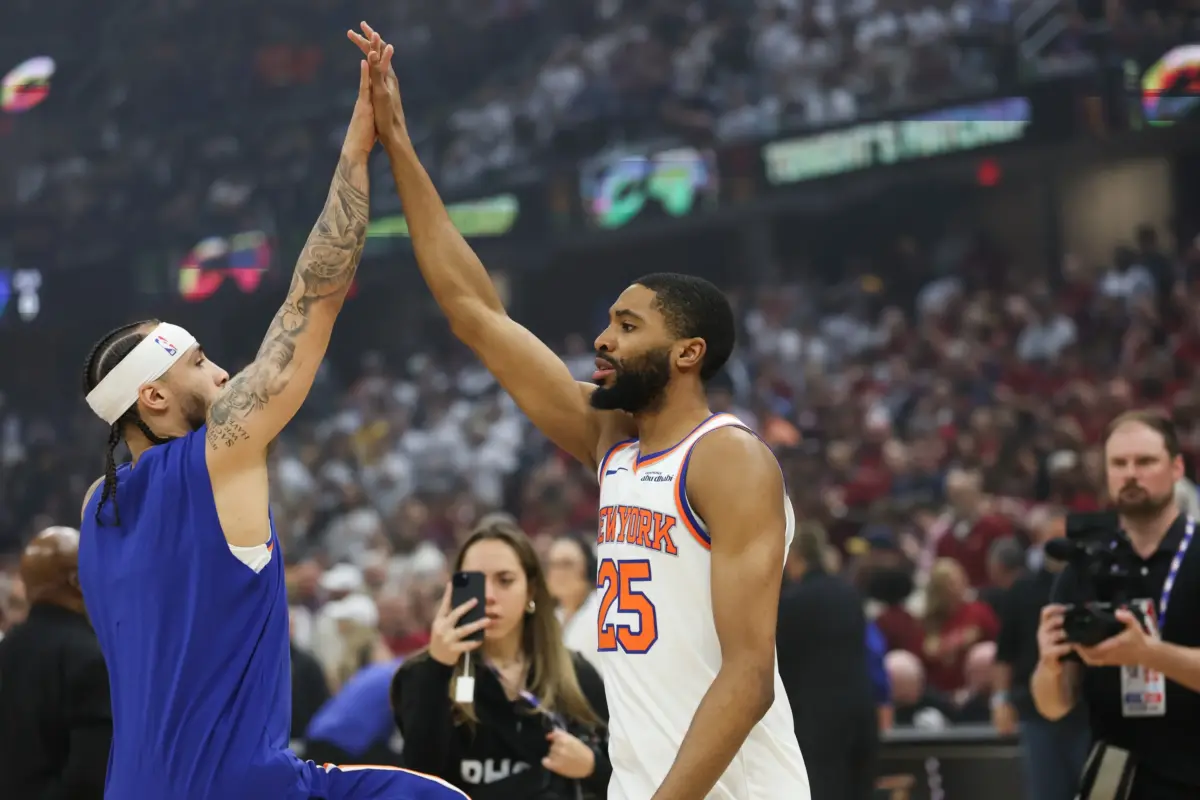

When the NBA postseason begins, most national attention focuses on superstars and their roles in a team’s success or failure. Everyone expects the primary drivers to take more on their shoulders, shoot more frequently, and dominate possessions. However, deep playoff runs require much more than peak performances from stars. A true push to the championship involves dependable roster pieces optimizing their role and providing an unexpected level of contributions. This is the case for Mikal Bridges and the New York Knicks’ run to the NBA Finals.
The Postseason Optimization of Mikal Bridges
Glancing at Bridges’ postseason numbers compared to his regular-season performance, the data suggests a player simplifying his game. In truth, he experienced a slight reduction in his playing time, going from 32.8 minutes per game in the regular season to 31.7 in the playoffs. Bridges’ usage rate also dipped from 16.8% to 15.6%. Still, despite spending less time with the ball in his hands, his scoring average increased from 14.3 to 14.6 points per game.
All About Efficiency
The data here is actually pretty interesting. It is uncommon for a player to score more points while taking on a smaller role with the offense. So, how does this happen? For Bridges, his uptick in production stems entirely from improved shooting efficiency.
During the regular season, Bridges served as a reliable offensive contributor for the Knicks. He shot a respectable 49.1% across 953 total shot attempts during the regular season. However, that efficiency skyrocketed once the postseason began. Currently, Bridges is shooting a remarkable 58.6% on 145 shots. Even his Points per Shot Attempt improved drastically, going from 119.3 to 127.2.
What makes this improvement glaring is where it comes from. One would typically connect Bridges’ jump with increased 3-point production. However, his success from behind the arc actually dipped from 37.2% to 34.1%. On the flip side, his uptick in success this postseason comes strictly from inside the arc and the foul line.
Bridges is increasing his value for New York by taking smarter, closer shots. During these playoffs, Bridges is cutting to the basket and finishing close to the rim at a much higher rate. Shooting 19-for-19 from the free-throw line, he is also capitalizing on his extra shot opportunities, connecting on the ones he is supposed to make.
From Creator to Finisher
This postseason, Bridges has accepted a different role in playmaking. The playoffs call for a team’s best decision-makers to step up. Due to this transition, Bridges now focuses entirely on finishing plays instead of setting them up.
Dropping from 3.7 assists per game in the regular season to 2.5 in the playoffs, Bridges’s passing numbers reflect this adjustment. His Assist Percentage also dipped from 15.7% to 11%. Typically, playoff defense becomes more physical, closing gaps more rapidly. Removing easy passing lanes makes it more challenging to find open teammates. For Bridges, the playoffs made it difficult to find teammates, as he increased his Turnover Percentage from 7.8% to 9.4%. By limiting his playmaking responsibilities and shifting his focus to scoring, Bridges keeps the offense moving and avoids empty possessions.
A Defensive Shift
Defense also tends to become more rigid in the playoffs. Coaches demand players stick to specific assignments rather than roam the court looking for a highlight-worthy moment.
Bridges remains a significant presence on the perimeter, keeping his Steal Percentage of 1.51% close to his regular-season mark of 1.69%. Always a strength, Bridges remains fully capable of disrupting passing lanes and preventing the opposition from finding an offensive flow.
Interestingly, Bridges’s shot-blocking dropped significantly, with his Block Percentage slipping from 1.22% to 0.43%. His rebounding average is also taking a hit, decreasing from 3.8 to 3.1 rebounds per game. These declines do not necessarily translate into reduced success. Instead, it reflects a more disciplined defensive approach. Prioritizing positioning, Bridges is focusing on defending the perimeter and preventing quality 3-point opportunities.
The Last Word
Bridges’s individual play this postseason is a major reason why the New York Knicks find themselves in the NBA Finals for the first time since 1999. Not focused on taking over a game, Bridges makes an impact by playing the correct way.
He has not needed a significant increase in shot attempts or the ball in his hands for a prolonged period of time. Instead, Bridges is playing his best basketball by taking better shots, finishing instead of creating, and playing disciplined defense.
All advanced stats courtesy of Cleaning the Glass.
© Scott Galvin-Imagn Images