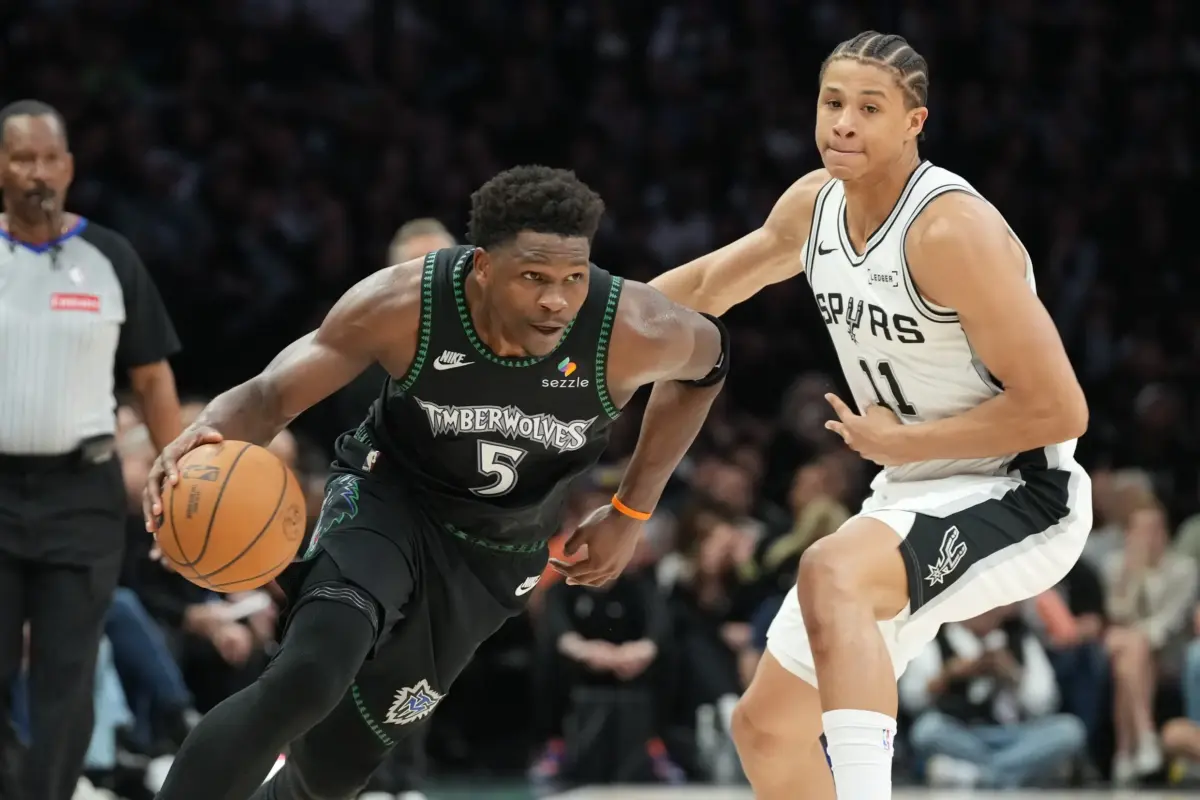

Every Minnesota Timberwolves recovery plan starts with honesty, not panic. The team went 49-33 and earned the sixth seed again. Yet the playoff exit revealed a roster built for resistance, not control. That difference now defines every single offseason decision ahead.
Timberwolves Recovery Plan Begins With Solving Anthony Edwards’ Biggest Problem
The Timberwolves struggled to score because a crowded frontcourt routinely clogged the paint, blocking driving lanes for Anthony Edwards. With Mike Conley getting older, the team had no one else to pass effectively, forcing players to take tough, solo shots that led to turnovers.
While the roster had talent, it was often criticized as being overly rigid and predictable, making it easier for elite, modern defenses to exploit. As a result, they finished the 2025-26 NBA regular season ranked 12th in the league with an offensive rating of 116.8.
Meanwhile, their strong defense ranked eighth, with a rating of 112.5. Along with their top-10 defense, the Wolves limited opponents to highly inefficient shooting nights, consistently ranking among the top squads in opponent field-goal percentage. Even when the offense sputtered, the defense kept the Wolves afloat and helped them push through the grueling winter months.
However, this lack of balance hurt them when it mattered most. In May, they could not score under playoff pressure and lost to the San Antonio Spurs in the second round.
Anthony Edwards Carried the Entire Offensive Burden
Edwards routinely carries a massive — and sometimes lone — offensive burden for the Minnesota Timberwolves. In the regular season, he led the team with a 31.4 percent usage rate and a career-high 28.8 points per game.
When the Timberwolves faced stagnant stretches or key absences, the half-court offense frequently relied on Edwards’ explosive shot creation. But his assists lagged behind his scoring burden under pressure. The roster asked him to bend everything offensively.
That burden grew heavier after his knee injury. He left Game 4 with a hyperextension and bone bruise. Donte DiVincenzo also tore his Achilles tendon, ruling him out for most if not all of next season. Minnesota lost creativity, spacing and defensive activity together.
Still, injuries cannot explain the whole failure. The Spurs switched, stayed home defensively, and squeezed Edwards into crowded lanes throughout the series.
Julius Randle Vanished in the Biggest Moments
Julius Randle produced solid regular season numbers as a second option, but his playoff fit became a larger concern later. In Game 6, he scored three points on 1-for-8 shooting. That cannot happen beside a trapped superstar.
The elimination loss against San Antonio exposed the friction in his on-court profile. When playoff basketball demands secondary creation, spacing, and quick decisions, Randle’s offensive tendencies often clash with the structural needs of an elite primary option.
Spacing and Tactical Flaws Choke the Playoff Attack
Anthony Edwards needs to be in empty corners, run early drag screens, and execute faster ball reversals. Instead, too many possessions ended with crowded paint drives and turnovers. The offense lacked another independent creator to bend defenses, a structural roster flaw that the front office failed to resolve.
While head coach Chris Finch builds competent defensive floors, his offense stalls under playoff adjustments. While third-quarter drops are not an annual certainty, recurring second-half offensive stagnation remains a primary factor in their postseason exits.
Because his postgame comments described symptoms rather than revealing concrete counter-strategies, ownership should demand visible coaching growth before next season begins.
Navigating Cap Constraints by Trading Julius Randle
The Minnesota Timberwolves’ Spotrac projections are $165 million for the salary cap, $201 million for the luxury tax line, $209.4 million for the first apron, and $222.4 million for the second apron. Active roster allocations total approximately $190.3 million, leaving the team $10.6 million below the luxury tax line and $16.8 million under the first apron.
Randle’s contract properly anchors matching rules for any incoming salary swap, as his 2026-27 base salary is $33.3 million. Minnesota should use this deal to target a movement shooter or a connector forward this summer. The new piece must pass, defend, and shoot quickly to help elevate the offense under these tight financial restrictions.
Rebuilding Perimeter Depth and Creation to Match True Contenders
Ayo Dosunmu should be the very first retention call this summer. Standing at 6’5″, Dosunmu uses his length to navigate screens and switch across multiple positions alongside Edwards and Jaden McDaniels.
Terrence Shannon Jr. also deserves a longer look after flashing creation, while Conley’s role should shrink significantly moving forward.
This perimeter overhaul matters because teams like Oklahoma City and San Antonio pressure defenses through multiple ball handlers constantly. By contrast, the Wolves still lean too heavily on Edwards’ individual scoring explosions. That approach becomes predictable and easier to scout in playoff settings.
The Timberwolves’ recovery plan requires pivoting away from overlapping big-money contracts in favor of a true, playmaking lead guard who can alleviate on-ball pressure on Edwards.
By consolidating veterans to find that primary creator and simplifying secondary roles, Minnesota can preserve its elite defensive identity and maximize Edwards’ superstar leap.
© Jesse Johnson-Imagn Images