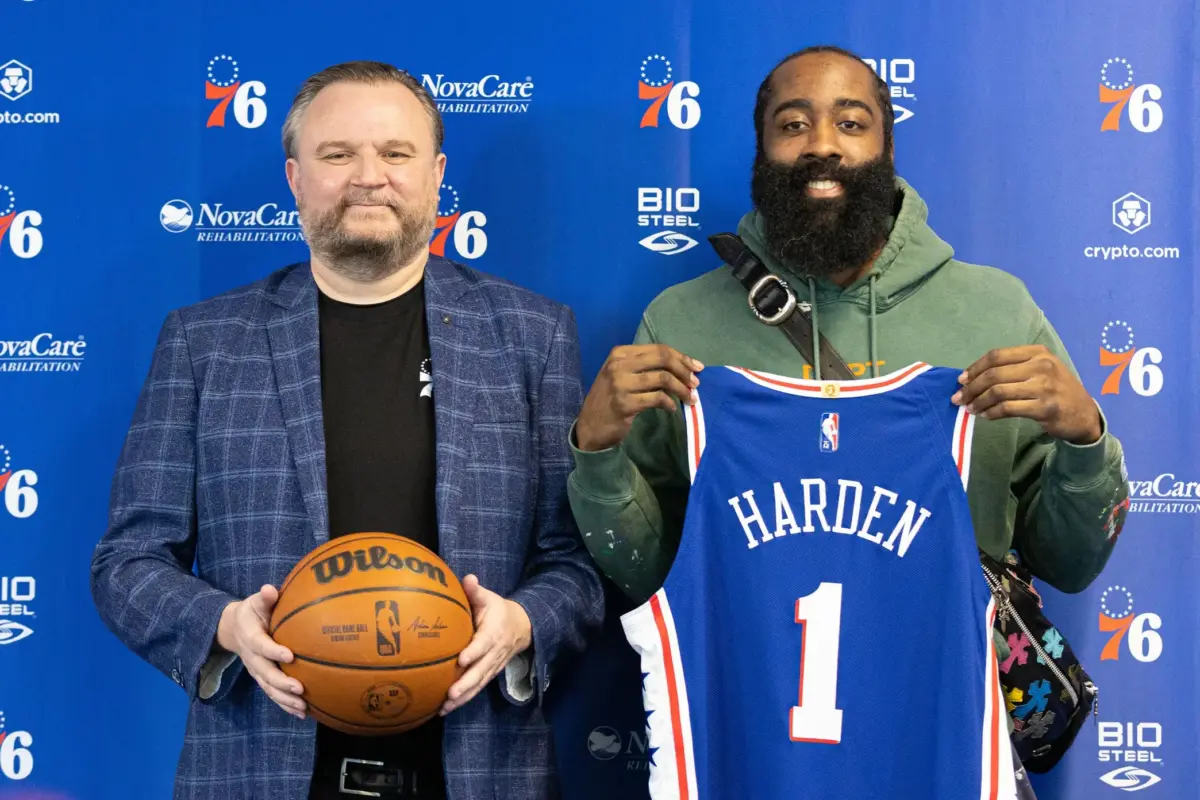

Earlier this month, the Philadelphia 76ers decided to part ways with President of Basketball Operations Daryl Morey. Morey had been with the team since 2020. Before that, he was memorably the Houston Rockets general manager for 13 years. Is there anything left of the Morey Rockets legacy in Houston?
Examining the Legacy of the Daryl Morey Rockets
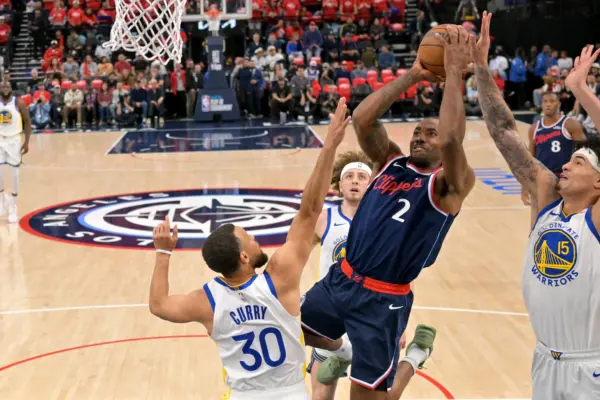
Morey started as the Rockets’ general manager in 2007. The apex of his tenure came in 2018. He guided the franchise to a seven-game Western Conference Finals against the Steph Curry, Kevin Durant Golden State Warriors. The Rockets lost Game 7 101-92 courtesy of 27 straight missed three-pointers.
It’s a poetic twist of fate, then, that Morey’s interim replacement on the Sixers is none other than Bob Myers. The same Bob Myers who was the general manager for that dynastic Warriors team. Considering Morey’s uninspiring Sixers tenure and his current reputation with the players, it seems unlikely he’d be appointed to lead another NBA front office.
But Morey’s Rockets tenure will continue to have a lasting legacy in the league. It just seems to be ignored for the moment in Houston.
Morey stayed with the Rockets until 2020, when he was replaced by Rafael Stone. Stone’s first assignment after serving as Morey’s long-time assistant? The deconstruction of the final Morey Rockets innovation – micro-ball.
The Morey Rockets’ Micro-Ball
In 2019-20, the Rockets had a starting lineup that featured the 6-foot-7 Robert Covington as its tallest player. 6-foot-5 PJ Tucker officially started at center and defended the opposing five. The center on offense was basically 6-foot-4 Russell Westbrook. The 6-foot-8 Jeff Green was the tallest player in the rotation.
That team flamed out in the second round versus the Los Angeles Lakers. They were simply too small to compete. Six years later, in 2025-26, the Rockets flamed out versus the Lakers again — this time in the first round. It certainly wasn’t because they were too small.
The Rockets have completely flipped on the size spectrum in Stone’s tenure. But for injuries, the Rockets probably would have started Durant, Steven Adams, Alperen Sengun and Jabari Smith Jr. — all 6 feet, 11 inches tall — alongside the 6-foot-7 Amen Thompson. That was Houston’s fourth most-played lineup this season at 97 minutes.
As it turned out, Adams was injured by the playoffs, and Durant missed all but one of Houston’s six postseason games. Size was still very much not the issue. Instead, it was another way in which the franchise has fully departed from the Morey Rockets era: 3-point shooting.
The Morey Rockets era was characterized by heliocentric basketball and as much 3-point shooting as possible. In 2017, the Rockets led the league with 40.3 three-point attempts per game. The Cleveland Cavaliers were second with 33.9. In the 2025-26 regular season, six teams took over 40 threes per game.
Morey’s vision was to have star players handle the vast majority of shot creation, most notably the now estranged 2018 MVP, James Harden. To enable that, he sought to surround them with teammates whose only offensive responsibility was hitting catch-and-shoot three pointers.
How the New-Look Rockets Play
Well, it still looks like the Rockets are trying to play heliocentric basketball at times. Unfortunately, they forgot about the 3-point shooters. The Rockets were middle-of-the-pack in 3-point attempts these playoffs, but they were dead-last in percentage.
The Rockets don’t have a generational passer and scorer like Harden anymore. Even so, the offense still quickly devolves into isolation basketball. They ranked sixth in the NBA in isolation frequency this season. It’s just that now, because of a lack of efficient perimeter shooters, the ball handler is far too easy to double.
The Rockets’ 3-point volume so far outpacing their own percentage is a testament to the problem. Sengun can make the right read to an open “shooter,” but the defense leaves them open for a reason. Durant can make simple reads out of double teams as well, but he gets visibly discouraged when his teammates consistently fail to convert.
The Morey Rockets Philosophy
The point of micro-ball wasn’t that being small was better. The point was that size was secondary to skill. Specifically, the sought-after skills were shooting and defensive switchability. The Rockets still value defensive switchability. They opted for defensive specialist Josh Okogie to fill their final roster spot last offseason, despite apparent redundancy alongside Jae’Sean Tate and Dorian Finney-Smith. But nowadays, size is very much being valued over shooting. Going from micro-ball to jumbo-ball, the Rockets may have gone too far the other way.
Of course, one could argue that the Morey Rockets’ philosophy wasn’t about trying to create ideal basketball. Primarily, it was about matching up optimally versus the best team at the time — the KD Warriors. That’s how they got to a Game 7 against a far more talented team.
By the time micro-ball came around, the KD Warriors were no longer in business. Instead, micro-ball was just about trying to maximize Westbrook. Meanwhile, acquiring Westbrook was a last-ditch attempt to salvage a roster designed to beat a superteam it had outlasted.
In the Western Conference Finals, the contest to decide the NBA’s next top dog is currently underway. The Oklahoma City Thunder have the advantage. They are defending champions and up 2-1 in the series. But in Victor Wembanyama, the San Antonio Spurs have the most celebrated prospect since LeBron James. The Rockets are hoping that size can be the key to defeating either team. Both of them can sometimes appear vulnerable to physicality in the paint and offensive rebounding.
Most of the NBA has followed the Morey Rockets playbook of filling their rosters with versatile, 3-point shooting players. The Rockets are trying to go the other way. In a sense, not adhering to the normal Daryl Morey moves is the most daringly Morey thing you could do.
© Bill Streicher-Imagn Images