
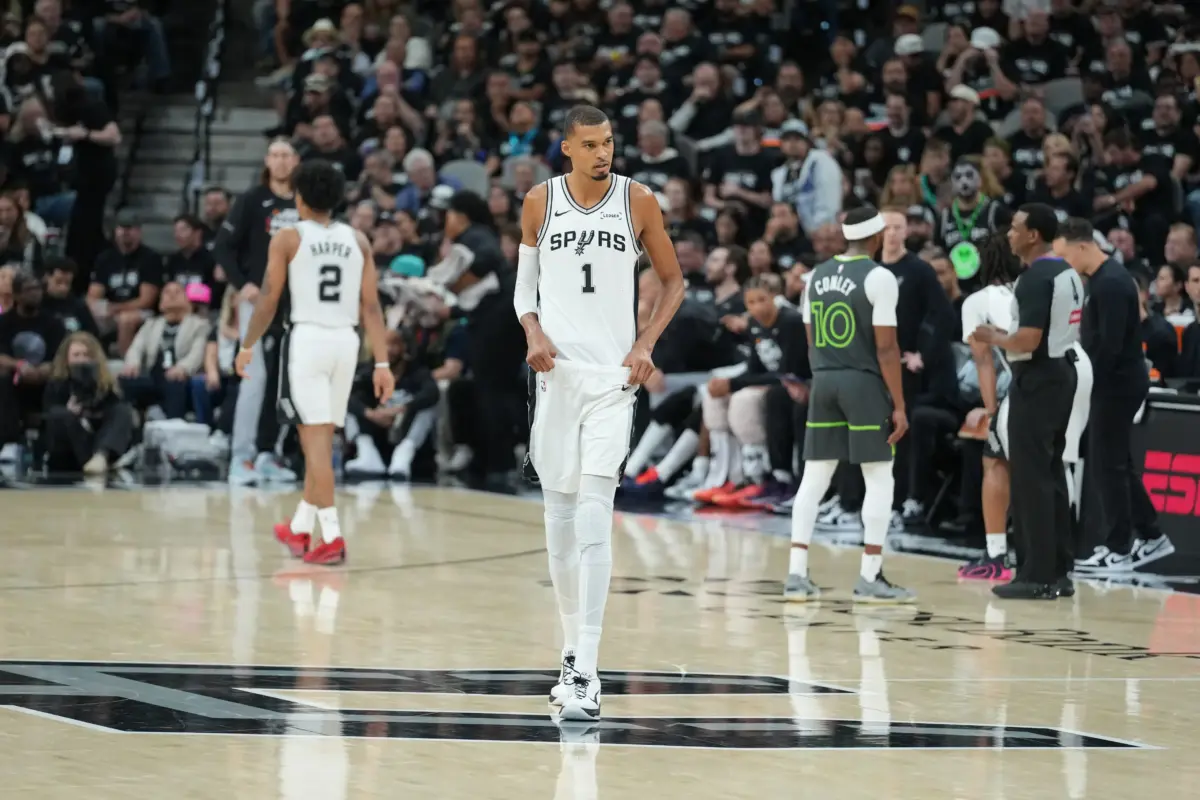
The San Antonio Spurs thrashed the Minnesota Timberwolves in Game 2, 133-95. After dropping Game 1, the Spurs made key adjustments. After wasting a historic performance from Victor Wembanyama, San Antonio improved in nearly every possible way. Disadvantaged in the series, the Spurs looked like they were in for several difficult games. But their performance Wednesday night made matchup issues seem negligible.
Spurs Adjustments That Helped Them Win Game 2
Team Adjustments
The Spurs had no lack of issues in Game 1. Rebounding, turnovers, matchups, a stagnant offense and a defense wholly reliant on Wembanyama. The Spurs’ two centers both had big roles — and Wembanyama put up a monster defensive performance — but these were symptoms of a problem. The Timberwolves had no trouble getting open threes because Wembanyama and Luke Kornet were both glued to the paint.
Any on-ball screens were not helped by either big because they were in drop coverage. This led to the Wolves getting open threes on every possession if they wanted them.
The Spurs likely did this because of matchup issues, namely the Timberwolves’ size advantage. With rookie forward Carter Bryant out, they lacked depth at the power forward position. For most of the game, Julian Champagnie was boxing out players like center Naz Reid and the 6’9″ Julius Randle. Champagnie has the height of a power forward but plays more like a shooting guard. San Antonio was also likely in drop coverage to try and beat Minnesota to the rim.
The Spurs quickly changed their defense Wednesday to a 2-3 zone and later man coverage. This allowed them to immediately collapse on ball handlers in the paint and let them choose which Wolves player got open threes. No longer would an on-ball screen be enough to disrupt the Spurs’ defense. They also showed improved their consistency when it came to boxing out.
Offensively, the Spurs started the game with extreme aggression, scoring almost exclusively in the paint in the first quarter. Although the obvious intent was to get respect from the Wolves’ defense, it also got the Spurs in rhythm. San Antonio saw a huge bounce-back in shooting, drilling 41% from three.
Individual Adjustments
De’Aaron Fox had more turnovers than made shots in Game 1. Like many players on Monday, he did not seem to have a clear plan or flow on offense. As San Antonio’s highest-paid player, he arguably faced the most pressure to play better. Fox had a rough start to Game 2. With an ugly turnover and some wasted possessions, it seemed like he was in for a repeat performance. But Fox, with the rest of the team, proved that continued aggression would work out the team’s issues.
The Timberwolves also struggled in transition, and the fastest player in the league was there to help expose their transition defense. Once Fox got aggressive in the paint and the rest of the team was energized, he was smart with the ball and shot efficiently.
Keldon Johnson is another player who faced mounting pressure. After winning Sixth Man of the Year, he has had a quiet postseason. Game 1 was the first playoff game where he scored in double figures. Even though he scored more in the first game on better efficiency, he played better in one key category in Game 2: rebounding.
Game 2 Johnson was a flashback to when he was the Spurs’ leading scorer. Back when he still played power forward, he would face much bigger players and still be efficient. He dominated the boards Wednesday to help secure the win.
Wembanyama is the most important player on the court any night. In the previous contest, he shot an abysmal 0-for-8 from three. His adjustment was simple: slow the game down and play in the paint. His fix was also very similar to the rest of the team. Just as a leader should, he led by example.
© Daniel Dunn-Imagn Images