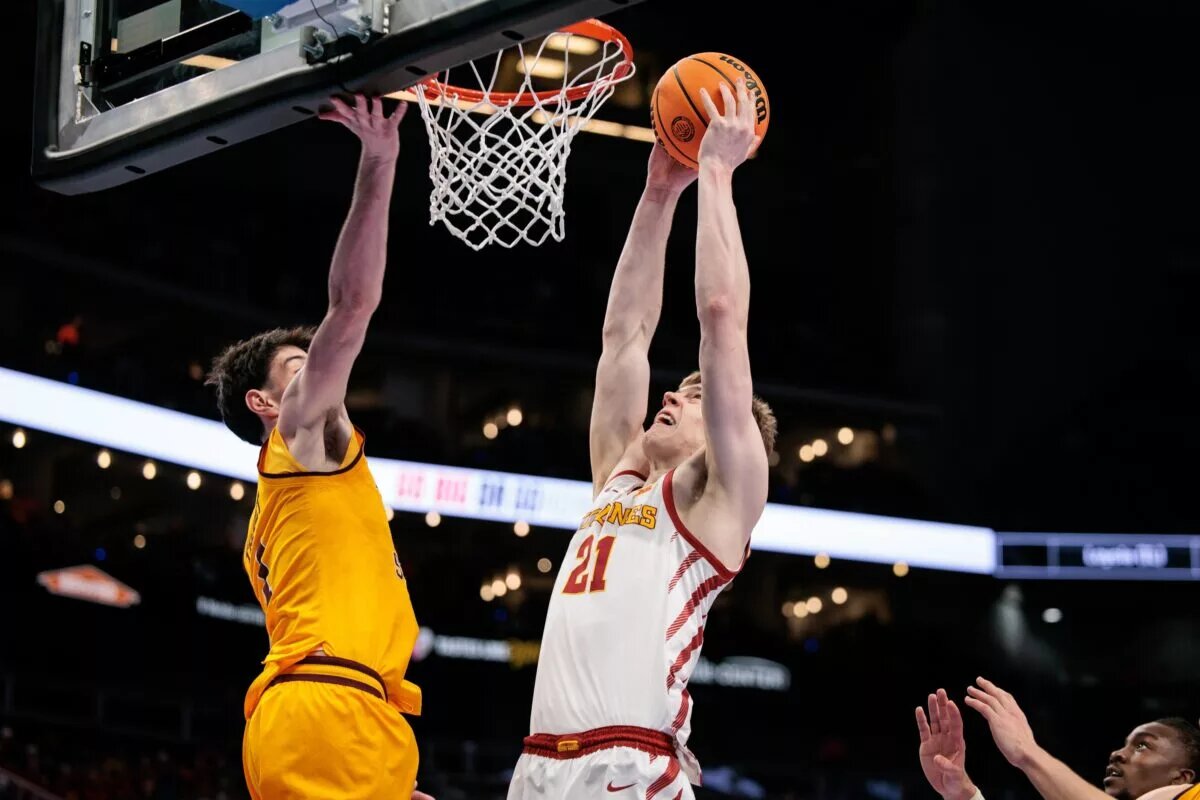
It’s on to the semifinals of the Big 12 Tournament and we have a monster game to look at between the Iowa State Cyclones and Arizona Wildcats. Iowa State got here with a 91-42 win over Arizona State and a 75-53 win over Texas Tech. They are now 27-6 on the year. Arizona comes in with a powerful 30-2 mark on the year and they are off an 81-59 win over UCF in their lone tourney game. The Wildcats are most likely playing for a No. 1 seed in the upcoming NCAA Tournament. Arizona won the lone regular-season meeting by a score of 73-57. How will this one play out? Continue reading to see my Iowa State vs Arizona prediction.
Iowa State Cyclones vs Arizona Wildcats: Prediction, Preview, Odds
Odds: Arizona -4; Over/Under 143
Iowa State Cyclones
Iowa State enters the Big 12 semifinal at 27-6 overall, coming off a 78-73 win over Texas Tech. The Cyclones average 75.6 points in conference games and shoot 45.5%, relying on balanced scoring and strong ball movement. Milan Momcilovic leads the team with 17.1 points and provides reliable perimeter creation. Joshua Jefferson adds 16.7 points, 7.6 rebounds, and 5.0 assists, giving Iowa State a versatile forward who impacts every possession. Tamin Lipsey contributes 13.2 points and 5.0 assists, helping control tempo and create efficient looks. Iowa State shoots 36.6% from three, ranking second in the Big 12, and their spacing forces defenses into difficult rotations. Their offensive rebounding at 10.2 per game also creates second‑chance scoring opportunities.
Defensively, Iowa State remains one of the toughest teams in the conference. They allow only 67.8 points in Big 12 play and hold opponents to 43.3% shooting. Their perimeter defense is strong, limiting opponents to 32.8% from three, and their ball pressure generates 8.2 steals, the best mark in the league. Lipsey anchors the perimeter defense, while Jefferson and Blake Buchanan protect the paint and rebound effectively. Iowa State also forces 12.6 turnovers, which fuels transition scoring. Their defensive discipline and ability to contest shots without fouling make them difficult to attack. Against Arizona’s elite interior scoring, Iowa State must stay connected on cutters and avoid giving up deep post position.
For Iowa State to win, they must control tempo and avoid getting dragged into a high‑possession game. Momcilovic must hit perimeter shots to stretch Arizona’s defense. Jefferson needs to win his matchup and create scoring balance. Lipsey must protect the ball and generate clean looks early in possessions. Iowa State must also rebound well and prevent Arizona from dominating the paint. Their best path is a controlled, physical game where defensive pressure disrupts Arizona’s rhythm. If they limit turnovers, defend the arc, and keep Arizona out of transition, they can stay competitive deep into the second half.
Arizona Wildcats
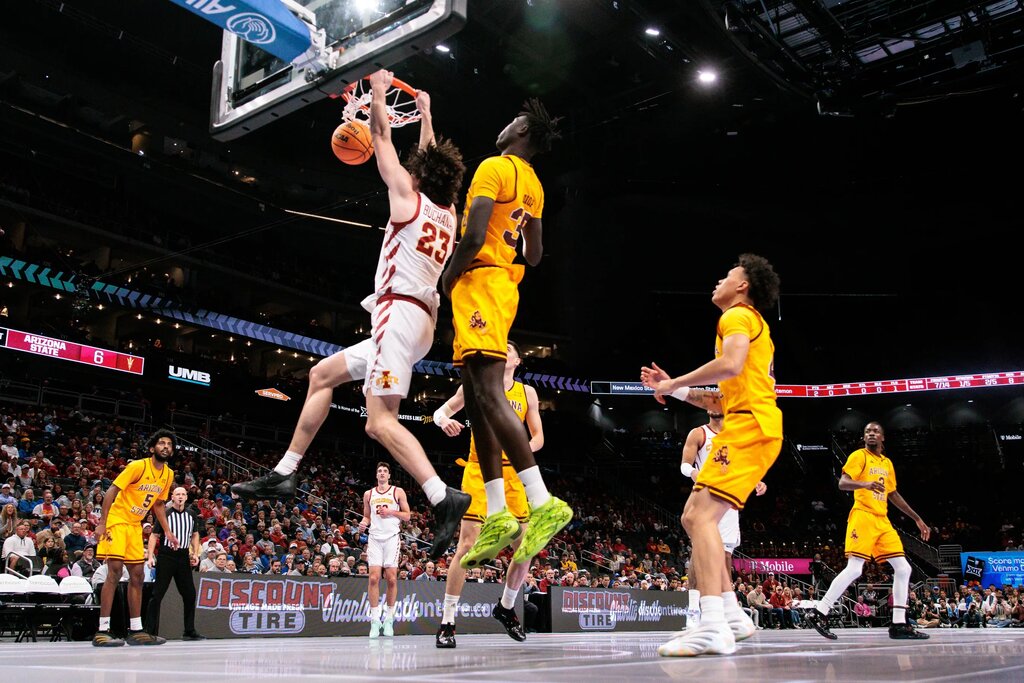
Arizona enters the semifinal at 29-3 overall and 16-2 in Big 12 play, coming off a dominant 81-59 win in the quarterfinals. The Wildcats average 84.1 points in conference games and shoot 49.0%, ranking first in the league in overall efficiency. Brayden Burries leads the team with 16.0 points and provides elite shot‑making from all levels. Koa Peat adds 13.8 points and 5.3 rebounds, giving Arizona a powerful, skilled forward who thrives in mismatches. Jaden Bradley contributes 13.4 points and 4.6 assists, stabilizing the backcourt and pushing tempo. Motiejus Krivas adds 10.8 points and 8.2 rebounds, anchoring the interior with size and touch. Arizona’s offense is built on spacing, cutting, and high‑percentage shots, especially inside the arc where they hit 54.3%.
Defensively, Arizona is one of the best units in the Big 12. They allow only 70.3 points in conference play and hold opponents to 38.5% shooting, the best mark in the league. Their interior defense is elite, allowing just 43.8% on twos, and their length disrupts passing lanes. Krivas and Tobe Awaka control the paint, while Bradley and Burries pressure the perimeter. Arizona also rebounds extremely well, grabbing 39.8 boards, which limits second‑chance opportunities. Their defensive communication and ability to switch screens make them difficult to exploit. Against Iowa State’s balanced offense, Arizona must stay disciplined on closeouts and avoid giving up open threes.
For Arizona to win, they must push tempo and attack Iowa State’s interior defense. Burries needs to establish himself early and create scoring pressure. Peat must win physical matchups and generate paint touches. Bradley must control pace and create open looks for shooters. Arizona must also dominate the glass and limit Iowa State’s second‑chance points. Their ball movement should create open threes, especially if Iowa State collapses on drives. If Arizona defends the arc, forces turnovers, and maintains their interior advantage, they can control this matchup and advance to the Big 12 title game.
Predictions
Arizona enters this Big 12 semifinal with the stronger efficiency profile and the more reliable scoring options. The Wildcats average 84.1 points in conference play and shoot 49.0%, giving them the league’s most complete offense. Burries leads the attack with elite shot‑making, while Peat and Bradley create mismatches in the half court. Iowa State relies heavily on Momcilovic and Jefferson, but Arizona’s length and interior strength can limit their clean looks. The Wildcats also defend at a high level, holding opponents to 38.5% shooting, the best mark in the conference. Their ability to control the paint and force contested jumpers gives them a clear edge. With Arizona’s balance, depth, and defensive discipline, the -4 sits in a favorable range.
The total leans lower because both defenses match up well and can slow scoring runs. Iowa State allows only 67.8 points in Big 12 play and forces 12.6 turnovers, which disrupts rhythm. Arizona’s defense is even stronger, especially inside, where they allow just 43.8% on twos. Iowa State shoots well from deep, but Arizona’s closeouts and switching reduce open attempts. Arizona also plays a structured style that limits wasted possessions and keeps games controlled. Iowa State prefers a similar pace, relying on execution rather than speed. With both teams defending at a high level and valuing possessions, extended scoring lulls are likely. The matchup leans toward a slower, more physical semifinal.
The most likely script features Arizona controlling the interior, limiting Iowa State’s second‑chance points, and generating enough efficient offense to cover the -4. Iowa State will compete defensively, but their scoring depth is thinner, and Arizona’s physicality should wear them down. Both teams defend well, rebound well, and avoid chaotic pace, which supports the Under 143. Expect a disciplined Big 12 semifinal where Arizona’s shot‑making and defensive structure carry them late, while the total stays below the posted number.
Final Predictions: Arizona -4 & Under 143
© William Purnell-Imagn Images