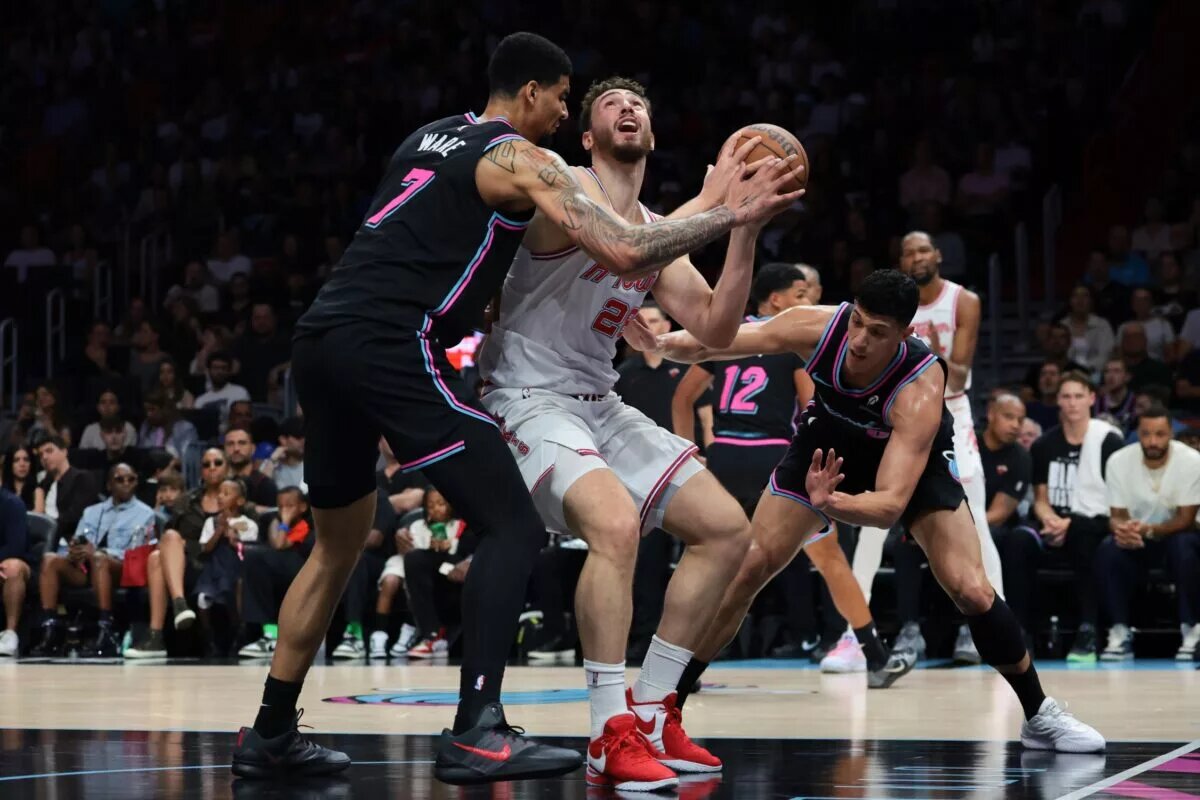
Houston Rockets star center Alperen Sengun had another tough game on Saturday afternoon.
Despite playing 35 minutes, the 23-year old Turk had just 13 points, six rebounds, and three assists (to three turnovers) versus the Miami Heat. He shot 6-14 (42.9%) from the floor and had four fouls. Seven of his eight missed shots from the field came in the paint. Last but not least, he was a -18 in a 10-point loss (115-105).
Is Sengun’s inefficient play a problem the Rockets can fix? For that matter, is it a problem the Rockets have caused?
Is Inefficient Alperen Sengun’s Play A Coaching Problem Or Just Who He Is?
Sengun is a thrilling player to watch. He’s a center who plays point guard. His one-on-one scoring is a chess match within a game of basketball. He loves to dime up his teammates with creative angles on passes around the rim. He’s averaging 20.2 points, 9.1 rebounds, and 6.3 assists per game and made his much-deserved second All-Star game (as an injury replacement).
Unfortunately, he has some flaws. Two of them have been attached to him since even before he was drafted.
His lack of athleticism makes him vulnerable on defense. He’s too slow to stay in front of players on the perimeter, and lacks the hops to offer explosive, last-second contests in the paint. He’s not really long enough to go the Marc Gasol, Brook Lopez, or post-prime Tim Duncan route of simply keeping his hands up around the basket either.
The other obvious issue is his lack of range. Sengun has experimented with his shooting at times. In the very first game of the season, he went 5 of 8 from 3. For the season overall, though, he’s averaging just 29.2% on 1.8 attempts per game. 1.4 of those 3-point attempts are classified as “wide open“.
These two issues on their own make Sengun a problematic star to build around.
Compensating for a defensively-limited center is a challenge to begin with. It’s the most important defensive position. Sengun’s lack of shooting means that compensating with other non-shooters significantly congests the offense. That’s what the Rockets have been struggling with in his pairing with Amen Thompson. Even an injured but seemingly ideal collaborator in Jabari Smith Jr. doesn’t help as much as one might think.
The Numbers On His Inefficient Habits
There’s another problem with Sengun. It’s one that especially attracts the ire of Sengun’s detractors. For a post-up wizard, Sengun is remarkably inefficient from the floor. Since Sengun came back from injury, he has had an effective field goal percentage of just 49.3% over 24 games. Even for the season overall, he’s only at 51.6%.
Sengun is 32nd in effective field goal percentage among NBA stars with a 25% usage rate playing over 30 minutes per game. Notably, that is ahead of players like Detroit Pistons MVP candidate Cade Cunningham and Phoenix Suns franchise cornerstone Devin Booker. However, Sengun’s shot profile is much closer to the basket, where a greater efficiency would be expected.
Frankly, Sengun over-engineers a lot of his layup attempts. He pump-fakes when nobody is there to contest. He takes baby hooks when nestling the ball in off the glass would suffice. His biggest problem, though, is that he works so hard to get to the rim that he doesn’t have his legs under him anymore when it’s time to shoot.
All of that being said, Sengun’s touch around the rim is not as bad as some would have you believe. He takes 9.8 shots (per game) within eight feet of the rim, the fourth-most in the NBA. He shoots 59.3% from that range, which is solid if unremarkable. Sengun also takes the 16th-most shots from 8-16 feet at 3.8 per game. From there, he shoots just 40.7%. Out of the 35 players taking at least three such shots per game, only Washington Wizards big man Anthony Davis and Orlando Magic forward Paolo Banchero shoot a lower percentage.
What Can Houston Do?
In short, Sengun does too much for his own good. However, Sengun takes those longer distance shots when his avenues to the rim are closed off, and his team still needs him to create. That’s the stage at which a lot of his 3.2 turnovers per game happen as well.
The question, then, is whether there’s an actual solution to this.
The Change Ime Udoka Needs To Make
Fixing the Sengun problem may require a larger offensive overhaul than Rockets head coach Ime Udoka is willing to provide. Too often, Houston’s offense defaults to Sengun or Kevin Durant isolations. In fact, the Rockets run the fifth-most isolation possessions in the league and are in the bottom half in points per possession on such plays.
Houston missing a starting point guard certainly doesn’t help matters. Ultimately, though, the Rockets need more offensive creativity from the coaching staff in utilizing Sengun’s skillset without overburdening him. Because of his quirks, Sengun will never be in the absolute top-tier of NBA talents. However, it will inevitably be a coach other than Udoka who cuts the inefficiency from his game and gets him as high as he can go.
© Sam Navarro-Imagn Images