
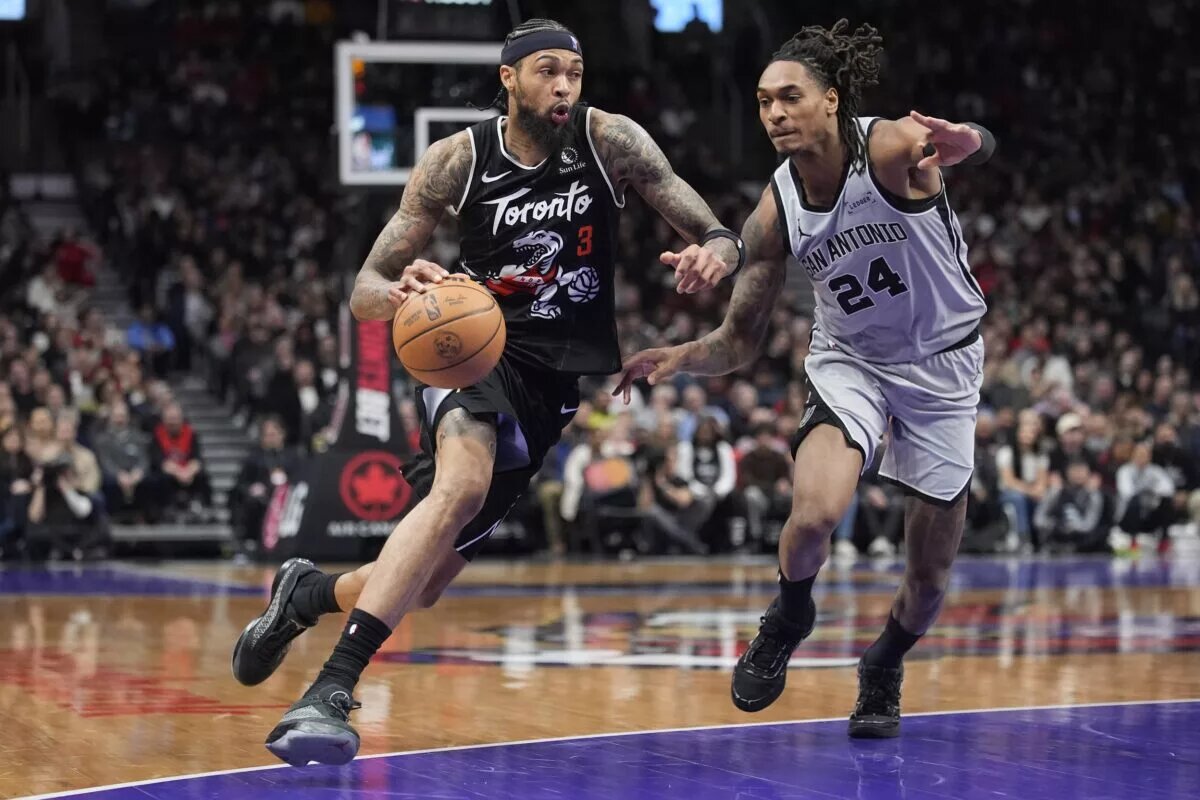

The Toronto Raptors are approaching a milestone that has historically defined elite regular-season success: the 50-win mark. The duo of All-Stars in Brandon Ingram and Scottie Barnes has been the spearhead of Toronto’s success. For most franchises, 50 victories represent contention status. For Toronto, it would also signal a meaningful return to relevance at the top of the Eastern Conference.
The Raptors have not reached 50 wins since the 2018–19 championship campaign, when they finished with 58 victories. Since that season, roster turnover, injuries, transitional years, and developmental phases have kept Toronto below that benchmark. While the team has remained competitive at times, it has not consistently performed at the level required to sustain a 50-win pace over 82 games.
This season, however, feels different.
Could the Toronto Raptors Get Back to 50 Wins This Season?
Where the Raptors Stand Now
Toronto enters the final stretch of the season with a strong record that keeps the 50-win conversation realistic rather than theoretical. The margin remains tight — reaching 50 wins requires sustained consistency — but the Raptors are positioned within striking distance.
To hit that mark, Toronto must maintain efficiency against mid-tier opponents while avoiding extended losing streaks against top competition. Historically, teams that reach 50 wins rarely drop games to rebuilding squads and tend to split or slightly exceed expectations against fellow playoff teams.
The Raptors’ ability to stack wins recently suggests they understand that formula.
Improved Offensive Structure
Earlier iterations of the Raptors often relied heavily on one or two primary creators. This season, the offensive balance is noticeably stronger. Multiple ball-handlers can initiate sets, reducing predictability and easing pressure in late-game situations.
With improved spacing and more consistent shot creation, Toronto is less dependent on isolation-heavy possessions. That evolution makes it easier to sustain scoring across long stretches of the season — a requirement for reaching 50 wins.
Defensive Identity Returning
Fifty-win teams are rarely one-dimensional. While offensive efficiency drives headlines, defensive stability usually determines consistency.
Toronto’s defensive activity — particularly in transition and switching schemes — has shown signs of returning to form. When healthy, the Raptors can deploy versatile lineups capable of contesting across positions, limiting easy paint touches, and controlling tempo.
Sustained defensive intensity will be critical down the stretch.
The Importance Of Health And Rotation Stability
One of the biggest obstacles to 50-win seasons is instability. Over the past few years, Toronto has struggled to keep a consistent rotation intact for extended periods. This season, however, the roster has shown improved health during key stretches.
When the Raptors are able to maintain defined roles — primary scorers, secondary playmakers, defensive specialists — their overall efficiency improves. Continuity builds rhythm, and rhythm translates into wins over time.
If health holds, Toronto’s ceiling rises significantly.
Comparing To Past 50-Win Raptors Teams
Looking back at previous 50-win seasons, Toronto’s most successful squads shared common traits:
- Strong point guard play
- Reliable secondary scoring
- Elite perimeter defense
- Bench depth capable of maintaining leads
While this roster differs stylistically from past versions, it checks several similar boxes. The current group may not mirror previous teams exactly, but the structural elements required for sustained success are present.
The biggest difference is balance. Instead of relying heavily on a single identity, this year’s Raptors have shown the ability to win in multiple ways — through scoring bursts, defensive stops, or controlled half-court execution.
That adaptability matters in long regular seasons.
The Schedule Factor

Reaching 50 wins is not solely about talent; it is about timing and opportunity. The remaining schedule will determine how realistic the path truly is.
If Toronto can capitalize on home games and avoid dropping contests against teams outside the playoff picture, the math works in their favor. A strong closing run — something in the range of sustained .650 to .700 basketball over the final stretch — would be enough.
The Raptors have already demonstrated they can string together winning streaks. The question is whether they can sustain that level under increasing pressure.
What Could Derail The Push?
No 50-win chase is guaranteed. There are clear risks:
- Injuries disrupting rotation continuity
- Offensive stagnation against elite defenses
- Defensive lapses in back-to-back situations
- Fatigue late in the season
Consistency remains the separating factor. Teams hovering around the high-40 win range often falter due to minor lapses that compound over time.
Toronto must avoid those dips.
Is 50 Wins Realistic?
Based on current trajectory, depth, and structural improvements, yes — it is realistic.
The Raptors are not chasing an unrealistic ceiling. They are building toward a number that aligns with their current competitiveness. More importantly, they are doing so with improved balance, clearer roles, and stronger late-game execution.
If health remains steady and recent trends continue, the Toronto Raptors’ return to the 50-win mark would not simply represent statistical success. It would signal that Toronto has officially transitioned from rebuilding momentum to legitimate conference contender status once again.
The next few weeks will determine whether this push becomes a milestone — or just a strong season that fell slightly short.
Featured Image: John E. Sokolowski-Imagn Images