
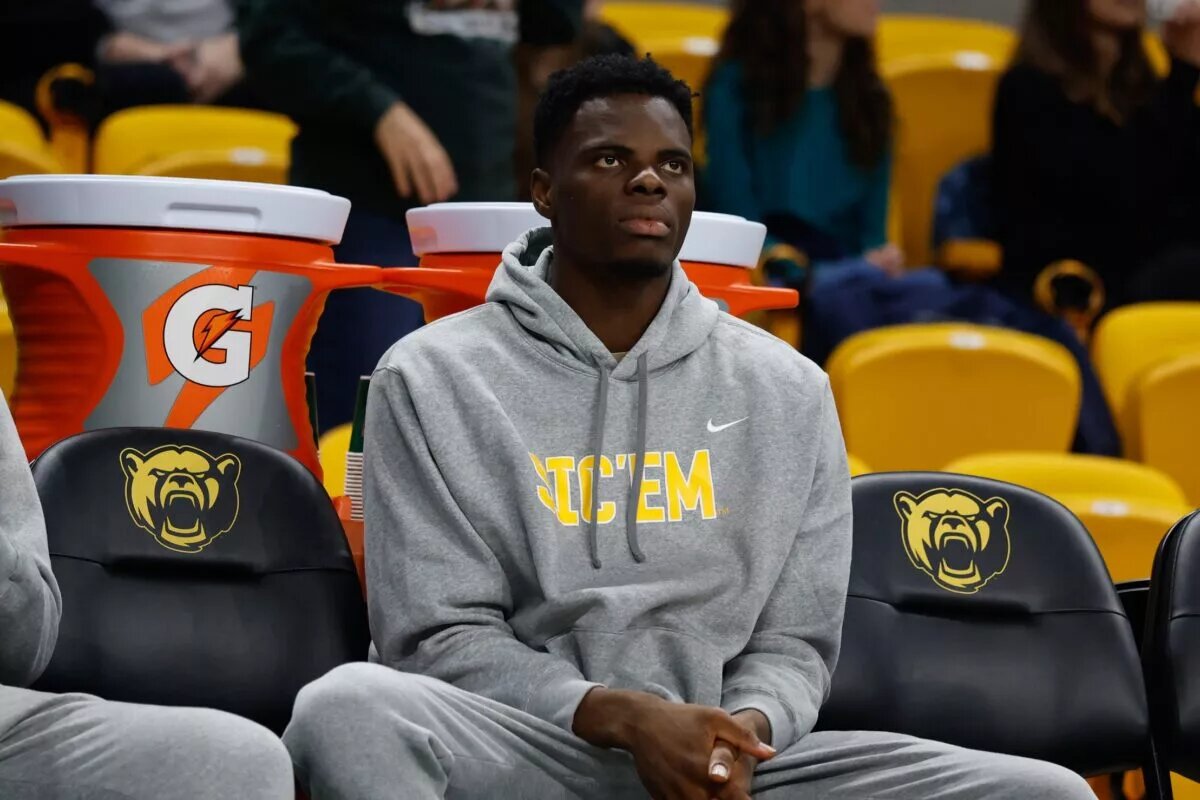
Christmas Eve brought an unusual turn of events for the college basketball world. The Baylor Bears announced the signing of James Nnaji. Selected in the second round of the 2023 NBA Draft, at 31st overall, Nnaji has played professional basketball for various European teams since 2019.
However, this is far from being an isolated incident. There are multiple cases of professional overseas basketball players not just showing interest, but also committing to American colleges and playing basketball for them.
So what does this mean for college basketball? And would others be able to do the same?
Why Professional Basketball Players are Returning to College
Back to school
James Nnaji began his professional basketball career with Rátgéber Akadémia, a team in the Hungarian league, in 2019. Nnaji later moved to Barcelona, joining FC Barcelona B, and subsequently moved up to Barcelona’s A team, with 13 appearances in the 2021-22 season. Barcelona later loaned Nnaji to professional teams in Turkey and Spain.
After being drafted by Detroit in 2023, Nnaji was traded to Charlotte and later to the Knicks as part of the Karl-Anthony Towns trade. Nnaji played in five Summer League games for the Knicks this past July in an effort to get on the Knicks roster before he decided to go back to college.
Thierry Darlan is another case of a player who has extensive professional basketball experience signing with a college. Darlan has played for basketball teams in Angola and Central Africa, in addition to playing for the G League Ignite, Rip City Remix, and the Delaware Blue Coats of the NBA G League.
Darlan became the first professional athlete to acquire NCAA eligibility after playing in the NBA G League. The NCAA granted him two years of eligibility. This allowed him to sign with the Santa Clara Broncos on September 23rd, 2025.
Loopholes in regulation
The NCAA’s rules state that players can make a case for eligibility if they are five years or fewer removed from their high school graduation. This also includes players who may have entered the NBA Draft but never signed an NBA contract.
However, there is one glaring loophole: The NCAA’s ruling on whether professional basketball players from leagues other than the NBA are under the same rules is murky at best. This means that players from the G League, EuroLeague, and other basketball leagues from all around the world, despite accepting payment for playing basketball, can play NCAA college basketball. This is as long as they fit certain age criteria. Not only does this include former and current pro players who are young enough to take advantage of these rules, such as Darlan, but it also includes fringe NBA players, such as Nnaji, who have previously entered the draft.
Due to this rule, many other overseas players were granted eligibility by the NCAA in the recent past. Aleksa Ristic, currently a player for Indiana, has three years of professional basketball under his belt. He previously played for KK Dynamic in Serbia’s KSL, the top league in Serbia. In October, 21-year-old London Johnson was ruled to have two years of college eligibility remaining despite playing three seasons in the NBA G League. This allows Johnson to join Louisville next season.
College outrage
Michigan State coach Tom Izzo has expressed his fury over this unusual turn of events in college basketball, according to USA Today.
“I thought I’d seen the worst — then Christmas came. What happened just topped it. … Now we’re taking guys that were drafted in the NBA and everything? … If that’s what we’re going to, shame on the NCAA. Shame on the coaches, too, but shame on the NCAA because coaches are gonna do what they gotta do, I guess, but the NCAA is the one”
First-year Auburn coach, Steven Pearl, disagrees, however, per The Athletic.
“It’s a waste of time to complain about it. If there’s a loophole that you can expose and exploit to help make your team better, that’s what you have to do. I think what Louisville [did] is brilliant. Those guys are creative thinkers, and they’re trying to find ways to be ahead of the curve.
Coach Pearl ended by saying:
“Every day, every week, [the rules] are changing. So you gotta roll with it.”
Whether it be Izzo’s indignation or Pearl’s fatalism, both are reactions to one thing. Clearly, the NCAA’s hold over the collegiate basketball landscape is loosening. And as the empire crumbles, the paper-thin barrier that separates college athletes and professionals is slowly evaporating.
© Chris Jones-Imagn Images