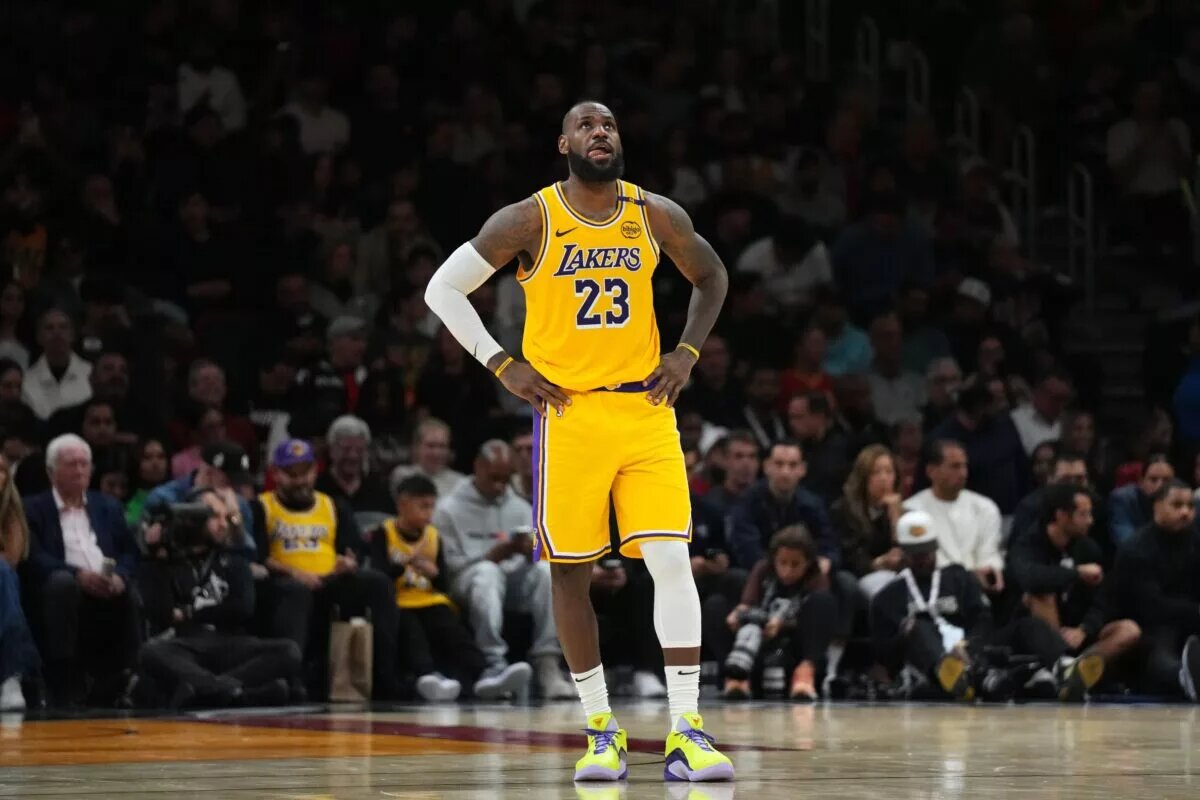
LeBron James remains a statistical marvel, averaging 22.3 points, 7.9 rebounds, and 9.0 assists per game. Despite these numbers, the Lakers’ performance suffers when James is on the court. The team is 21.4 points per 100 possessions worse with him playing, putting him in the absolute worst percentile. This is the first time this has happened in his career. While some of this disparity is attributed to poor three-point shooting and opponents’ exceptional accuracy during his minutes, these anomalies aren’t the sole culprits for the team’s struggles. More than ever, it’s obvious that LeBron is declining and it asks an uncomfortable and awkward question: can he still contribute to winning basketball?
Will LeBron James’ Greatness Excuse His Biggest Question Now
LeBron James’ Various Struggles This Season Already
LeBron has been used in a more shooting role on the Lakers this season and to his credit, he had a hot start to the season. Through the first 15 games, he was averaging 43.0% from behind the arc on 5.7 attempts per game. That has slowed down considerably over the last couple of games. Over the last 15 games, he’s averaging 29.8% on 5.6 attempts per game. Yikes
The Lakers’ offense also stagnates at times, particularly in transition, where James historically excelled. They are currently in the bottom half of the league (18th) in points per transition possessions. For reference, the Lakers finished second in the NBA in this same category last season.
His current turnover average of 4.1 per game ranks fifth in the league, with many mistakes being uncharacteristically careless. These lapses are particularly costly in close contests against elite teams, magnifying their impact on the Lakers’ win-loss record.
Signs of Aging in LeBron’s Game
November saw LeBron commit 59 turnovers in just 14 games—the highest monthly tally since early 2021. These errors suggest slower decision-making and reduced explosiveness, factors tied to age. At 39, LeBron’s ability to dominate through physicality has diminished, forcing him to adjust his playing style. His shooting efficiency has also declined, with fewer finishes at the rim and a heavier reliance on contested jump shots.
Defensively, LeBron struggles to sustain the energy required to anchor the team, often conserving effort for offensive duties. Opponents capitalize on these lapses, frequently targeting him in pick-and-roll scenarios. Though his basketball IQ remains unparalleled, it hasn’t been enough to compensate for his reduced mobility.
Can the Lakers Reverse the Trend?
The Lakers’ poor three-point shooting during LeBron’s minutes will likely improve over time due to statistical regression. Similarly, opponents’ unsustainable shooting percentages should normalize, potentially narrowing the team’s performance gap. However, these adjustments won’t address the underlying issues of offensive stagnation and defensive inefficiency.
Head coach JJ Redick must optimize rotations and emphasize ball security, particularly during LeBron-led lineups. Surrounding him with younger, athletic players capable of running in transition could mitigate his physical decline. Additionally, offloading more ball-handling responsibilities to teammates like Austin Reaves or D’Angelo Russell may reduce turnovers.
The Bigger Question: Can LeBron James Still Lead a Title Contender?
LeBron’s greatness has always excused minor flaws, but the current struggles demand a reassessment. His value remains immense, yet it’s no longer sufficient to carry a team without substantial support. The Lakers must ask themselves whether they can build a system that accommodates his evolving role or if the time has come to pass the torch entirely.
The answer hinges on LeBron’s willingness to adapt further and the Lakers‘ ability to maximize their roster around him. If they fail, his twilight years risk being defined by unfulfilled potential rather than a graceful exit.