
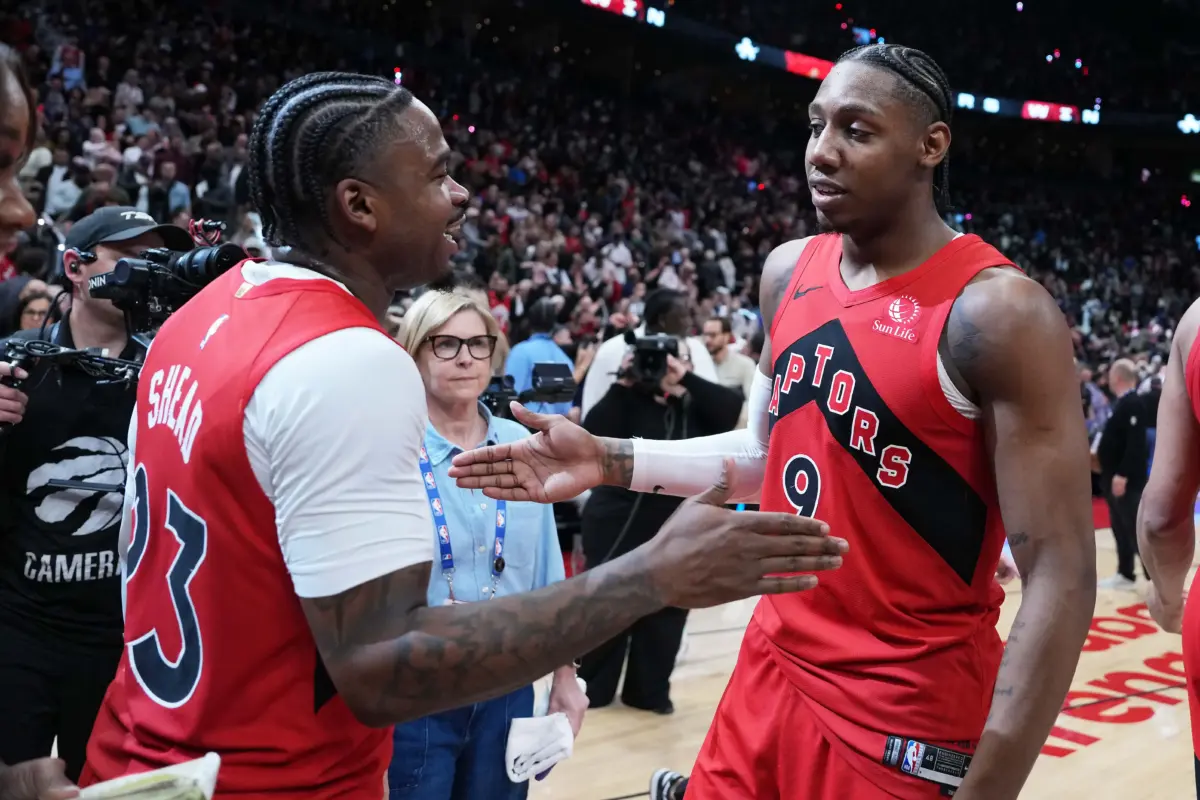

Jamal Shead has quietly become one of the more reliable pieces of Toronto’s bench, and the Raptors made that clear when they exercised his $2.3 million team option for the 2026-27 season.
What We Learn From Shead’s Year 3 Outlook
A 2024 second-round pick who essentially fell into Toronto’s lap during a draft-night salary dump involving the Sacramento Kings, Shead has started every step of his career as an afterthought who kept forcing his way into the conversation. Heading into Shead’s Year 3, though, the storyline is less about whether he belongs and more about whether one specific flaw can get fixed.
The Defense and Playmaking Are Already There
Nobody questions what Shead brings on the ball or away from it. As a rookie, he averaged 7.1 points, 4.2 assists, and 1.5 rebounds across 75 games, then followed it up by pushing his assist number to 5.4 per game in his sophomore season — a mark that places him among the better bench playmakers in the league alongside names like Isaiah Collier and TJ McConnell.
His feel for the game, his competitiveness on defense, and his willingness to take on tough backcourt matchups have never been in doubt. Darko Rajaković has been one of Shead’s biggest believers since day one, and the Raptors rewarded that development track record by handing their head coach a contract extension this offseason.
Scoring Efficiency Took a Real Step Back
The concern about Shead’s game is his shooting. Shead knocked down 40.5% of his shots from the field as a rookie, a solid number for a rookie point guard finding his footing. In his second season, his shot volume barely changed, but his efficiency cratered to 36.7% from the field while his three-point percentage held steady in the low-30s. That kind of drop for a player whose role depends on being a plus-connector off the bench is the single biggest swing factor for Shead in year 3.
The Shot Chart Tells the Real Story
A closer look at the shot chart shows exactly where things went wrong. Most of Shead’s non-three-point attempts came from the mid-range area just outside the restricted zone, and he converted only 34.4% of those looks. His outside shooting wasn’t much better — he made 33.2% of his above-the-break threes, and he struggled even further from the corners, shooting a combined 14-for-51 (27.4%) from both sides.
Toronto doesn’t need Shead to become a high-volume scorer. He needs to be part of the Raptors’ second unit built around Immanuel Quickley and Scottie Barnes that needs its secondary ball-handler to at least punish defenses that sag off him. That need only grew after Sandro Mamukelashvili left in free agency, and with Kyle Anderson and Allen Graves now expected to help replace his frontcourt minutes off the bench.
Why This Matters for Toronto’s Second Unit
With Kawhi Leonard expected back in the fold and RJ Barrett, Barnes, and Quickley set to carry the bulk of the scoring load, Shead won’t need to fill up the box score for Toronto to win games. But if his shooting stabilizes even modestly, defenses lose the freedom to sell out on the Raptors’ other bench scorer. This group could look very different if a DeMar DeRozan Raptors reunion actually materializes this summer. That ripple effect is exactly why Shead’s Year 3 has become one of the more important storylines of Toronto’s offseason.
The Bigger Picture
Shead has already proven he can run an NBA offense, a rare trait for a 45th overall pick just two years into his career. The defense, the playmaking, and the availability — he appeared in 82 games last season — are already established. What’s left is the hardest part to fix in this league: efficiency. If Shead’s Year 3 brings even a modest rebound in his shooting numbers, Toronto’s second unit gets a lot more dangerous, and a player who was gifted to the franchise almost by accident could end up looking like one of its better value finds.
Photo Credit: Nick Turchiaro, Imagn Images via Reuters Connect